
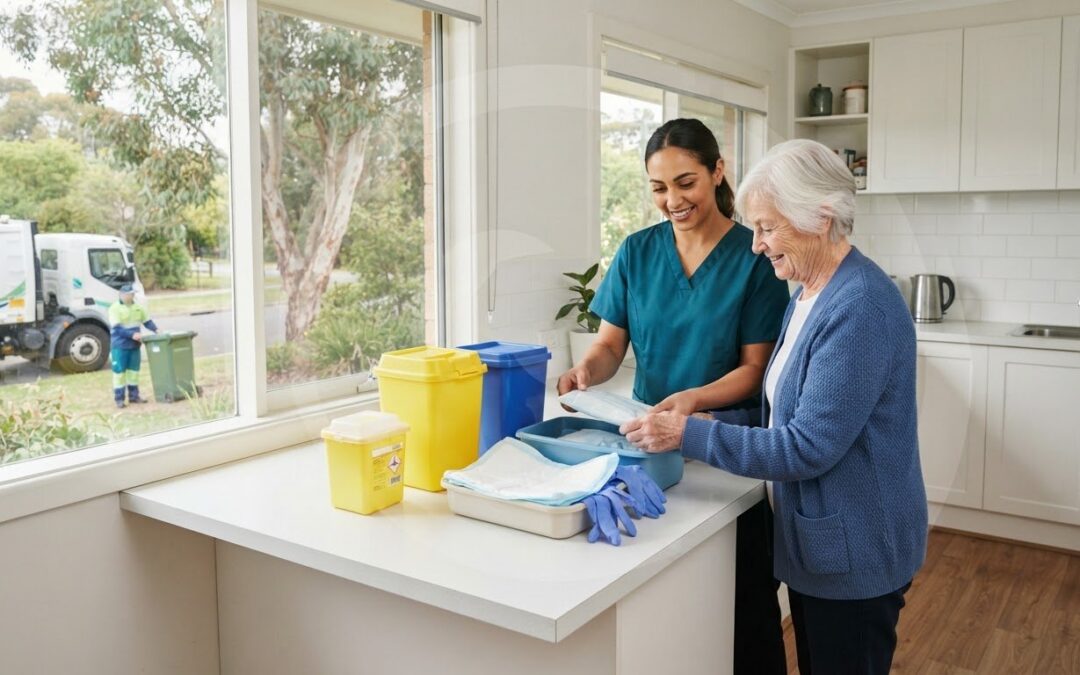
A used continence pad may not be clinical waste unless it’s visibly contaminated with blood, while a small lancet needs a safe sharps disposal pathway. That difference matters when arranging medical waste disposal for home care in Victoria. The right next step depends on the waste type and who generated it.
It’s understandable to feel unsure about what belongs in household rubbish, what needs secure containment and who should arrange collection. Start by sorting waste where it’s produced, rather than treating every used care item the same way.
This guide explains how to recognise common home-care waste, contain sharps and separate other items safely. It also covers how disposal arrangements can differ for someone managing personal medical waste and a provider generating waste while delivering care. You’ll learn when to check current Victorian or council guidance, and when a care provider may need to discuss a specialist collection service for its waste stream.
Key Takeaways
- Classify each used care item by its type, contamination risk and care context before deciding how to handle it.
- For safe medical waste disposal for home care, identify and separate the waste, contain it appropriately, then check current handling and disposal advice.
- Clarify who is responsible for disposal by asking whether care is family-managed, delivered by paid support workers or managed by a provider.
- Check current EPA Victoria, Victorian Department of Health and local council guidance for the appropriate disposal pathway.
- Care providers can prepare details about recurring waste, sharps and site arrangements before asking a specialist service whether it can manage their waste stream.
What counts as medical waste during home care in Victoria?
Medical or clinical waste is waste that may present an infection or injury risk because of its nature or contamination. It doesn’t automatically include every item used during a care activity. Classification depends on the item, what it may be contaminated with and the care arrangement in which it was generated. The broader term biomedical waste covers several categories. For specific items, use Victorian guidance and the relevant care provider’s procedures.
Home-care examples can include used needles and lancets, dressings or disposable items that may be contaminated with blood or body fluids, and continence products. These items don’t all belong in the same disposal stream. For instance, Victorian guidance identifies incontinence pads as generally not clinical waste unless visibly contaminated with blood. If an item’s contamination or status is unclear, check current advice before classifying it.
Which home-care items may need special handling?
Used needles, lancets and other sharps can cause injuries. Keep them separate from other waste and follow the instructions for the sharps container being used. Don’t put a loose sharp in a rubbish bag. Dressings and disposable care items that may carry blood or body fluids can require a specific containment and disposal route, so confirm their classification with the care provider or relevant Victorian authority. The same principle applies in allied health settings — for example, clinical waste disposal for physiotherapists also requires matching each item to the task that produced it rather than treating every used item as high-risk. Unused or expired medicines are a separate stream. Check approved medicine-return guidance rather than putting them in a clinical waste container by default.
Household waste and clinical waste are not always the same
A care activity alone doesn’t determine how every item should be disposed of. A used glove, a blood-stained dressing and an ordinary food wrapper may come from the same visit, but their materials and contamination risks differ. Assess continence waste according to its condition and current guidance rather than automatically labelling it clinical waste.
Classify waste before choosing a disposal route. The right pathway depends on the item, its contamination risk and who generated it.
First establish whether the waste comes from someone managing their own care, a paid support worker’s visit or a service managed by a care provider. A provider generating clinical or sharps waste during service delivery may need procedures that differ from ordinary household rubbish arrangements. Confirm the waste stream, responsibility and disposal route with the provider, local council or relevant Victorian authority. This helps you arrange medical waste disposal for home care without assuming one pathway suits every household.
How to handle and contain home-care medical waste safely
A consistent sequence can reduce unnecessary contact and keep waste contained while you confirm its disposal route. Use the instructions supplied with the container and follow current advice from the care provider or relevant Victorian authority. Container type, labelling and storage requirements can depend on the waste stream and location, so check the details rather than assuming one procedure suits every household.
- Identify: Work out what the item is and whether it may present an infection or injury risk.
- Separate: Keep different waste streams apart, following the responsible provider’s procedures.
- Contain: Put waste in the specified bag or container promptly, minimising handling.
- Label if required: Follow the container or provider’s instructions about labels and identification.
- Store securely: Keep contained waste away from children, visitors, pets and food preparation areas.
- Confirm disposal: Check who will collect or dispose of the waste and what arrangements apply to it.
Wash or sanitise your hands after handling waste, in line with the relevant care procedures. Don’t sort through a waste bag or transfer its contents between containers unless the provider’s instructions specifically require it.
Safe handling of sharps in a home-care setting
Place used needles, lancets and other sharps directly into an appropriate sharps container, following its instructions and current provider or local guidance. Don’t leave loose sharps in household rubbish or recycling. Don’t recap, bend or manually remove needles, as handling them can increase the risk of injury. If you’re unsure about the container or disposal route, pause and ask the responsible provider or council.
Keep waste contained until its disposal route is confirmed
Use only the containers and separation procedures specified for each waste stream. Store containers in a secure, designated place away from everyday household activity. Confirm any storage limits and collection arrangements with the care provider, council or relevant authority. Don’t assume a household bin or a provider’s collection route is suitable for every item.
For more guidance on sharps handling and collection arrangements, read about professional sharps disposal services in Melbourne. Care providers managing recurring sharps or clinical waste can also ask BioSafe Waste Management whether its clinical and sharps waste collection is suitable for their waste stream and home-care arrangements. Confirm service suitability before making collection plans. Clear containment and confirmed arrangements support safer medical waste disposal for home care.
Who is responsible for medical waste disposal in home care?
There isn’t one arrangement for every home-care visit. Responsibility can depend on who generated the waste, the waste type, the service agreement and current local guidance. A family managing care themselves may need to check household disposal options. A paid support worker or care provider should clarify the procedures that apply to waste produced during their service.
Use these questions to establish the practical arrangement before waste builds up:
| Care arrangement | Questions to ask | Who to contact |
|---|---|---|
| Family-managed care | What type of waste is being generated? Does the local council have guidance or a disposal option for it? | Local council or relevant Victorian authority |
| Paid support-worker visits | Which waste streams are covered by the worker’s procedures? Who supplies containers and arranges replacement or collection? | Support worker’s employer or care coordinator |
| Care-provider-managed service | Who is responsible for separation, secure storage and disposal under the service agreement? Does the provider’s collection arrangement accept this waste? | Care provider and its waste contractor |
The table is a starting point, not a substitute for checking the details. Ask the provider which waste streams its procedures cover, who supplies containers and who organises replacement or collection. Record whom to contact if a container is damaged, waste is spilled or an item’s classification is uncertain. That gives families and workers a clear escalation pathway instead of leaving them to guess.
What home-care providers should clarify
Providers should check that written procedures identify who separates and stores each relevant waste stream and arranges its disposal. Confirm accepted waste types and collection arrangements directly with the contractor, then compare them with current Victorian guidance. Don’t assume household bins are suitable for waste generated through professional care. Clear documentation helps families, support workers and coordinators follow the same agreed process.
For broader context on provider and facility arrangements, see aged-care waste management in Victoria. BioSafe Waste Management provides clinical, medical and sharps waste collection in Victoria, including services for NDIS providers and aged-care facilities. Providers can ask about clinical and sharps waste collection and confirm whether the specific waste stream and home-care arrangement can be accommodated. This keeps medical waste disposal for home care aligned with the actual service setup, rather than an assumption.
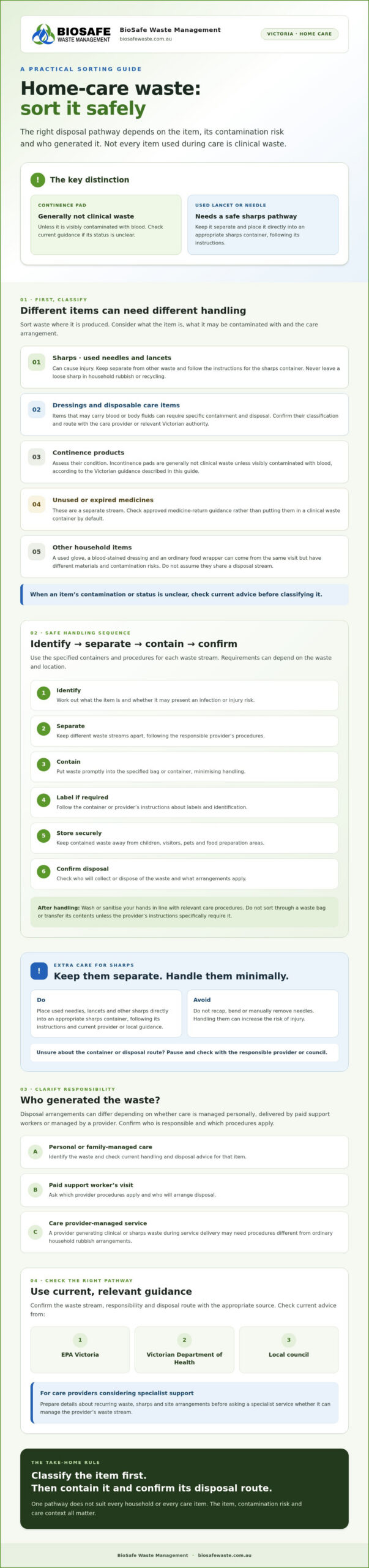
How to arrange medical waste disposal for home care in Victoria
Confirm the waste stream and care arrangement before choosing a disposal route. Advice can differ for household waste and waste generated by a provider, so use current Victorian and local information rather than relying on assumptions or instructions intended for another setting.
- Identify the waste: Record what it is, how it was generated and any known contamination or injury risk.
- Check current guidance: Consult EPA Victoria and relevant Victorian Department of Health information for guidance on the waste type.
- Confirm responsibility: Ask the person coordinating care or the provider who is expected to arrange disposal under the service agreement.
- Choose the route: Follow relevant household guidance, or discuss a suitable collection arrangement with the provider or a specialist contractor.
- Confirm the practical details: Check which containers are required, what waste the service accepts and how collection is arranged.
Check Victorian disposal advice against the specific waste stream and care setting.
Check the guidance that applies to the waste and location
Start with current EPA Victoria and Victorian Department of Health information, then contact the local council if the item may fall under household disposal arrangements. Council services and instructions can differ, so don’t treat one council’s advice as statewide guidance. If information is unclear or appears inconsistent, check with the relevant authority or care provider before disposing of the waste.
When professional collection may be appropriate
Care providers managing recurring clinical or sharps waste can ask a specialist contractor whether professional collection suits the waste stream and care setting. Confirm accepted waste types, suitable containers, collection coverage and any arrangements needed at the home. BioSafe Waste Management provides clinical, medical and sharps waste collection in Victoria, including services for NDIS providers and aged-care facilities. Providers should confirm suitability directly rather than assume every household arrangement is covered.
For more context, see this guide to medical waste collection in Victoria. If your organisation generates managed clinical or sharps waste, ask BioSafe about collection suitability for the waste stream and care arrangement. A clear description of the waste and setting will help establish whether the service is appropriate.
When home-care providers should seek specialist waste support
Seek advice if clinical waste is generated regularly, sharps are part of care, responsibility for disposal is unclear or containment practices vary between visits. These are signs that the organisation may need a consistent, documented approach rather than relying on household routines or individual judgement. Specialist support can help providers clarify suitable containers and collection arrangements for the waste they generate. Allied health providers operating in community settings face similar questions — the clinical waste disposal guide for physiotherapists illustrates how item-by-item classification and documented procedures apply across different care contexts.
Before speaking with a contractor, prepare a short record of the service setting and waste streams. Note what is generated, how often it arises, how it is currently contained and where containers are kept. This gives the provider a clearer basis for discussing suitability without assuming every home-care arrangement is covered.
A practical checklist for contacting a waste provider
Confirm who in the care organisation can discuss or approve a collection service. Then prepare these details and questions:
- Care setting: Describe the home-care service and how staff access and store waste at each site.
- Waste streams: List the clinical or sharps waste generated and its approximate pattern of generation.
- Current containment: Note the containers and procedures in use, including any recurring difficulties.
- Service scope: Ask which waste types are accepted, what containers are appropriate and what collection arrangements may apply.
- Responsibilities: Confirm who in the care organisation manages segregation, storage and contractor communication.
BioSafe Waste Management provides professional clinical, medical and sharps waste collection in Victoria, including services for NDIS providers and aged-care facilities. Providers should ask BioSafe whether their specific waste type and home-care arrangement are within scope before planning a service. This helps align medical waste disposal for home care with the organisation’s actual needs.
Connecting home care with wider aged-care waste planning
Consistent procedures help staff, clients and household members understand how waste is managed, even when different workers attend a home. Organisations coordinating home care across multiple settings can include these procedures in broader waste planning. For additional organisational context, read the aged-care waste management guide.
If your organisation is assessing professional collection for clinical or sharps waste, you can contact BioSafe about professional waste services to discuss the waste stream and care arrangement.
Make your next disposal decision with confidence
Safe medical waste disposal for home care starts with identifying the waste, containing it appropriately and confirming who will arrange its disposal. The right pathway depends on the waste stream and care arrangement, so check current Victorian and local guidance rather than assuming household and provider procedures are interchangeable.
For providers managing clinical or sharps waste, clear procedures and a confirmed collection arrangement can help staff and households handle waste consistently. BioSafe provides professional clinical, medical and sharps waste collection across Victoria, including services for NDIS providers and aged-care facilities. Suitability depends on the specific waste and home-care arrangement.
If your organisation is assessing its options, contact BioSafe to discuss professional clinical and medical waste collection. Describe the waste stream and care arrangement to discuss whether the service is suitable.
Frequently Asked Questions
What counts as medical waste in home care?
Medical waste is an item that may pose an infection or injury risk because of its nature or contamination. Examples can include used needles and lancets or dressings contaminated with blood or body fluids. Classification depends on the item and care context. Continence products aren’t automatically clinical waste; Victorian guidance generally treats them as non-clinical unless visibly contaminated with blood. Check current advice if you’re unsure.
Can medical waste from home care go in household bins in Victoria?
Not automatically. The disposal route depends on the item, contamination risk, who generated it and the care arrangement. Waste from a provider’s professional service may need different procedures from an individual’s household waste. Check current EPA Victoria or Victorian Department of Health guidance, and contact your local council about household disposal options. Don’t assume one council’s instructions apply across Victoria or that a household bin is suitable.
How should needles and other sharps be disposed of at home?
Place used needles, lancets and other sharps directly into an appropriate sharps container, following the container instructions and current provider or council advice. Don’t recap, bend or manually remove needles, and don’t put loose sharps in household rubbish or recycling. Some Victorian councils offer sharps disposal options for residents, but arrangements vary and may not apply to waste generated by a care business. Confirm the correct pathway locally.
Who is responsible for medical waste disposal when a support worker visits?
Responsibility depends on who generated the waste, the service agreement and the provider’s procedures. Ask the support worker or care coordinator which waste streams their procedures cover, who supplies containers and who arranges collection or replacement. Clarify whom to contact about damaged containers or uncertain items. For family-managed personal care, check local council guidance. Don’t assume the worker, household or provider automatically handles every waste stream.
Do home-care providers need a medical waste collection service?
Providers don’t all have the same waste streams or collection needs. Recurring clinical waste or sharps generated through care may warrant a specialist assessment and a defined disposal arrangement. Identify the waste types, containment methods and care settings, then check requirements against current Victorian guidance. BioSafe provides professional clinical, medical and sharps waste collection in Victoria, including services for NDIS providers and aged-care facilities. Ask whether your specific arrangement is within scope.
What should I do if I am unsure how to dispose of a care item?
Don’t guess or put an uncertain item in a household bin. Keep it safely contained and avoid unnecessary handling while you check. Contact the care provider or coordinator first, and describe the item, how it was used and any visible contamination. For household disposal questions, ask your local council; consult current EPA Victoria or Victorian Department of Health guidance where relevant. Treat medicines separately and check an approved medicine-return option.