
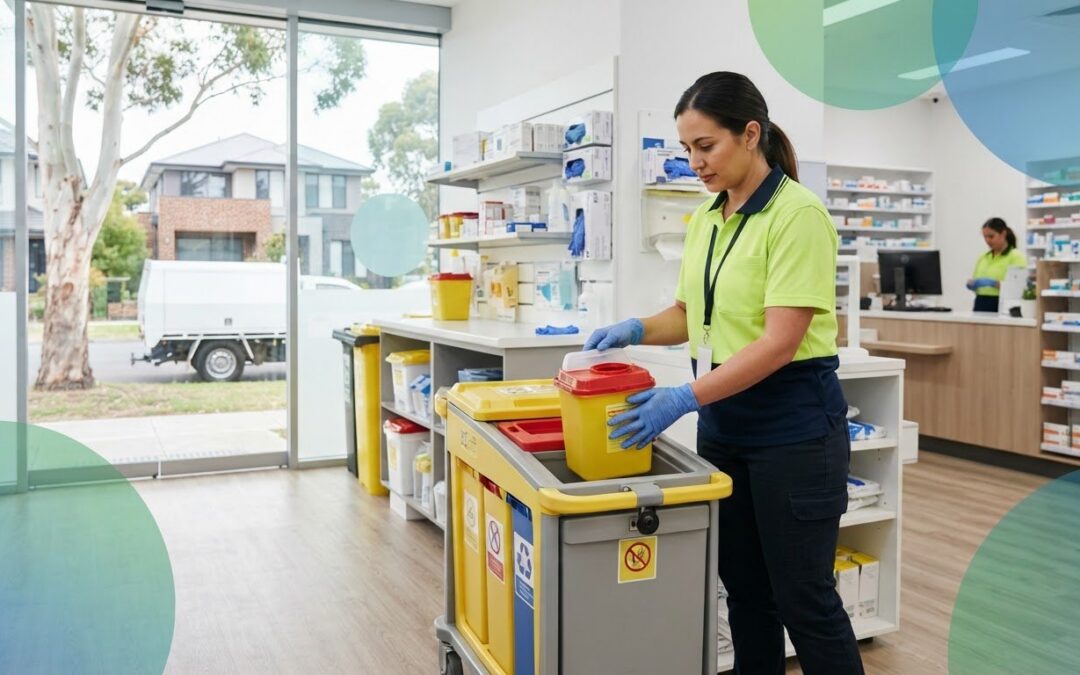
A pharmacy sharps programme depends not just on the container, but on what happens before and after it is used. Reliable pharmacy clinical waste disposal in Victoria relies on clear segregation, secure storage and dependable collection working together.
It can be difficult to know how to separate used sharps, where to store containers and how to plan collection around your pharmacy’s workflow. Staff need practical routines they can follow consistently, as well as a clear understanding of the Victorian requirements that apply. Getting these details in order helps protect staff and the public while keeping waste handling organised.
This guide explains how to establish a day-to-day sharps workflow, compare collection approaches against your pharmacy’s waste volume and operations, and identify Victorian guidance to verify, including EPA Victoria’s requirements for clinical and related waste. Specialist sharps collection can support your programme as part of a wider waste management plan. Aligning containers, staff responsibilities and collection gives your pharmacy a safer, more dependable process.
Key Takeaways
- Build a clear workflow for identifying, separating and securely storing pharmacy sharps before collection.
- Choose container placement and staff routines that fit your pharmacy’s work areas and daily processes.
- Compare internal handling with specialist collection to find an approach that suits your waste volume and operational oversight.
- For pharmacy clinical waste disposal in Victoria, verify current EPA Victoria guidance, including applicable requirements for waste records and tracking.
- Align staff responsibilities, regulatory checks and a dependable collection plan to support safer sharps management.
Pharmacy Clinical Waste & Sharps Disposal in Victoria
A pharmacy sharps disposal programme is the coordinated process of identifying sharps, handling them safely, storing them securely and arranging their collection and disposal. Each step should fit the pharmacy’s work areas and procedures, keeping used sharps separate from general waste.
Separating sharps where they are generated reduces the chance that pharmacy staff or collection personnel will encounter a loose or concealed sharp while handling other waste. It also gives staff a consistent routine to follow, rather than leaving them to decide how to manage an item each time. Sharps are one distinct waste stream. Other clinical and pharmaceutical waste may need different handling and disposal pathways.
The general overview of sharps waste describes items that can puncture or cut. Check current Victorian regulator guidance for classification and handling requirements. This distinction matters in pharmacies, where not every medicine-related item belongs in a sharps container.
Which pharmacy items may need sharps disposal?
Common examples include used needles, lancets and other injection-related sharps generated through pharmacy services. Classification depends on the item and current Victorian requirements. Staff procedures should direct uncertain cases to the relevant guidance rather than rely on assumptions. Don’t treat every item associated with a medicine as a sharp. Follow the pharmacy’s waste-stream instructions to determine the correct pathway.
Why pharmacies need a clear sharps workflow
A documented routine helps staff segregate sharps consistently, place them in the designated secure storage area and understand how they move through the collection process. Clear responsibilities reduce uncertainty during busy periods and support safe handling beyond the dispensing or treatment area, including during collection.
Review the workflow when pharmacy activities or work areas change, and make sure staff know where to find the instructions. For broader context on clinical waste collection and disposal in Victoria, see the Victoria clinical and medical waste collection guide. A well-defined sharps stream gives the pharmacy a practical foundation for decisions about container placement, staff routines and collection arrangements.
How Victorian pharmacies can set up sharps containers and staff routines
A dependable setup turns the pharmacy’s sharps procedure into routine practice. The steps below help managers assign responsibilities and coordinate collection without assuming one container or placement suits every pharmacy. Before using the procedure, verify technical requirements such as container type, capacity, labelling, closure and storage against current Victorian guidance.
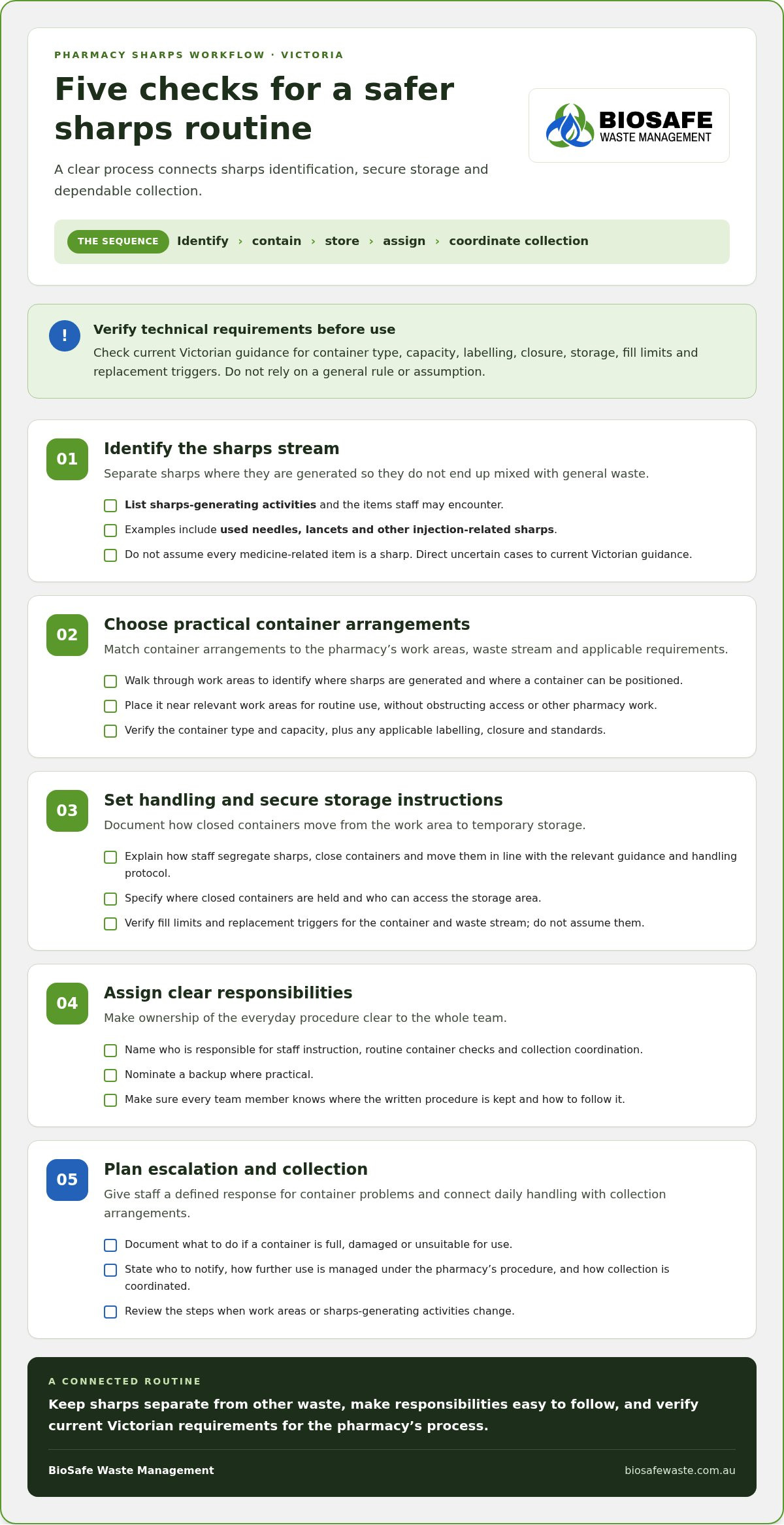
- Identify the sharps stream. List the activities that generate sharps and distinguish those items from other waste streams. Record how staff should handle items whose classification is unclear, using current Victorian guidance rather than guesswork.
- Choose container arrangements. Select a container type and capacity suited to the sharps stream and applicable requirements. Plan placement near relevant work areas so staff can use the container as part of their routine without obstructing access or other pharmacy work. Verify technical specifications before purchase or use.
- Set handling and storage instructions. Document how staff segregate sharps, close containers and move them to temporary storage in line with applicable guidance and the pharmacy’s handling protocol. Specify where closed containers are held and who can access that area. Verify fill limits and replacement triggers for the container and waste stream rather than assuming them.
- Assign responsibility. Name the person responsible for staff instruction, routine container checks and collection coordination. Where practical, nominate a backup. Make sure the whole team knows where the written procedure is kept and how to follow it.
- Define escalation and collection steps. Explain what staff must do if a container is full, damaged or unsuitable for use. Identify who to notify, how to manage further use under the pharmacy’s procedure and how collection is coordinated. Document the steps and review them when work areas or sharps-generating activities change.
Choosing placement and container arrangements
Walk through the pharmacy’s work areas to identify where sharps are generated and where a container can be positioned for safe, practical use. Avoid locations that interfere with normal work or make routine access difficult. Match the container type, capacity and placement to the waste stream and current requirements. Verify details such as labelling, closure and any applicable standards rather than relying on a general rule.
Building staff responsibilities into everyday practice
Keep instructions direct: what belongs in the container, how to close it in line with the relevant protocol, where it is temporarily stored and who manages collection. Include a clear escalation route for problems so staff don’t improvise with a full or damaged container. A consistent procedure supports pharmacy clinical waste disposal in Victoria by connecting daily handling with collection planning.
BioSafe Waste Management provides clinical and medical waste collection, including sharps disposal, with arrangements tailored to the facility. Explore BioSafe’s sharps disposal service to see how specialist collection can fit your pharmacy’s workflow.
Pharmacy sharps collection options in Victoria: compare the operating models
Collection arrangements should reflect how much sharps waste the pharmacy generates, how it is stored and how staff manage the workflow. An internal process can coordinate handling and collection, but it still needs an appropriate disposal pathway. A specialist service connects the pharmacy’s storage routine with external collection and disposal support.
| Consideration | Internal coordination | Specialist collection service |
|---|---|---|
| Workflow | Staff manage container checks, storage and collection arrangements as part of pharmacy operations. | Staff maintain safe segregation and storage, while an external service supports sharps removal. |
| Oversight | A designated staff member monitors the process and makes sure procedures are followed. | The pharmacy retains responsibility for day-to-day handling, while collection is planned with a specialist service. |
| Collection coordination | Managers organise the disposal pathway and coordinate collection as needed. | Collection planning is arranged around the facility’s waste stream and operational needs. |
| Operational fit | May suit a pharmacy with the staff capacity and systems to manage each stage consistently. | May suit a pharmacy seeking external support for ongoing sharps waste removal. |
When an internal process may suit a pharmacy
An internal model relies on staff to monitor containers, follow handling procedures, maintain secure temporary storage and coordinate an appropriate disposal pathway. Managers need to assign responsibility and make sure the process remains workable during normal pharmacy activity. Internal coordination does not remove the need to follow applicable safety procedures or verify current Victorian requirements.
What specialist collection can add to the workflow
A specialist service can support collection and disposal, while pharmacy staff continue to manage segregation and storage on site. The right arrangement depends on the pharmacy’s activities, waste volume, storage capacity and working routines. These factors help managers plan collection around actual needs rather than assume a fixed schedule or container exchange arrangement.
BioSafe Waste Management provides clinical and medical waste collection, including sharps disposal, across Victoria. Its arrangements can be tailored to the facility, making specialist collection one part of a broader pharmacy clinical waste disposal victoria workflow. Read more about professional sharps disposal services in Melbourne, or explore BioSafe’s sharps disposal service.
Victorian requirements and records: what pharmacy managers should verify
Distinguish the pharmacy’s practical procedures from legal duties. A written instruction about where staff place containers can be a useful workplace control, but it should not be described as a statutory requirement unless current legislation or regulator guidance supports that claim. Requirements may differ according to the waste stream and the pharmacy’s circumstances, so verify each compliance statement before relying on it.
For pharmacy clinical waste disposal in Victoria, check the current Environment Protection Act 2017, associated Environment Protection Regulations and EPA Victoria’s Clinical and related waste – operational guidance (IWRG612.1). EPA guidance identifies clinical and related waste as reportable priority waste and states that movements must be recorded in Waste Tracker, regardless of volume. Confirm current requirements and how they apply to the pharmacy’s specific waste stream before implementation.
Where to verify Victorian clinical waste guidance
Use EPA Victoria material for operational and environmental requirements, and check relevant Victorian Department of Health guidance for healthcare-specific information. Confirm which authority and rules apply to each waste stream, including sharps, rather than assuming one general procedure covers every category. Keep the guidance title and review date with the pharmacy’s compliance notes so staff can identify the basis for any legal claim.
Take care with wording. A recommended practice, such as assigning a staff member to inspect storage areas, should not be presented as law unless an applicable source establishes that duty. Verify claims about classification, containers, labels, storage, transport and tracking against current government material.
What to document for an auditable pharmacy process
Even where a particular format or retention period hasn’t been verified as mandatory, clear internal records help managers maintain a consistent process and explain how it operates. A practical file may include:
- the staff roles responsible for handling procedures, container checks and collection coordination;
- the current internal procedure and the date it was reviewed;
- the pharmacy’s collection arrangements and relevant service records; and
- notes showing which regulator guidance was checked for waste classification and handling.
Keep statutory records, such as any applicable Waste Tracker entries, distinct from internal management documents. Verify required record formats, responsible parties and retention periods against current requirements rather than assuming they are the same for every waste stream.
BioSafe supports sharps collection as part of a wider pharmacy waste process. Learn about clinical and medical waste collection with BioSafe.
Arrange pharmacy clinical waste disposal in Victoria with a dependable collection plan
A workable collection plan connects the pharmacy’s sharps procedures with an appropriate disposal pathway. Start by identifying the sharps waste stream, then establish staff routines for handling and temporary storage. Verify current Victorian requirements for the waste and plan collection around the pharmacy’s activity, waste volume and storage arrangements. This gives managers a clear basis for organising pharmacy clinical waste disposal in Victoria without relying on assumptions about service frequency or container exchange.
Before settling on an arrangement, bring the operational details together:
- Location: Note where sharps are generated and where containers are held for collection.
- Waste stream: Describe the sharps generated through the pharmacy’s activities and keep other waste streams distinct.
- Current process: Explain how staff segregate, close and store containers under the pharmacy’s procedure.
- Coordination: Identify the staff contact responsible for collection planning and internal updates.
Prepare the pharmacy for a collection arrangement
Clear information about the pharmacy’s location, sharps stream and storage process helps make collection coordination part of the existing workflow. A named staff contact can manage service communication, while a consistent internal routine keeps the team informed about handling and storage. BioSafe Waste Management provides clinical and medical waste collection across Victoria, including sharps disposal, with arrangements tailored to the facility.
Maintain the programme as pharmacy needs change
Review the process when pharmacy activities, sharps volume or storage arrangements change. Check that staff understand their responsibilities and that written procedures still reflect day-to-day practice. Regular reviews can show when the collection plan needs reconsideration, before operational changes disrupt established routines. Keep current Victorian guidance in view when reviewing classification or technical requirements.
A dependable programme brings identification, staff practice, compliance checks and collection planning together. BioSafe’s Victorian clinical and medical waste collection can support pharmacy sharps disposal as one part of that system. Explore BioSafe clinical waste collection to plan an approach suited to your facility.
Put a dependable sharps programme in place
A practical pharmacy sharps programme brings three elements together: clear segregation and storage routines, staff who understand their responsibilities, and collection arrangements that fit the pharmacy’s operations. Keep procedures distinct from legal duties, and verify current Victorian guidance for the waste streams and circumstances that apply.
These steps give pharmacy clinical waste disposal in Victoria a clear operational foundation. Review the process when pharmacy activity, waste volumes or storage arrangements change, so staff routines and collection planning remain aligned.
BioSafe Waste Management provides clinical and medical waste collection across Victoria, including specialised sharps disposal for professional facilities. Explore a collection approach that supports your pharmacy’s sharps workflow: Explore clinical and sharps waste collection across Victoria.
Clear procedures and dependable collection support help your pharmacy manage sharps with confidence, day to day.
Frequently Asked Questions
What is a pharmacy sharps disposal programme?
A pharmacy sharps disposal programme is the practical system for separating, containing, storing and arranging collection of sharps waste. It should set out staff responsibilities and suit the pharmacy’s work areas and daily routines. For pharmacy clinical waste disposal in Victoria, the exact waste classification and container requirements depend on the material and applicable guidance. Check current Victorian requirements before setting procedures, particularly if staff are unsure which waste stream an item belongs to.
Can pharmacies in Victoria put used needles in general waste?
No. Used needles shouldn’t be placed in general waste as an informal disposal shortcut. Staff should follow the pharmacy’s sharps handling procedure, use an appropriate sharps container and arrange an appropriate disposal pathway. Make sure the procedure explains what to do if a container is damaged or unsuitable, rather than leaving staff to improvise. Check current Victorian guidance for the waste stream and circumstances, and make sure relevant staff know where to find the instructions.
How often should a pharmacy arrange sharps collection?
There’s no single collection interval that suits every pharmacy. The appropriate arrangement depends on how much sharps waste the pharmacy generates, its secure storage capacity and its operational needs. Establish a process for monitoring containers and plan collection before storage becomes unsuitable. Set the arrangement around the pharmacy’s actual workflow rather than relying on a generic interval. Review it if activity, waste volume or storage arrangements change.
What should pharmacies look for in a sharps collection service?
Choose an arrangement that accounts for the pharmacy’s location, sharps waste stream and operating workflow. Clear collection coordination should complement internal responsibilities for container monitoring, segregation and storage. Container types and schedules can vary, so avoid building procedures around assumptions. BioSafe Waste Management provides clinical and medical waste collection, including sharps disposal, for professional facilities across Victoria, with arrangements tailored to the facility.
Do Victorian pharmacies need a separate sharps container?
Manage sharps separately from general waste through an appropriate container and procedure. The specific container type, placement and handling requirements depend on the waste stream and current Victorian guidance, so don’t assume one specification applies to every item or setting. Document the pharmacy’s procedure and make it accessible to staff. If an item’s classification is unclear, direct staff to relevant current guidance rather than asking them to guess.
Who regulates clinical waste disposal in Victoria?
EPA Victoria provides guidance on clinical and related waste, and Victorian Department of Health material may also be relevant to healthcare settings. The authority and requirements that apply depend on the waste stream and circumstances. Check current official Victorian guidance before relying on a specific legal statement. In internal procedures, distinguish verified regulatory duties from additional practices the pharmacy adopts to support safe, consistent waste handling.
Can a pharmacy use a specialist service for sharps disposal?
Yes. A pharmacy can include specialist collection in its sharps disposal arrangements, alongside its own segregation procedures, container monitoring and staff instructions. Plan collection around the pharmacy’s operational needs and storage arrangements, and verify relevant handling requirements against current Victorian guidance. BioSafe provides clinical and medical waste collection, including specialised sharps disposal, across Victoria. A specialist collection service supports the disposal pathway, while the pharmacy’s internal routines remain essential.