
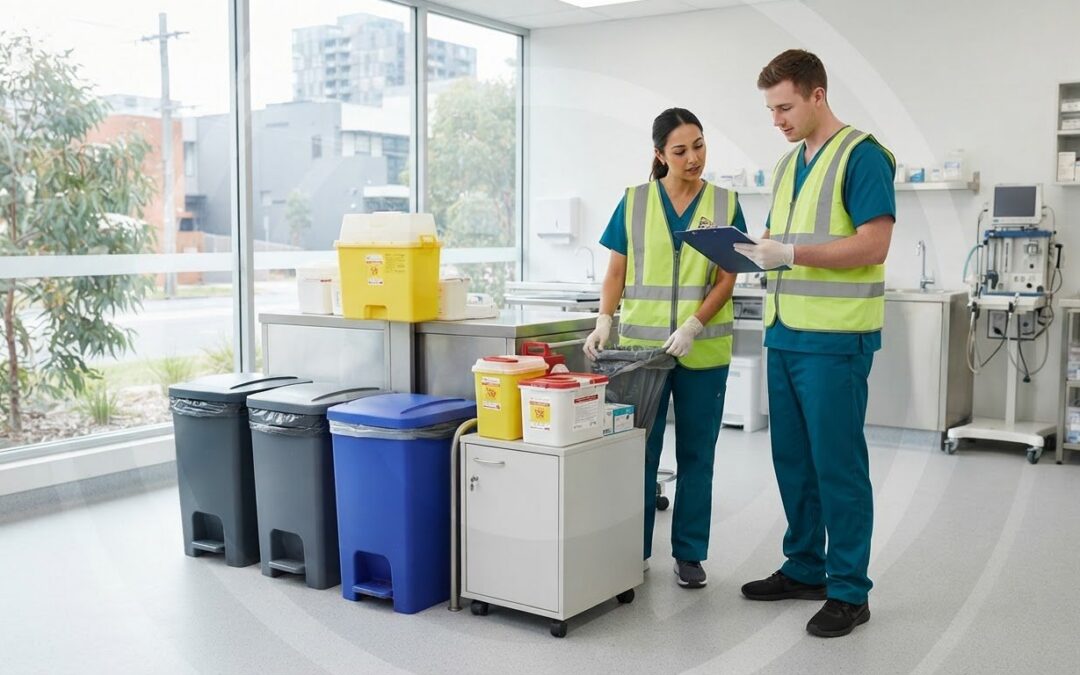
Choosing veterinary waste disposal Melbourne clinics can rely on starts with identifying each waste stream, not simply comparing collection days. Sharps, potentially infectious materials, animal tissue and medicines may need different handling, so treating them as one category can leave staff uncertain about segregation, storage and disposal. For clinic managers, the challenge is to match the waste produced at the practice with current Victorian guidance and a provider’s confirmed service scope.
A suitable service begins with a clear list of waste streams and agreed collection arrangements. This guide explains how to assess the waste your clinic produces, check current EPA Victoria guidance and compare providers on accepted streams, containers, records and collections. It also covers how to prepare staff so waste is sorted and stored consistently. BioSafe Waste Management serves veterinary clinics and provides clinical and medical waste collection, including sharps disposal. Confirm suburb coverage and accepted waste streams directly before deciding whether the service suits your clinic.
Key Takeaways
- List the waste produced during routine care and treatment, then check current Victorian guidance before deciding how each stream should be managed.
- When comparing veterinary waste disposal Melbourne providers, confirm accepted streams and suburb coverage. Don’t assume a general clinical waste service covers every veterinary waste type.
- Before requesting collection, record likely waste volumes, storage arrangements and the procedures staff currently follow.
- Clarify collection arrangements and provider communication so staff know how to prepare waste and what to expect at handover.
- BioSafe serves veterinary clinics and provides clinical and medical waste collection across Victoria. Confirm accepted streams and availability for your Melbourne address.
Veterinary waste disposal in Melbourne: what may need specialist collection?
Veterinary clinics produce different waste streams during routine care and treatment. Consultations may generate used sharps and potentially infectious materials. Other procedures may produce animal tissue, while medicines or chemical products may need separate review. These materials don’t automatically share the same classification or disposal route. Their composition, how they were used and current Victorian guidance all matter.
Veterinary waste disposal is the managed process for waste requiring specific handling. Collection is one part of that process: a provider removes an agreed stream from the clinic, while treatment and final disposal occur later through the applicable route. Don’t assume a provider collecting clinical or medical waste also accepts every type of veterinary waste. The Biomedical waste overview discusses categories such as infectious, pathological and sharps waste, including waste from animal treatment, but it isn’t a substitute for Victorian guidance.
Which veterinary clinic waste streams should managers assess?
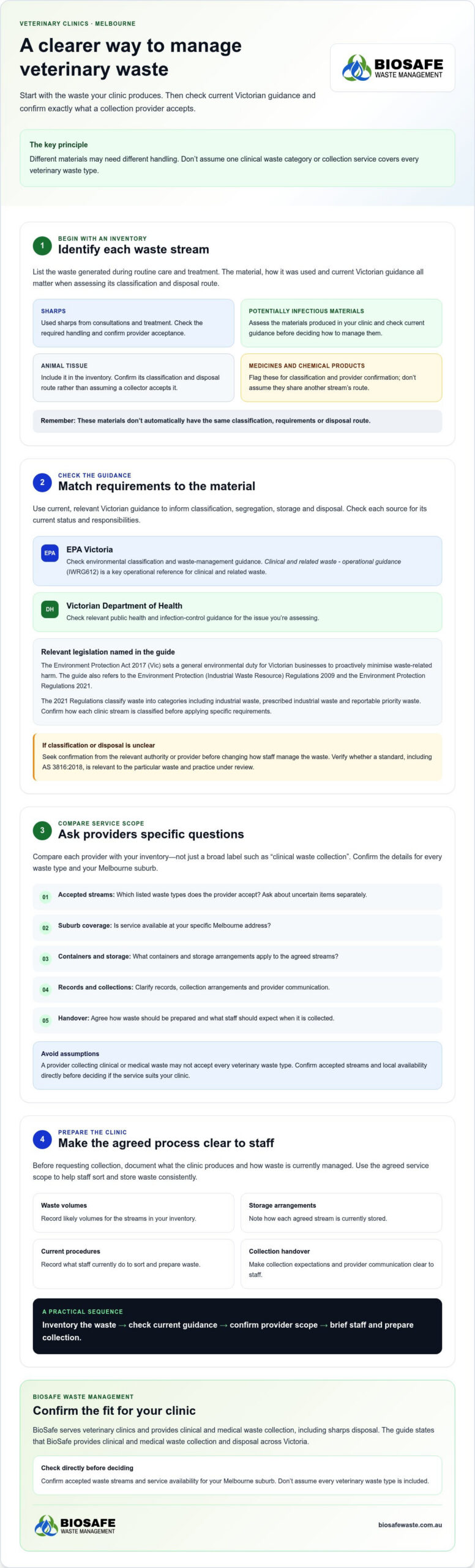
Build an inventory based on the procedures performed at your clinic. List sharps, potentially infectious materials and any other waste streams produced. Include animal tissue, medicines and chemical products as items that need classification and provider confirmation, rather than assuming a collector accepts them. Check each stream against current EPA Victoria guidance. If its classification or disposal route is unclear, seek confirmation from the relevant authority or provider before changing how staff manage it.
Why Melbourne clinics need a clear local service scope
Ask each provider to confirm service availability for your specific Melbourne suburb, then compare its accepted streams with your inventory. Check each waste type separately rather than relying on a broad description such as clinical waste collection. BioSafe provides clinical and medical waste collection and disposal across Victoria and serves veterinary clinics, but clinics should confirm suburb coverage and accepted streams directly. For further context, see the clinical and medical waste collection guide for Victoria.
A clear service scope helps managers distinguish specialist streams from other clinic waste without assuming that every item is regulated or collected in the same way. Use current Victorian guidance to inform classification and segregation, and check uncertain items before arranging collection. This gives staff and the provider a shared understanding of what will be stored for collection and what may need a separate disposal route.
How Victorian guidance informs veterinary waste handling and disposal
Classification affects how a clinic should segregate, store and arrange disposal. The right approach depends on the material and its circumstances. Check current Victorian guidance rather than assuming that every clinical or veterinary waste stream has the same requirements.
For clinical and related waste, EPA Victoria’s Clinical and related waste – operational guidance (IWRG612) is a key operational reference. EPA Victoria regulates the storage, transport, treatment and disposal of clinical and related waste under the Environment Protection (Industrial Waste Resource) Regulations 2009. The Environment Protection Regulations 2021 classify waste into categories that include industrial waste, prescribed industrial waste and reportable priority waste. Confirm how each clinic stream is classified before applying specific requirements.
The Environment Protection Act 2017 (Vic) sets a general environmental duty for Victorian businesses to proactively minimise waste-related harm. The Victorian Department of Health is another source for relevant public health and infection-control guidance. Check each agency’s current guidance and responsibilities for the issue you’re assessing. Don’t rely on an old document or assume a standard applies without checking its current status and relevance. This includes verifying whether AS 3816:2018 is relevant to the particular waste and practice under review.
How to check current Victorian requirements
Start with EPA Victoria for environmental classification and waste-management guidance, then check the Victorian Department of Health for relevant health guidance. Match the guidance to the waste type and activity, and confirm whether specific legal provisions apply to your clinic’s circumstances. If classification or the disposal route remains unclear, seek authoritative clarification before changing procedures or arranging collection.
Segregation and sharps handling in a veterinary clinic
Staff should follow documented clinic procedures and applicable guidance to keep waste streams separate. Sharps need a distinct handling and collection arrangement from general clinical waste. Confirm the appropriate container and disposal route against current guidance and with the provider. BioSafe lists sharps disposal among its services, but confirm acceptance of your clinic’s specific sharps stream and suburb coverage. The Melbourne sharps disposal service guide offers further context.
When assessing veterinary waste disposal Melbourne services, compare each provider’s confirmed scope with your clinic’s waste streams and current requirements. To ask whether a collection service may suit your clinic, you can contact BioSafe Waste Management about accepted streams and local availability.
How to compare veterinary waste disposal services in Melbourne
A general clinical waste service doesn’t necessarily cover every stream produced by a veterinary clinic. Compare the provider’s written scope with your clinic’s procedures, then confirm what it accepts and what needs another disposal route. This helps you assess veterinary waste disposal Melbourne services on practical fit, not just broad service descriptions.
Questions to ask before appointing a collection provider
Ask each provider the same questions so you can compare their responses. Focus on accepted waste, local availability and the arrangements that affect staff day to day.
- Accepted streams: Which specific clinic waste streams are accepted, and which need another disposal route?
- Suburb coverage: Can the provider service your clinic’s Melbourne suburb?
- Collections: What schedule options are available, and how are changes or missed collections handled?
- Containers and instructions: Which containers are included, and what handling or preparation instructions should staff follow?
- Records and responsibilities: What service records are supplied, who prepares the waste, and what happens at collection?
- Communication: Who should staff contact with routine questions or an issue requiring follow-up?
Ask providers to confirm these details directly. Don’t assume that containers, documentation or an escalation contact are automatically included. Written answers help staff understand the agreed scope and their responsibilities.
Matching service arrangements to clinic operations
A suitable arrangement reflects the clinic’s procedures, waste types and volumes, and available storage capacity. Share these details when discussing collection options. Agree on collection frequency with the provider, considering clinic needs and applicable Victorian guidance, rather than choosing a schedule by default.
Compare each proposal with your operational requirements. Check whether the proposed schedule and containers suit your waste volumes and storage conditions. If a stream isn’t accepted, ask what other route you should investigate. Request a tailored quote once the required streams, collection arrangements and inclusions are clear. Avoid comparing headline figures without checking what each proposal covers.
This gives clinic managers a practical basis for comparing scope, communication and fit. BioSafe provides clinical and medical waste collection across Victoria and serves veterinary clinics. Confirm accepted streams and suburb coverage directly. To discuss your clinic’s requirements, contact BioSafe Waste Management.
Set up veterinary waste collection at your Melbourne clinic
Plan a collection arrangement by first documenting the waste your clinic generates and how staff currently handle it. Recording procedures, likely volumes and storage arrangements before approaching providers makes it easier to explain what the clinic needs and identify questions to check against current Victorian guidance.
Use this sequence to prepare:
- Map waste streams: List the materials generated by each procedure and identify which may need external collection, after confirming classification and the appropriate route.
- Record current practices: Note how each stream is segregated and stored, along with likely volumes and existing collection arrangements.
- Contact providers: Share the clinic’s address, operating hours, procedure mix and waste list. Ask which materials are accepted, which are excluded and what preparation is required.
- Confirm the arrangement in writing: Agree on accepted streams, containers, collection schedule, handover steps, records and who to contact about changes or issues before implementation.
- Brief staff and review: Explain the agreed procedures, then revisit them if clinic activities, waste volumes or provider requirements change.
Prepare your clinic information before requesting service
Provide the Melbourne suburb and clinic address, operating hours, procedures performed and waste streams that may need external collection. Describe current segregation and storage, approximate volumes and existing collection processes. Ask the provider to confirm accepted materials, exclusions, container arrangements and any preparation required from staff. Check uncertain classifications and handling questions against current Victorian guidance before changing procedures.
Brief staff and review the collection arrangement
Assign a clinic contact to coordinate provider communication and keep the agreed service details accessible to relevant staff. Explain how waste should be segregated and stored, how collection handover works and whom to notify if an issue arises. Review the arrangement if procedures or volumes change, or if the provider updates its requirements. Check safety and legal instructions against current authoritative Victorian guidance.
Written confirmation gives staff a consistent reference and reduces uncertainty at handover. For clinics assessing veterinary waste disposal Melbourne options, BioSafe provides clinical and medical waste collection across Victoria and serves veterinary clinics. Confirm suburb availability, accepted streams and service details directly. Discuss your clinic’s waste requirements with BioSafe.
Choose a veterinary waste disposal partner in Melbourne with BioSafe
Once you’ve mapped your clinic’s waste streams and identified what you need from a collection service, compare providers against those requirements. BioSafe Waste Management provides clinical and medical waste collection and disposal across Victoria and serves veterinary clinics. Sharps disposal is also among its stated offerings. These services may be relevant to your clinic, but confirm that BioSafe accepts each specific veterinary stream you need collected before making arrangements.
A suitable provider should clarify the service scope for your location and explain how the agreed collection process works. Don’t assume that a general clinical and medical waste service includes every material generated during veterinary procedures. Confirm details directly, especially for streams not already discussed with the provider.
What to confirm with BioSafe before arranging collection
Ask whether your Melbourne suburb is within the current service area, then discuss your clinic’s waste list and proposed arrangements. Confirm collection options, accepted containers, staff preparation requirements, the handover process and what service documentation is provided. If a stream isn’t accepted, ask what you’ll need to clarify or arrange separately. Clear answers help you assess fit without relying on assumptions about what’s included.
BioSafe’s stated offerings include clinical and medical waste collection and sharps disposal. Acceptance of other veterinary streams must be confirmed directly. Focus your enquiry on the materials your clinic generates and the service requirements you need met.
Request a veterinary clinic service discussion
Before making an enquiry, prepare the clinic address, a list of waste streams, likely volumes and preferred collection arrangements. Include current storage or segregation details that may affect the discussion. This helps the team assess suburb coverage and explain the service scope, containers, documentation and any requirements for clinic staff.
For clinics comparing veterinary waste disposal Melbourne options, BioSafe may be worth considering for clinical and medical waste collection and sharps disposal, subject to confirming your clinic’s needs and location. Ask the team to clarify accepted streams and arrangements before proceeding. Contact BioSafe about veterinary waste collection to discuss your clinic’s requirements.
Build a clear, dependable waste collection plan
A suitable veterinary waste disposal Melbourne arrangement starts with knowing which streams your clinic generates and checking how each should be managed under current Victorian guidance. Compare providers on confirmed service scope, suburb coverage, collection arrangements and communication. Before collection begins, document clinic procedures and agree in writing on accepted materials, containers, handover steps and staff responsibilities.
BioSafe serves veterinary clinics and provides clinical and medical waste collection and disposal across Victoria. Sharps disposal is also among its stated offerings. Confirm that your Melbourne address is within the service area, and check directly which veterinary waste streams BioSafe accepts and what collection arrangements apply.
Prepare your clinic address, waste list and preferred arrangements, then contact BioSafe to discuss your veterinary clinic’s waste requirements. Clear information and confirmed procedures help your team make a considered choice and establish an organised collection process.
Frequently Asked Questions
What veterinary waste needs specialist disposal in Melbourne?
Sharps and potentially infectious materials are common examples of veterinary waste streams that may need specialist collection. Procedures may also produce animal tissue, medicines or chemical products, but their classification and disposal route depend on the material and how it was used. Check current Victorian guidance and confirm requirements with the relevant authority. Don’t assume every clinic waste stream has the same handling requirements or is accepted by the same provider.
How should a veterinary clinic separate sharps from other waste?
Keep sharps separate from other waste and follow current guidance and clinic procedures for safe handling and storage. Use an appropriate sharps container and confirm the relevant container requirements, including whether AS 4031 applies to your circumstances. Don’t place sharps in general clinical waste containers unless provider instructions and applicable guidance confirm this is suitable. Ask your collection provider which sharps streams it accepts and how handover works.
Can a veterinary waste provider collect animal tissue or medicines?
Possibly, but acceptance depends on the provider, the material and its classification. Ask specifically about animal tissue and each type of medicine your clinic needs to dispose of. Don’t assume they’re included in a general clinical waste service. Confirm the appropriate Victorian disposal route and any segregation or storage requirements using authoritative guidance. BioSafe provides clinical and medical waste collection and sharps disposal, but confirm acceptance of these specific veterinary streams directly.
How often should a veterinary clinic arrange waste collection?
Agree on a collection schedule that reflects your clinic’s procedures, waste volumes, storage capacity and applicable Victorian guidance. A clinic producing more sharps or potentially infectious waste may need different arrangements from one producing smaller amounts. Ask providers what schedule options are available and how changes or missed collections are handled. Don’t base the frequency solely on another clinic’s routine. Confirm an arrangement for your site and waste streams.
How do I choose a veterinary waste disposal company in Melbourne?
Ask which specific veterinary waste streams each provider accepts, whether it services your suburb and how collections are arranged. Confirm container requirements, staff instructions, service records, handover responsibilities and who to contact with questions or issues. Request the details in writing before service begins. The phrase veterinary waste disposal Melbourne can describe providers with different scopes, so check that the proposed service matches your clinic’s waste list.
Does BioSafe collect veterinary waste across Melbourne?
BioSafe Waste Management provides clinical and medical waste collection and disposal across Victoria and serves veterinary clinics. Its stated offerings also include sharps disposal. Confirm Melbourne suburb coverage and acceptance of specific veterinary waste streams directly. Share your clinic address and waste list, then ask about collection arrangements, containers and documentation. This helps establish whether the service scope fits before you proceed.
What Victorian requirements apply to veterinary waste disposal?
Requirements depend on the waste classification and activity. Check current EPA Victoria guidance, including its Clinical and related waste – operational guidance, IWRG612. EPA Victoria regulates relevant waste management under Victorian environmental laws, including the Environment Protection Act 2017 and applicable regulations. The Act also establishes a general environmental duty for businesses. Check the Victorian Department of Health for relevant health guidance, and verify which requirements apply to your clinic’s specific streams and practices.