
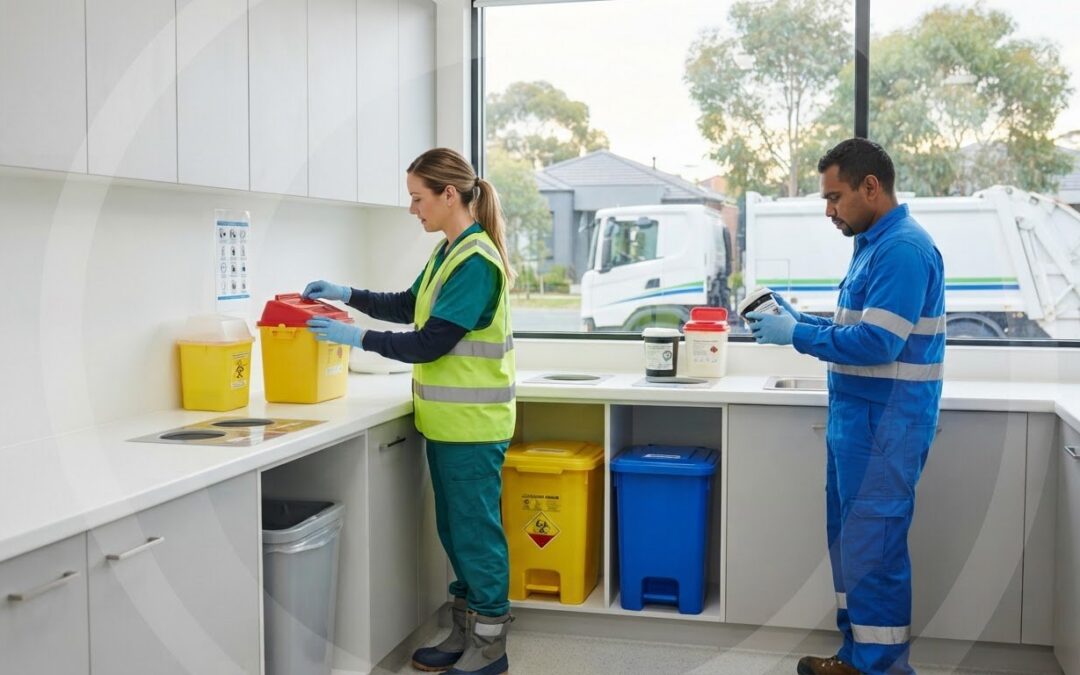
A waste contractor collecting your bins doesn’t, by itself, make a dental practice compliant. The dental practice waste regulations victoria framework requires practices to manage waste risks, separate relevant waste streams and check that collection arrangements support safe, documented handling. Responsibility doesn’t end when waste leaves the practice.
It’s understandable to be unsure which requirements are legal duties, which are regulator guidance and where Australian Standards apply. This guide explains the Victorian framework, including the Environment Protection Act 2017, the Environment Protection Regulations 2021 and EPA Victoria’s Waste Tracker requirements for reportable priority waste. It outlines practical checks for your practice without treating every waste stream as if it follows the same rules.
You’ll learn what to check when segregating and storing clinical waste, sharps, amalgam and other relevant streams, and what records may help demonstrate appropriate handling. We’ll also cover questions to ask a collection provider about accepted waste streams, transfer arrangements and service documentation. Use the guide to review whether your procedures and collection arrangements suit your practice, and identify details you may need to confirm with EPA Victoria or another relevant authority.
Key Takeaways
- Learn which Victorian laws and regulator guidance to check, and how they differ from technical standards.
- Use the article’s waste-stream comparison to identify segregation questions for clinical waste, sharps, amalgam and other dental waste.
- Follow a practical review sequence to check procedures, storage, records and staff responsibilities.
- Ask prospective collectors about service scope, transfer arrangements and documentation before deciding whether an arrangement suits your practice.
- Understand how dental practice waste regulations victoria apply to day-to-day waste management, and where to verify current requirements.
Which dental practice waste rules apply in Victoria?
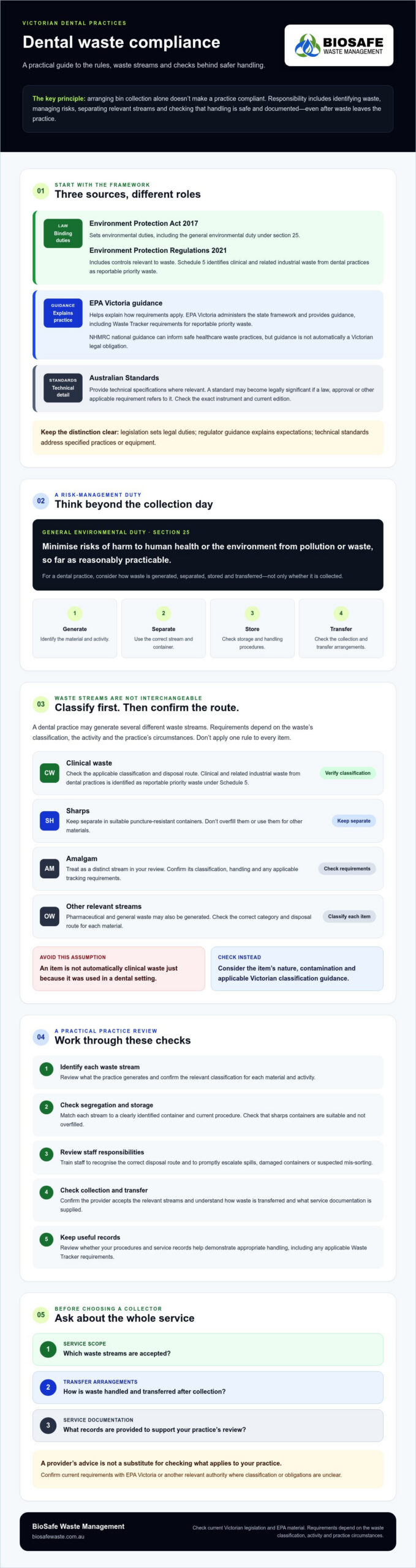
In Victoria, dental waste compliance means identifying the waste a practice generates and managing it in line with the environmental duties and specific controls that apply to that waste and the way it is handled. The dental practice waste regulations victoria framework is not one rule for every item. Requirements can depend on the waste’s classification, the activity being carried out and the practice’s circumstances.
The main environmental legislation to check is the Environment Protection Act 2017 and the Environment Protection Regulations 2021. Together, they establish legal duties and controls for waste in Victoria, including requirements relevant to reportable priority waste. EPA Victoria administers the state’s environmental framework and publishes waste-related guidance. Check current legislation and EPA material rather than assuming a rule applies based only on a bin colour, a supplier’s advice or a general industry description.
What does “dental practice waste” include?
Dental practices may generate clinical waste, sharps, pharmaceutical waste and general waste, alongside distinct streams such as amalgam. These categories can require different handling, so correct classification matters. A disposable item isn’t automatically clinical waste just because it was used in a dental setting. Its nature, contamination and applicable classification are relevant.
For a broad overview of the health and environmental issues associated with biomedical waste management, readers can consult this general reference. It doesn’t determine Victorian legal classification. Before assigning a category or disposal route, check current Victorian definitions and EPA classification guidance for the particular material and activity.
Which Victorian sources should practices check?
Start with the Act and Regulations for binding legal requirements, then use EPA Victoria’s current guidance to understand how those requirements apply in practice. Clinical and related industrial waste from dental practices is identified as reportable priority waste under Schedule 5 of the Regulations. Confirm the relevant classification for each stream rather than applying this label indiscriminately.
Other sources serve different purposes. National guidance from the National Health and Medical Research Council (NHMRC) can inform safe healthcare waste practices, but guidance is not automatically a Victorian legal obligation. Australian Standards provide technical specifications where relevant. A standard may become legally significant if a law, approval or other applicable requirement refers to it. Check the exact instrument and current edition rather than assuming every standard applies to every practice.
Keep these sources distinct when reviewing procedures: legislation sets legal duties, regulator guidance explains expectations, and technical standards address specified practices or equipment. The practice remains responsible for checking which requirements apply to its own waste streams and handling arrangements.
How Victorian environmental duties affect dental waste handling
Victoria’s general environmental duty (GED) is a proactive risk-management obligation. Under section 25 of the Environment Protection Act 2017, a person engaging in an activity that may give rise to risks of harm to human health or the environment from pollution or waste must minimise those risks so far as reasonably practicable. For a dental practice, that means considering how waste is generated, separated, stored and transferred, not simply arranging collection.
Good segregation helps prevent needlestick injuries, contact with potentially infectious material and waste entering an unsuitable disposal stream. It also supports accurate classification. The Victorian Branch of the Australian Dental Association explains how amalgam and non-amalgam clinical waste relate to reportable priority waste and the EPA’s tracking requirements in its Australian Dental Association waste tracking guidance.
What should happen at the point of waste generation?
Match each waste stream to a clearly identified container and the practice’s current procedure. Keep sharps separate in suitable puncture-resistant containers. Don’t overfill them or use them for other materials. Train staff to recognise the correct disposal route and promptly escalate spills, damaged containers or suspected mis-sorting. Procedures should reflect current Victorian requirements, not generic advice alone.
Practical checks include whether containers are easy to identify at the point of use, whether staff know what to do when an item’s classification is unclear, and who records an incident or arranges follow-up. Consistent instructions reduce the chance of an item being placed in the wrong stream under time pressure.
How should practices manage storage and records?
Review waste storage for security, access, labelling, container condition and housekeeping. Storage should prevent unauthorised handling, leakage or exposure and follow the requirements that apply to the particular waste. Check EPA Victoria’s current guidance for any activity-specific controls, including whether registration or other requirements apply to the practice’s storage arrangements.
Keep relevant collection documents, tracking records and incident reports organised where required. Don’t assume one retention period or document set applies to every waste stream. Confirm mandatory records and retention requirements against the current regulations and EPA instructions, then assign responsibility for maintaining them and reviewing procedures.
A collector can support off-site handling, but the practice remains responsible for its own procedures and compliance. If you’re reviewing these arrangements, you can discuss dental waste disposal and sharps collection with BioSafe Waste Management and clarify which streams and service documents are relevant to your practice.
How do requirements differ across common dental waste streams?
Each stream can have a different classification, container and disposal pathway. The examples below are indicative, not a substitute for checking the current Victorian classification of a particular item. Incorrect mixing can expose staff to avoidable risks and send waste into an unsuitable handling or treatment pathway. These distinctions are central to applying dental practice waste regulations victoria in day-to-day procedures.
| Waste stream | Typical examples | Separation considerations | Verification source |
|---|---|---|---|
| Non-amalgam clinical waste | Items contaminated during patient care, depending on their nature and classification | Separate at the point of generation where classified as clinical waste; use the required container and labelling. | EPA Victoria guidance and Environment Protection Regulations 2021, including Schedule 5 where applicable |
| Sharps | Used needles and other items capable of puncturing or cutting | Keep apart from other waste in a suitable, puncture-resistant container. Follow the practice’s collection procedure. | Current EPA guidance and applicable container standards, including AS 4031 or AS/NZS 4261 where relevant |
| Amalgam | Scrap amalgam and material collected from dental equipment | Keep separate from clinical waste and never discharge into a drain. Confirm the correct container and recovery pathway. | EPA Victoria classification guidance and applicable wastewater requirements |
| Pharmaceutical waste | Expired or unused medicines | Keep distinct from routine clinical waste and confirm an appropriate disposal route. | EPA Victoria guidance and relevant professional advice |
| General waste | Uncontaminated packaging and other items not classified as a special waste stream | Check before placing an item here; use the practice’s waste assessment and procedures. | Current Victorian definitions and EPA classification guidance |
Clinical waste and sharps in a dental setting
Not every item from a treatment room is automatically clinical waste. Assess the material and contamination against current definitions before classifying it. Sharps need a separate, secure containment and collection process. Verify whether AS 4031:1992 and AS/NZS 4261:1994, identified as relevant container standards, apply under current requirements. For step-by-step procedures, consult the practice’s dental waste management and sharps disposal guides.
Amalgam, pharmaceuticals and other specialist streams
EPA Victoria classifies non-amalgam clinical waste as R100 and amalgam waste as D120 in the relevant reportable priority waste context. Confirm those classifications and their handling requirements against current EPA material. Keep amalgam and chemical-containing materials separate for assessment. Pharmaceutical waste also needs its own verified disposal pathway. A collection provider can clarify which streams its service covers, but the practice should confirm applicable requirements with EPA Victoria and relevant professional guidance.
How can a Victorian dental practice check its waste compliance?
A structured review helps turn the dental practice waste regulations victoria framework into practical checks. Compare what staff do each day with written procedures, and record any gaps so they can be addressed and reviewed.
A practical internal review for practice managers
- Identify waste streams. List the waste the practice generates, including clinical waste, sharps, amalgam and pharmaceuticals. Check classifications against current EPA Victoria guidance.
- Check procedures and training. Confirm that written instructions explain where each stream goes, and that staff know how to segregate it, handle sharps and respond to spills or exposure incidents.
- Inspect storage. Compare actual container placement and condition with practice procedures. Check labels, access controls, housekeeping and whether containers are suitable for their contents.
- Review records. Locate relevant collection documents, Waste Tracker records where applicable, and incident reports. Verify required records and retention periods against current rules rather than assuming one standard applies to every stream.
- Confirm collection arrangements. Check that the provider’s accepted streams and service arrangements match the waste the practice generates. Record any changes needed to procedures or staff instructions.
Assign a named person to coordinate training, incident escalation and periodic procedure reviews. Revisit the process when the practice changes its services, waste streams or collection arrangements, and when relevant regulator guidance changes. Record identified issues, corrective actions, responsibility and follow-up so the review leads to practical improvements.
Questions to ask a clinical waste collector
Use a provider discussion to clarify the service, not to replace regulatory advice. Ask which waste streams are accepted, how each must be presented for collection, what collection frequency is available, and what records or transfer information the provider supplies. For reportable priority waste, ask how the collection arrangement supports applicable Waste Tracker processes.
Also confirm how the provider communicates a missed collection, rejected container or other service issue, and who the practice should contact. Compare the answers with your procedures and verify legal uncertainties directly with EPA Victoria. For broader collection considerations, consult the existing Victoria clinical waste collection guide.
BioSafe Waste Management provides clinical, medical, dental and sharps waste collection across Victoria. Discuss your dental waste collection requirements and clarify which streams and service arrangements may suit your practice.
Choosing a dental waste collection partner in Victoria
A suitable collection arrangement should fit the practice’s waste streams and written procedures. Segregation, storage, collection and records work together. If a stream is misidentified or the service doesn’t match how it is presented, safe handling and record-keeping can be affected. A provider can support off-site collection, but the practice remains responsible for its own procedures and compliance with the dental practice waste regulations victoria framework.
What a suitable collection arrangement should clarify
Before agreeing to a service, document what the provider accepts and how each stream must be prepared for collection. Confirm container arrangements, collection responsibilities and how the practice will be told about service changes or exceptions. Check that the proposed service matches the practice’s actual waste profile, including any specialist streams that may need separate arrangements.
Ask practical questions:
- Which waste streams are included, and which require a separate arrangement?
- What containers or presentation requirements apply to each accepted stream?
- What collection records or transfer information will the practice receive, and how are they provided?
- How will the provider communicate a missed collection, rejected container or change to the service?
Clear answers help the practice align collection arrangements with staff instructions and records. They don’t replace checking legal requirements with EPA Victoria or obtaining appropriate professional advice.
When to review your current arrangement
Review the service if the practice changes its procedures, premises or the types or volumes of waste it generates. Changes to relevant guidance are another prompt to check that the arrangement still fits. Repeated collection issues, unclear documents or staff uncertainty can also signal that the service scope or internal procedures need attention.
BioSafe Waste Management provides dental, clinical and sharps waste collection across Victoria. Practices can discuss their waste profile and clarify which streams and collection arrangements may be relevant. For further service and handling detail, consult the existing dental waste management Victoria pillar in this article’s related resources. Check current Victorian requirements separately, as a provider’s explanation of its service scope isn’t a legal determination.
Make your dental waste arrangements easier to review
Good compliance starts with knowing what your practice generates, separating waste streams appropriately and checking the current Victorian requirements that apply. Clear procedures, suitable storage and organised records help staff manage waste consistently. A collection provider can support off-site handling, but your practice remains responsible for its own processes and compliance.
Use this guide to review the dental practice waste regulations victoria framework against your actual waste streams and procedures. Check classifications and requirements with EPA Victoria, then confirm that your collection arrangements cover the streams your practice produces and provide clear information about service records and communication.
BioSafe Waste Management provides clinical and medical waste collection and disposal across Victoria, including dental waste disposal and sharps disposal. To discuss whether its collection services may suit your practice, discuss dental waste collection in Victoria with BioSafe.
A careful review can clarify what’s working and where procedures or arrangements may need attention. With clear responsibilities and a suitable collection partner, your team can move forward with greater confidence.
Frequently Asked Questions
What regulations apply to dental practice waste in Victoria?
Dental practice waste in Victoria is primarily governed by the Environment Protection Act 2017 and the Environment Protection Regulations 2021. The Act’s general environmental duty requires risks from pollution or waste to be minimised so far as reasonably practicable. EPA Victoria guidance helps explain how requirements apply. Specific controls depend on the waste classification and activity, so check current legislation and EPA guidance when applying dental practice waste regulations victoria to your practice.
Is dental waste automatically classified as clinical waste in Victoria?
No. An item doesn’t become clinical waste solely because it was used in a dental practice. Its characteristics, contamination and relevant Victorian classification determine how it should be managed. Dental practices can generate distinct streams, including sharps, amalgam, pharmaceutical and general waste, each with potentially different handling requirements. Check the current EPA Victoria definitions and classification guidance for the specific item before assigning it to a container or disposal pathway.
How should a dental practice dispose of sharps in Victoria?
Place sharps in a suitable puncture-resistant container and keep them separate from other waste. Follow the practice’s procedures for container use, storage and collection, and don’t overfill the container or place unrelated materials in it. Check current EPA Victoria guidance and applicable Australian Standards, including AS 4031 or AS/NZS 4261 where relevant. Confirm that your collection arrangement accepts the sharps stream and clarifies how it should be presented for collection.
Do Victorian dental practices need to keep waste collection records?
For reportable priority waste, the EPA’s Waste Tracker system requires an electronic record when the waste is transferred. Dental practices should confirm which of their waste streams are reportable and follow current EPA instructions for each transfer. Keep relevant collection and incident records organised, but don’t assume a single retention period applies to every document or waste type. Check current legal requirements and guidance to confirm what must be recorded and retained.
Who regulates clinical waste in Victoria?
EPA Victoria is the key environmental regulator for waste under the state’s environment protection framework. It administers relevant requirements and publishes guidance on waste classification, handling and tracking. Other health-related rules or professional guidance may also be relevant to a dental practice, depending on the activity. Use EPA Victoria for environmental requirements, and check the appropriate health regulator or professional body for separate clinical safety guidance. A waste collector can explain its service scope, not determine your legal duties.
Can a dental practice use one bin for all clinical waste?
Don’t assume one bin is suitable for every clinical waste stream. Sharps require separate puncture-resistant containment, and amalgam must be assessed and managed separately from non-amalgam clinical waste. The correct arrangements depend on the waste classification and applicable requirements. Review where waste is generated, match each stream to your documented procedure and check current EPA Victoria guidance. If staff are unsure where an item belongs, provide a clear escalation process rather than relying on guesswork.
How often should a dental practice review its waste procedures?
There isn’t a single review interval established here for every practice. Set a regular internal review schedule, and reassess procedures when the practice changes its services, premises, waste streams or collection arrangements, or when relevant guidance changes. Review sooner if staff are uncertain, records are unclear or collection issues recur. Assign someone to coordinate training and corrective actions, then record what was reviewed and any follow-up needed. Check current requirements with EPA Victoria.