
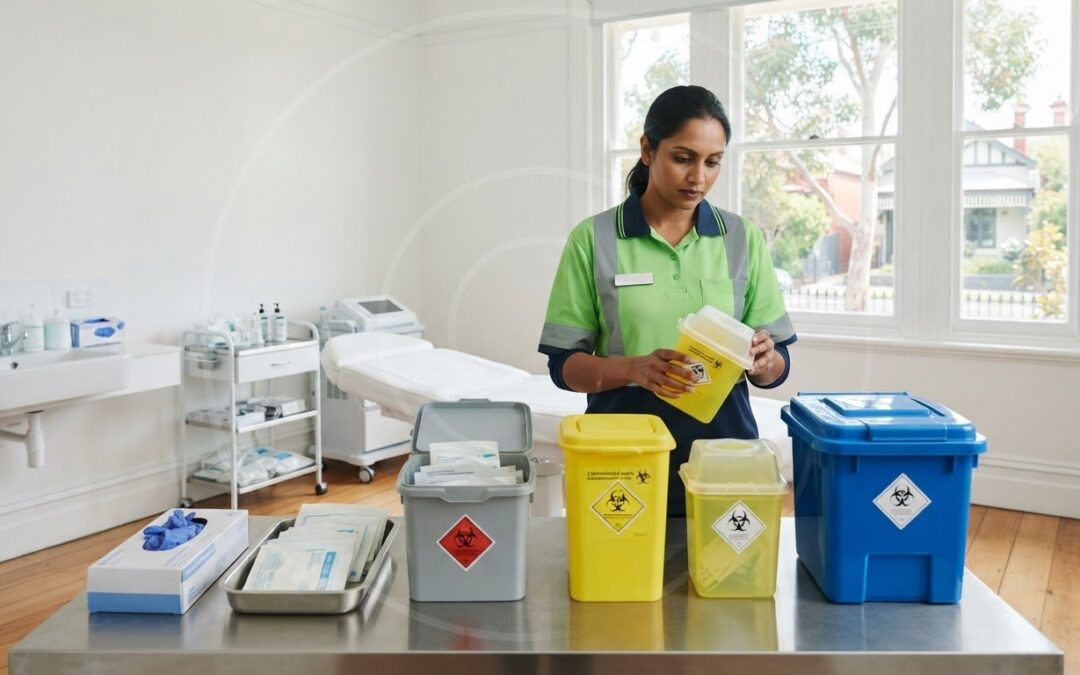
After an injectable treatment, a clinic may have used needles, contaminated materials and ordinary packaging to manage, but they don’t all belong in the same bin. Getting the distinction wrong can leave staff unsure how to handle, store or prepare waste for collection. That’s why medical waste disposal for cosmetic clinics should start with the procedures performed and the waste each one produces.
If you manage a Victorian clinic, you need a clear, practical way to identify waste streams and arrange suitable collection. This checklist will help you review treatment-related items, set out staff instructions and records, and assess providers by asking how they handle the specific materials your clinic generates.
Work through the process step by step: identify what needs clinical or sharps disposal, check current Victorian guidance for handling and storage, then confirm each provider’s accepted materials, service coverage and collection arrangements. BioSafe Waste Management provides clinical and medical waste collection across Victoria, including sharps disposal. It may be a potential collection partner once your clinic’s requirements are clear. Confirm that your location and specific waste streams are covered before engaging a provider.
Key Takeaways
- Build a procedure-by-procedure inventory so your medical waste disposal for cosmetic clinics plan reflects the items your team actually uses.
- Check current Victorian guidance before assigning waste classifications, and document who in the clinic is responsible for confirming them.
- Compare providers using clear questions about accepted materials, location coverage, collection arrangements and staff procedure support.
- Turn the agreed process into practical staff instructions for segregation, storage and collection, then review it with the team.
- Keep appropriate records of your decisions and provider arrangements so staff can follow the process consistently.
Medical waste disposal for cosmetic clinics: what belongs in your checklist?
Before choosing a collection service, identify the waste your clinic actually generates. The right plan for medical waste disposal for cosmetic clinics depends on the treatments performed, the items used and whether those items become contaminated. A procedure list is a more reliable starting point than assuming every cosmetic clinic produces the same waste.
“Medical waste” and “clinical waste” are broad terms, and the correct classification can depend on the material and circumstances. General information about biomedical waste can provide background, but it isn’t a substitute for Victorian requirements. Check current Victorian guidance, including advice from EPA Victoria, or seek qualified advice when a classification is uncertain.
Which cosmetic clinic activities affect waste disposal?
Start with an inventory of procedures, such as injectable treatments, skin treatments and wound care. For each one, record the items used, whether they may be contaminated, and where staff currently place them. A needle used during an injectable procedure may need to be assessed as a sharps stream. Other items from that treatment may require a different assessment. Don’t assume every treatment generates sharps or clinical waste.
- Procedure: What treatment is performed?
- Item: What materials or devices are used?
- Condition: Is the item contaminated, or does another handling concern apply?
- Current practice: Where do staff put it, and what instructions do they follow?
This record helps reveal differences between treatments and highlights uncertainties for follow-up. It also gives staff a clearer basis for consistent segregation.
Why should a clinic classify waste before choosing a service?
Classification helps determine which containers and handling arrangements may be suitable. It also gives providers a clear description of the materials they’re being asked to collect. If a clinic labels everything as clinical waste without checking, staff may be unsure where items belong, while a provider may be asked to handle a stream it doesn’t accept.
Ordinary business waste and specialist waste aren’t interchangeable. Keep them distinct in your procedure, but don’t assign a formal category based on appearance alone. If an item’s status is unclear, check current Victorian authority guidance or obtain qualified advice before setting staff instructions or requesting a service.
Once you’ve documented the procedures and likely waste streams, verify classifications and discuss specific materials with prospective providers. This sequence supports a practical checklist without assuming one rule or collection arrangement applies to every item.
Classify cosmetic clinic waste by treatment, item and handling need
A useful waste checklist follows the path from procedure to item, rather than assigning one waste category to an entire clinic. The same treatment can produce several different materials, and the correct handling depends on the item, its condition and applicable Victorian guidance. For medical waste disposal for cosmetic clinics, record what is generated before deciding how it should be separated or collected.
- Injectable treatments: List needles and other items used, along with any materials that may be contaminated. Assess sharps separately from other items.
- Skin treatments: Note the devices and consumables used, and whether they’re contaminated after the procedure.
- Wound care: Record dressings and other materials, then check their classification against current Victorian guidance.
- Other specialist materials: Set aside pharmaceutical, chemical or mixed items for confirmation. Don’t assume they belong in a clinical waste or sharps stream.
This item-by-item approach helps staff avoid broad assumptions. The World Health Organization’s Safe management of wastes from health-care activities offers broader information on healthcare waste management, but Victorian guidance should inform local classification and handling decisions.
When should sharps disposal be part of the clinic plan?
Check whether any procedure generates needles or other items that require a designated sharps container. If so, include that stream in the clinic’s plan. Staff should follow the container instructions and the clinic’s approved handling procedure, rather than improvising or placing items in an unsuitable container. For further service considerations, see this professional sharps disposal guide.
How should staff handle uncertain or mixed waste streams?
Staff shouldn’t guess when an item’s classification is unclear, especially if it combines materials or may need specialist handling. Record the procedure and item, keep the uncertainty visible in the checklist, then consult current Victorian authority guidance or obtain qualified advice. Don’t prescribe a disposal route until the classification is confirmed.
Once the clinic has identified its likely streams, ask prospective providers which materials they accept and what details they need to assess them. BioSafe Waste Management provides clinical and medical waste collection across Victoria, including sharps disposal. You can contact BioSafe about its waste streams to confirm location coverage, accepted materials and collection arrangements before engaging.
Compare medical waste disposal providers for cosmetic clinics
Once your clinic has documented its waste streams, compare providers against those specific needs. A clear proposal should explain whether the provider covers your address, accepts each identified stream and can describe the collection arrangements. This makes it easier to assess service fit for medical waste disposal for cosmetic clinics without relying on assumptions about what a provider handles.
| Criteria | Questions to ask | Evidence to request |
|---|---|---|
| Accepted waste streams | Do you accept each material on our procedure-based list? Are any items excluded or subject to separate arrangements? | Written confirmation of accepted streams and any conditions. |
| Victorian service coverage | Can you service our clinic’s specific address? | Confirmation of location coverage. |
| Containers and storage | Which containers are suitable, and what instructions apply before collection? | Container guidance and written storage instructions relevant to the agreed streams. |
| Collection and handover | How are collections arranged, and what should staff prepare at handover? | A description of collection arrangements and staff responsibilities. |
| Documentation and changes | What service records are provided? How should we notify you if procedures or waste volumes change? | Sample or description of service documentation, plus a process for updating requirements. |
What should a clinic ask before engaging a provider?
Share the clinic’s waste-stream list and ask the provider to respond to each item, rather than relying on a general description of its services. Confirm the address is covered, then request clear instructions for containers, storage, collection and documentation. Ask how to report changes to treatment types or waste volumes so the agreed arrangements can be reviewed. Keep the answers with your clinic procedures.
How can managers assess service fit rather than choose on assumptions?
Match every requested service to a documented clinic waste stream. Compare providers on how clearly they explain their scope and answer practical questions, not on unsupported claims of performance or compliance. For broader collection considerations, consult this Victoria clinical waste collection guide.
Staff handling procedures matter too. The US Occupational Safety and Health Administration’s Bloodborne Pathogens Standard is a US reference, not Victorian guidance. Use current Victorian sources for local requirements, and ask providers to explain how their container and handover instructions fit your clinic’s approved procedures.
It may be one provider to assess. Confirm directly whether your address and specific waste streams are covered, and clarify collection arrangements before engaging. You can ask BioSafe about clinical waste collection as part of your comparison.
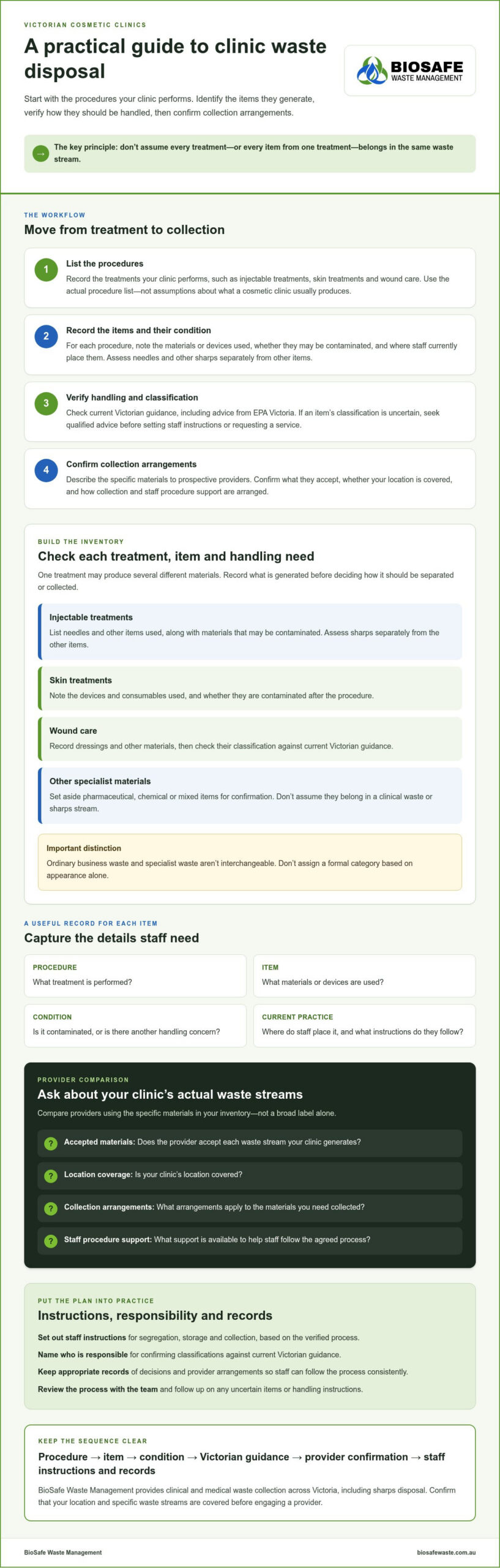
A practical setup checklist for cosmetic clinic waste disposal
Turn your treatment and item inventory into a working process before arranging collection. This sequence gives the clinic manager clear points to verify and helps staff understand what to do in daily practice. It also creates a record to revisit if treatments or service arrangements change.
- 1. List procedures and materials. Record each treatment, the items it generates, estimated waste volumes and whether sharps are produced. Note mixed or uncertain items without assigning an unverified category.
- 2. Check classifications. Assign a responsible person to confirm classifications against current Victorian guidance or obtain qualified advice. Record the source of the decision and flag anything still awaiting confirmation.
- 3. Document current handling. Note the containers in use, their locations, storage arrangements and which staff roles are responsible for segregation and oversight. Compare current practice with the clinic’s approved procedures and applicable guidance.
- 4. Confirm provider scope. Give prospective providers the clinic’s waste-stream list. Ask them to confirm in writing which materials they accept, whether they service the clinic’s specific address, and what collection arrangements apply.
- 5. Request practical instructions. Obtain written information relevant to the agreed service, including container use, storage before collection, handover steps and any service documentation provided. Keep it with the clinic’s waste procedures.
- 6. Brief staff and review. Make the instructions accessible where staff need them, explain how to raise questions, and record who is responsible for reviewing the process.
What should the clinic record before requesting a service?
A useful record connects each procedure to the items it generates and their estimated volumes. Include any sharps, current containers and storage locations, along with the staff responsibilities that need review. Mark unclear materials for confirmation rather than making a best guess. This gives a provider enough detail to discuss service fit without treating every item as the same waste stream.
How can a clinic brief staff and review the process?
Use concise, accessible instructions that explain segregation, container use and what to do when an item is uncertain. Name the person staff should contact if a container or collection issue arises. Review the checklist whenever procedures, materials, premises or provider arrangements change, then update staff instructions to reflect the confirmed process.
If you’re considering BioSafe for medical waste disposal for cosmetic clinics, contact BioSafe to discuss your clinic’s waste streams and confirm accepted materials, location coverage and collection arrangements before engaging.
Arrange cosmetic clinic medical waste collection with a suitable Victorian partner
A workable collection arrangement follows a clear sequence: identify the clinic’s waste streams, verify classifications against current Victorian guidance, compare providers against the confirmed requirements, then brief staff on the agreed procedures. This check helps ensure the service discussion reflects the clinic’s actual treatments and handling needs, rather than assumptions about what a cosmetic clinic might generate.
What information should a clinic include in its service enquiry?
Give a prospective provider enough detail to confirm service fit. Include the clinic’s Victorian suburb, the type of practice and a summary of its procedures. Describe the resulting waste streams, noting sharps separately from uncertain or other specialist materials. Where possible, share estimated volumes and explain how the clinic currently stores items for collection.
Ask the provider to confirm which listed materials it accepts and whether it services the clinic’s specific location. Request details about collection arrangements and any preparation required from clinic staff, including relevant container, storage and handover instructions. If a material hasn’t been classified, identify it as uncertain and seek guidance rather than describing it as an established waste category.
How can BioSafe support a clinic’s next steps?
BioSafe Waste Management provides clinical and medical waste collection and disposal across Victoria, including specialised sharps disposal. These services may be relevant after a clinic has identified its waste streams, but coverage for a particular cosmetic clinic, its location and its materials must be confirmed directly. Contact BioSafe with your procedure and waste summary, then ask what it can accept and how collection would be arranged for your address.
Before confirming a service, keep the provider’s written scope and handling information with the clinic’s procedures. Assign someone to review the arrangement if treatments, materials, premises or waste volumes change. Make sure staff know which instructions apply and who to contact if an item falls outside the agreed streams or a collection issue arises. This keeps the working process aligned with the service the clinic has confirmed.
For medical waste disposal for cosmetic clinics, a provider conversation is most useful when the clinic can clearly explain what it generates and what still needs confirmation. Discuss your clinic’s waste collection needs with BioSafe, including your Victorian location, procedures and identified streams, and confirm service availability and scope before making arrangements.
Put your clinic’s waste plan into practice
A reliable approach to medical waste disposal for cosmetic clinics starts with the treatments and items your clinic actually generates. Verify classifications using current Victorian guidance, then match each confirmed waste stream to a provider’s accepted materials, location coverage and collection arrangements.
Make the process practical for staff. Keep written instructions on segregation, container use and escalation, and review them when procedures, materials or service arrangements change. Clear responsibilities help the team follow the agreed process consistently.
BioSafe Waste Management provides clinical and medical waste collection and disposal across Victoria, including specialised sharps disposal. To assess whether the service fits your clinic, share your location and identified waste streams, then confirm directly which materials are accepted and how collection is arranged. Discuss your clinic’s waste collection needs.
With a documented plan and a suitable, confirmed collection arrangement, your team can manage clinic waste with greater clarity and confidence.
Frequently Asked Questions
Does every cosmetic clinic need medical waste collection?
Not necessarily. First identify the waste generated by your procedures, then confirm how each item is classified under current Victorian guidance. A clinic that produces sharps or other specialist waste may need dedicated arrangements for those streams. Don’t assume every treatment creates clinical waste, or that ordinary business waste is suitable for items requiring special handling. If an item’s classification is unclear, seek authoritative guidance or qualified advice before deciding how to manage it.
What medical waste can a cosmetic clinic produce?
A clinic’s waste profile depends on its treatments, the materials used and whether items become contaminated. Some clinics may generate sharps, while others may produce different materials that need assessment. Build an inventory by procedure and item, then check classifications against current Victorian guidance. A generic list can be a starting point, but it can’t confirm what your clinic produces. Ask prospective providers which materials they accept and explain your specific procedures.
How should cosmetic clinics dispose of used needles?
Follow the clinic’s approved handling procedure and the instructions for the designated sharps container used on site. Don’t place used needles in ordinary rubbish or improvise a container. Check current Victorian guidance for applicable requirements, then confirm collection arrangements with a suitable provider. Ask whether the provider accepts your clinic’s sharps stream, which container arrangements apply and what staff need to prepare for collection. Keep the confirmed instructions accessible to the team.
Do cosmetic clinics need separate bins for different waste?
That depends on the clinic’s waste streams and the applicable Victorian guidance. List the items generated by each procedure, then confirm the appropriate segregation and containers for each classification. Don’t create extra categories based on guesswork. If an item is uncertain, seek advice from a qualified adviser or ask a prospective provider what information it needs to assess the material. Give staff instructions that match the clinic’s confirmed classifications and collection arrangements.
How do I choose a medical waste disposal provider for my clinic?
Choose a provider by comparing its service scope with your actual waste inventory and location. Ask which streams it accepts, whether it services your Victorian address, how collection is arranged, and what handling instructions and documentation it provides. Check that answers address your procedures rather than relying on broad marketing claims. Verify regulatory or compliance statements independently, and request written confirmation of accepted materials and relevant service arrangements before making a decision.
Can one provider collect both clinical waste and sharps?
Some providers offer both, but service coverage and accepted materials vary. Confirm your clinic’s address, the specific waste streams and any container or preparation requirements directly with the provider. BioSafe Waste Management provides clinical and medical waste collection across Victoria and offers specialised sharps disposal. Cosmetic clinics should confirm that their location and procedure-related materials are within the provider’s service scope before making collection arrangements.
What should a cosmetic clinic include in a waste disposal checklist?
Record the clinic’s procedures, the items each generates, likely waste streams, sharps where applicable, current containers, storage arrangements and staff responsibilities. Mark uncertain classifications for confirmation rather than guessing. Add the provider’s confirmed accepted materials, collection arrangements and staff instructions. Assign someone to review the checklist when procedures, materials, premises or service arrangements change. Check that the process remains consistent with current Victorian guidance and is clear to everyone who handles waste.