
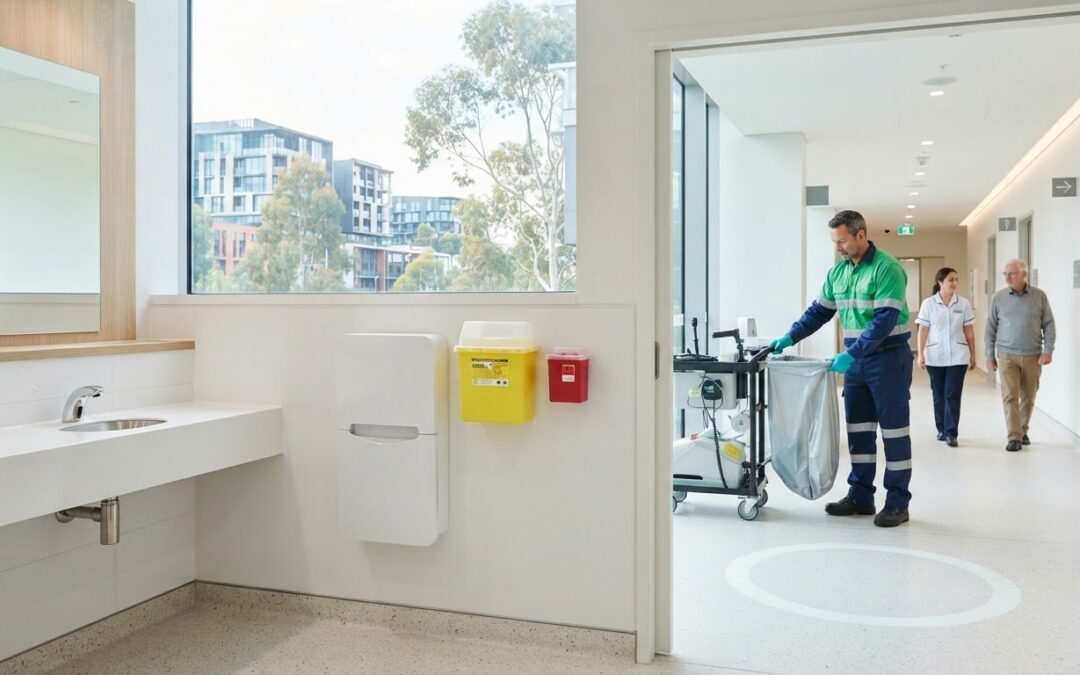
A clinic opens for the day, but an overdue sanitary bin collection has left an odour in the washroom. It’s a small service lapse with a real impact on staff and patient confidence. For Melbourne clinics and professional workplaces, a sanitary bin service Melbourne facility managers can rely on is part of maintaining good hygiene, not simply a washroom amenity.
Facility managers need dependable collection, discreet servicing and clear information about how sanitary waste is handled. They also need to understand the service schedule, what is included and how to raise an issue if a unit needs attention between visits.
This guide explains what to look for in a provider, how sanitary waste management fits within Victoria’s regulatory framework, and which service details to confirm before committing. You’ll also learn how BioSafe Waste Management supports healthcare, dental, aged care and NDIS facilities with specialised sanitary bin services alongside other medical waste streams, including sharps disposal. The aim is to help you choose an arrangement that suits your site and supports clean, professional washrooms.
Key Takeaways
- A reliable sanitary bin service Melbourne clinics can depend on supports washroom hygiene and responsible waste management.
- When comparing providers, check how bins are serviced, how discreetly collections are carried out and how the provider manages sanitary waste.
- Match bin capacity and collection frequency to staff, patient and visitor use. Review the arrangement if units fill or odours arise before collection.
- Understand your responsibilities under Victoria’s waste rules and ask how the service supports appropriate handling and disposal.
- Consider whether one specialist can coordinate sanitary bin services with related medical waste streams, such as sharps disposal.
Professional Sanitary Bin Service Melbourne: Ensuring Clinical Compliance
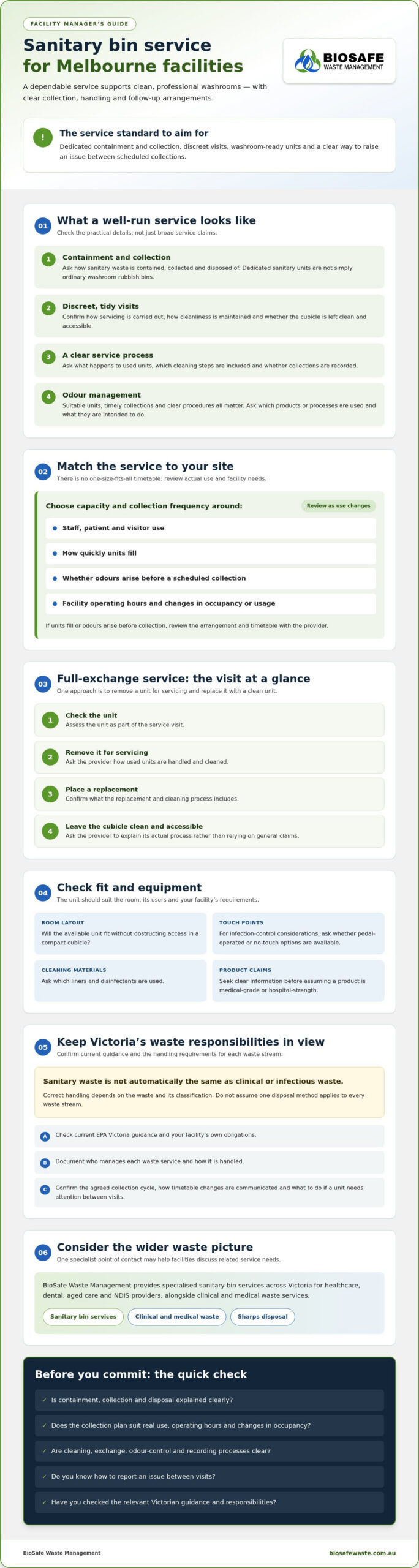
In a clinic or dental practice, sanitary waste is one part of a wider hygiene system. A professional sanitary bin service Melbourne facilities can rely on provides dedicated containment and collection for feminine hygiene products, rather than treating them as ordinary washroom rubbish. General waste collection isn’t designed around the servicing needs of sanitary units, so ask how waste is contained, collected and disposed of.
Waste categories matter. Sanitary waste isn’t automatically the same as clinical or infectious waste, and the correct handling depends on the waste and its classification. For background on how clinical and biomedical waste is categorised and managed, see Biomedical waste management. Check current EPA Victoria guidance and your own obligations rather than assuming one disposal method applies to every waste stream.
BioSafe Waste Management provides clinical and medical waste services across Victoria, including sanitary bin services for healthcare, dental, aged care and NDIS providers. Its clinical waste handling and experience with related streams, including sharps disposal, give facilities a specialist point of contact for discussing different waste management needs.
The Importance of Odour Control and Sanitisation
Odour control depends on suitable units, timely collections and clear servicing procedures. Some services use antimicrobial granules or vapour-phase sanitisers. Ask providers which products and processes they use and what those measures are intended to do. Confirm how units are cleaned or exchanged, and how the service helps manage odours between visits. Consistent washroom standards support comfort and confidence for staff, patients and visitors.
For sensitive healthcare settings, ask how servicing is carried out discreetly and how cleanliness is maintained at each visit. These details help you compare services without assuming every provider uses the same method.
Melbourne Facility Requirements in 2026
High-traffic medical centres and dental clinics may need service arrangements that reflect patient use as well as staff numbers. Review how quickly units fill, whether odours arise before scheduled collection and whether the timetable suits your facility’s operating hours. Reassess these factors when occupancy or usage changes.
Hygiene expectations and waste requirements can differ by facility and waste stream. Check current Victorian guidance and document who manages each waste service. BioSafe provides specialised sanitary and medical waste services across Victoria, which healthcare providers can discuss when organising these responsibilities.
The BioSafe Standard: Medical-Grade Hygiene Management
Sanitary waste needs a clear handling process, not an afterthought in a general commercial waste routine. In healthcare environments, defined service procedures help keep washrooms presentable and reduce the handling required of clinic staff. BioSafe Waste Management provides specialised sanitary bin services for healthcare, dental, aged care and NDIS providers across Victoria, alongside clinical and medical waste services.
A full-exchange model is one approach to sanitary bin servicing. Instead of emptying a unit in the washroom, a service worker removes it for appropriate handling and replaces it with a clean unit. This can limit on-site handling and help keep the washroom tidy. Ask a provider to explain its collection, cleaning and disposal processes so you know what happens during each visit.
How a Full-Exchange Service Works
A typical exchange can involve checking the unit, removing it for servicing, placing a replacement and leaving the cubicle clean and accessible. Off-site cleaning may separate waste handling from the patient-facing washroom, but ask the provider to explain its actual process rather than relying on broad claims. Confirm how used units are managed, what cleaning steps are included and whether collections are recorded.
For a predictable service arrangement, confirm the agreed collection cycle, how schedule changes are communicated and what to do if a unit needs attention between visits. These practical details matter more than broad claims about service coverage.
Equipment for Healthcare Settings
Unit design should suit the room and its users. In a compact clinic cubicle, ask whether the available unit fits without obstructing access. For settings with infection-control considerations, check whether pedal-operated or no-touch options are available, and ask what liners and disinfectants are used. Don’t assume a product is medical-grade or hospital-strength without clear information from the provider.
Servicing should be discreet and consistent with the facility’s daily operations. Staff should know which areas are serviced and how access is managed, particularly in clinical environments where privacy and patient confidence matter.
Facilities managing multiple waste streams can also check whether their providers’ services align with their broader requirements. BioSafe offers sharps disposal alongside sanitary bin services. See its information on professional sharps disposal services Melbourne for more on that service. When assessing a sanitary bin service Melbourne provider, ask for a clear description of its servicing, equipment and collection arrangements. You can also review BioSafe’s waste management services to understand its specialist offering.
Choosing the Right Service Frequency and Bin Size
The right setup depends on how a washroom is used, not just how many staff work at the site. A small practice with steady appointments may generate less sanitary waste than a busy medical centre with high patient turnover. Consider staff numbers, patient and visitor volume, the number of female and unisex cubicles, and how quickly each unit fills. This gives you a practical basis for discussing capacity and collection frequency with a provider.
Use a simple review process: note which units fill first, check them at consistent intervals, and record when odours or overflow become a concern. Reassess during seasonal peaks, staff changes or changes to appointment capacity. This helps distinguish a temporary increase in use from a lasting need to change the service arrangement.
Assessing Volume in Medical Clinics
Multi-doctor practices and allied health centres should consider the whole facility rather than relying on staff count alone. Patient turnover, opening hours and the number of washrooms all affect demand. A 22-litre unit may suit some locations, while aged care settings or busy clinics may need to ask providers about higher-capacity options. Confirm the sizes available rather than assuming a standard unit will suit every cubicle.
Weekly, fortnightly and monthly collections are possible scheduling intervals to discuss. Monthly servicing isn’t automatically unsuitable, but it may not work for a high-use facility if units fill or odours arise well before collection. Choose a cycle based on observed use and agreed servicing arrangements, then review it if conditions change.
Flexible Scheduling for Growing Businesses
For a growing practice, ask how the provider reviews service needs when staff, patient numbers or room usage increase. Confirm whether collection days are set, how schedule changes are managed and whether additional collections are available for unexpected demand. Don’t assume emergency or ad-hoc servicing is included. Check availability and any contract terms before relying on it.
A predictable collection day can make facility planning easier. Make sure the schedule is clear, responsibilities are understood and there’s a process for raising concerns between visits. For practices managing sanitary units alongside dental waste, review the service arrangements together and see BioSafe’s guidance on dental waste management in Victoria.
A sanitary bin service Melbourne provider should be able to explain how unit capacity and collection frequency are matched to your facility’s actual use. BioSafe provides waste services for healthcare and dental providers across Victoria. Explore BioSafe’s waste management services to learn more about its specialist offering.
Navigating EPA Victoria Compliance and Duty of Care
Sanitary waste shouldn’t automatically be treated as clinical waste. In Victoria, its classification depends on the waste and applicable requirements. Sanitary waste is often treated as offensive waste, while items such as sharps and some contaminated materials may fall under different waste categories. Correct segregation matters. A sanitary bin service Melbourne facility chooses should be able to explain how it identifies, handles and disposes of the waste it collects.
Victoria’s Environment Protection Act 2017 and Environment Protection Regulations 2021 set the framework for waste management. The Act’s General Environmental Duty requires businesses to minimise risks of harm from their activities, including waste. Facility managers should check current EPA Victoria guidance for their waste streams and maintain clear oversight of how waste is managed after collection.
Victorian Legislative Requirements
Transport and record obligations depend on waste classification. Movements of priority waste must be accompanied by an EPA transport certificate, and businesses generating priority waste must keep records for the required period. These requirements shouldn’t be assumed to apply identically to every sanitary waste collection. Ask your provider which classification applies and what documentation you should retain. For related clinical waste handling, see BioSafe’s guide to EPA compliant clinical waste.
Before engaging a contractor, check that its handling and transport arrangements meet the requirements relevant to your waste. Ask who is responsible for documentation, what collection records you’ll receive and how any priority waste movements are tracked. Don’t rely on a general assurance of compliance without understanding what it covers.
Risk Management and Liability
Clear segregation, suitable containment and defined collection procedures can reduce unnecessary staff contact with waste and help prevent sanitary items from entering the wrong stream. Keep internal responsibilities clear, including who monitors units and who raises collection or documentation issues. Improper disposal can create compliance and workplace risks, so confirm the appropriate process for each waste category rather than treating all washroom waste alike.
BioSafe’s clinical waste handling and specialist experience support responsible waste management, but don’t assume that a provider’s service indemnifies your organisation or transfers its legal duties. Check the contract for the responsibilities that apply.
For more information, review BioSafe’s waste services and ask how its Victorian collection and record processes align with your facility’s waste streams: discuss your waste management requirements.
Why BioSafe is the Specialist Choice for Melbourne Healthcare
Healthcare waste needs a provider that understands the differences between waste streams and the practical demands of professional facilities. BioSafe Waste Management provides clinical and medical waste services across Victoria, with sanitary bin services for healthcare, dental, aged care and NDIS providers. That specialist focus is relevant to clinics where washroom hygiene sits alongside other waste management responsibilities.
BioSafe also supports veterinary clinics and tattoo studios with clinical waste and sharps services. For more detail on its clinical and medical waste collection in Victoria, review the service scope and ask how it fits your facility’s requirements. Aged care waste management also needs to account for the setting and the needs of the people who use it.
Coordinating Different Waste Streams
Using one specialist for sanitary bins, sharps disposal and clinical waste may make service coordination simpler. Before combining services, confirm which streams the provider handles, how collection schedules will work together and what records or reporting are available. Consolidated reporting and coordinated collection arrangements can be useful topics to discuss, but ask the provider what it can deliver for your site rather than assuming they are included.
BioSafe’s Victorian service scope includes a range of medical waste services, giving facilities one specialist to discuss related requirements with. This can help managers keep responsibilities clear across dental, aged care, NDIS and other healthcare environments.
Request a Tailored Melbourne Service Quote
To assess whether a service suits your facility, prepare details such as the number of washrooms, expected usage, relevant waste streams and preferred collection arrangements. Ask what the quote includes, how schedules are agreed and how a changeover from your current provider would be planned. Confirm the process and transition timing directly rather than assuming an assessment is free or that uninterrupted service can be guaranteed.
If you’re comparing a sanitary bin service Melbourne facility can rely on, discuss your site’s hygiene and waste requirements with BioSafe. Contact BioSafe for a professional sanitary bin service quote.
Set Up a More Dependable Hygiene Service
A well-managed sanitary waste service supports cleaner washrooms and helps keep waste responsibilities clear. The right arrangement should reflect your facility’s usage, provide a predictable collection schedule and explain how each waste stream is handled. For healthcare and dental settings, those details are part of choosing a specialist, not just comparing collection options.
BioSafe Waste Management provides specialised sanitary bin services and clinical waste handling for healthcare, dental, aged care and NDIS providers across Victoria. When assessing any provider, confirm the relevant transport requirements and ask what records and service terms apply to your facility. This helps you make an informed choice without relying on broad compliance claims.
If you’re looking for a sanitary bin service Melbourne facility managers can discuss with a Victorian waste specialist, take the next step and request a professional sanitary bin service quote for your Melbourne facility. A clear conversation about your site’s needs can help you plan a suitable service.
Frequently Asked Questions
How often should sanitary bins be serviced in a Melbourne medical clinic?
Choose a collection frequency based on how quickly bins fill and whether odours develop between visits. A clinic with steady patient appointments may need a different schedule from a smaller practice with lower washroom use. Review staff and visitor numbers, cubicle use and collection records, then discuss a suitable cycle with your provider. Weekly, fortnightly or monthly servicing may be considered, but the right interval depends on your facility’s actual usage.
Are sanitary bin services legally required for small businesses in Victoria?
Businesses need to provide a hygienic way to dispose of sanitary items, but applicable obligations depend on the workplace and current guidance. Safe Work Australia guidance addresses hygienic disposal, while Victorian waste management is governed by the Environment Protection Act 2017 and Environment Protection Regulations 2021. Don’t assume every small business has identical requirements. Check current authoritative guidance for your workplace and confirm how sanitary waste should be classified and managed.
What happens to the waste once it is collected by BioSafe?
BioSafe provides sanitary bin services and clinical and medical waste collection across Victoria, but the precise downstream process for sanitary waste isn’t specified here. Ask BioSafe how collected sanitary waste is classified, transported and disposed of, and what service records are provided. This is especially useful if your facility manages several waste streams, since sanitary waste may not be classified the same way as clinical or infectious waste.
Can I combine sanitary bin services with medical waste collection?
Yes. BioSafe offers sanitary bin services and clinical and medical waste collection, as well as sharps disposal. Discuss the waste streams your facility produces and confirm which services can be arranged together, how collection schedules will be coordinated and what documentation is available. For a dental practice, for example, discussing sanitary bins alongside dental waste and sharps needs can help clarify responsibilities and organise service arrangements.
How does BioSafe ensure odour control in high-temperature Melbourne summers?
Odour control depends on appropriate bin capacity, suitable collection timing and the service provider’s specific handling procedures. BioSafe’s odour-control products and procedures aren’t specified here, so ask what measures it uses and how often units should be serviced at your site. If odours appear before collection, record when and where they occur. That information can help determine whether the schedule, unit placement or capacity needs review.
What is the difference between a standard sanitary bin and a medical-grade unit?
“Medical-grade” can mean different things, so don’t rely on the label alone. Ask about the unit’s intended use, construction, containment features, cleaning process and how it fits your facility’s hygiene procedures. A sanitary bin is intended for sanitary items; it isn’t automatically suitable for sharps or clinical waste. Keep waste streams separate and confirm the provider’s handling process for each type of waste your workplace generates.
Are your sanitary bin services compliant with NDIS and aged care standards?
BioSafe provides tailored sanitary waste solutions for NDIS providers and aged care facilities, with a focus on reliable service and clinical waste handling. Requirements can vary with the facility and the waste stream, so confirm how the proposed service supports your organisation’s procedures and applicable standards. Ask what collection arrangements and records are included, and check that internal responsibilities are clear alongside the provider’s service scope.
How quickly can BioSafe set up a new sanitary service in Melbourne?
Set-up timing isn’t specified, so contact BioSafe to confirm current availability and the steps required for your facility. Be ready to outline your location, number of washrooms, expected usage, preferred collection arrangements and any related medical waste services. Ask when servicing could commence, how the first collection will be scheduled and how a transition from an existing provider can be coordinated. Confirm dates directly rather than relying on an assumed lead time.