
Could a single oversight in your waste stream result in a corporate fine exceeding $1.8 million? Under the Environment Protection Act 2017, Victorian healthcare facilities face this exact reality if they fail to uphold their General Environmental Duty. Managing 2026 clinical waste handling protocols requires more than just the right bins; it demands a disciplined culture of safety and meticulous adherence to EPA Victoria standards. You likely feel the weight of this responsibility every time a sharps container is locked or a yellow bag is sealed. It’s natural to feel concerned about the complexity of colour-coding or the devastating impact of a staff needle-stick injury.
This guide provides the absolute certainty you need to protect your team and your practice. We will clarify the latest regulatory requirements, including the specific 2026-27 fee units and mandatory segregation rules for reportable priority waste. By the end of this briefing, you’ll have a clear, printable checklist to ensure your facility remains a safe, compliant environment that meets every Victorian standard with total confidence. We aim to be the steady, professional partner you can rely on to manage these high-stakes requirements without ambiguity.
Key Takeaways
- Understand your General Environmental Duty under the Environment Protection Act 2017 and the significant financial implications of non-compliance for Victorian facilities.
- Master the mandatory Victorian colour-coding standards for bins and liners to ensure accurate source segregation at the moment waste is generated.
- Implement rigorous 2026 clinical waste handling protocols to satisfy EPA Victoria Waste Tracker requirements and maintain a transparent, digital audit trail.
- Identify the essential Personal Protective Equipment and safe transport techniques required to protect your staff from needle-stick injuries and accidental spills.
- Learn the critical factors for selecting a compliant waste management partner in Melbourne who understands the unique needs of healthcare and aged care settings.
Understanding Clinical Waste Handling Protocols in Victoria
Clinical waste is defined as any waste product with the potential to cause infection, disease, or physical injury to humans or the environment. In the current Victorian regulatory climate, maintaining rigorous clinical waste handling protocols is a non-negotiable legal requirement. The Environment Protection Act 2017 and the associated 2021 Regulations have fundamentally changed how healthcare facilities must manage their waste streams. This Biomedical Waste Overview provides a foundation for these classifications, but Victorian providers must adhere to the specific “reportable priority waste” standards set by EPA Victoria.
The primary objective of these protocols is twofold: protecting staff from immediate physical harm and ensuring long-term environmental sustainability. Standardised procedures create a “safe pair of hands” environment within a clinic, where every team member understands the gravity of waste management. Relying on general rubbish disposal methods is insufficient and presents a significant legal risk. Medical waste requires specialised containment and destruction pathways that municipal waste systems cannot provide.
What Constitutes Clinical Waste in 2026?
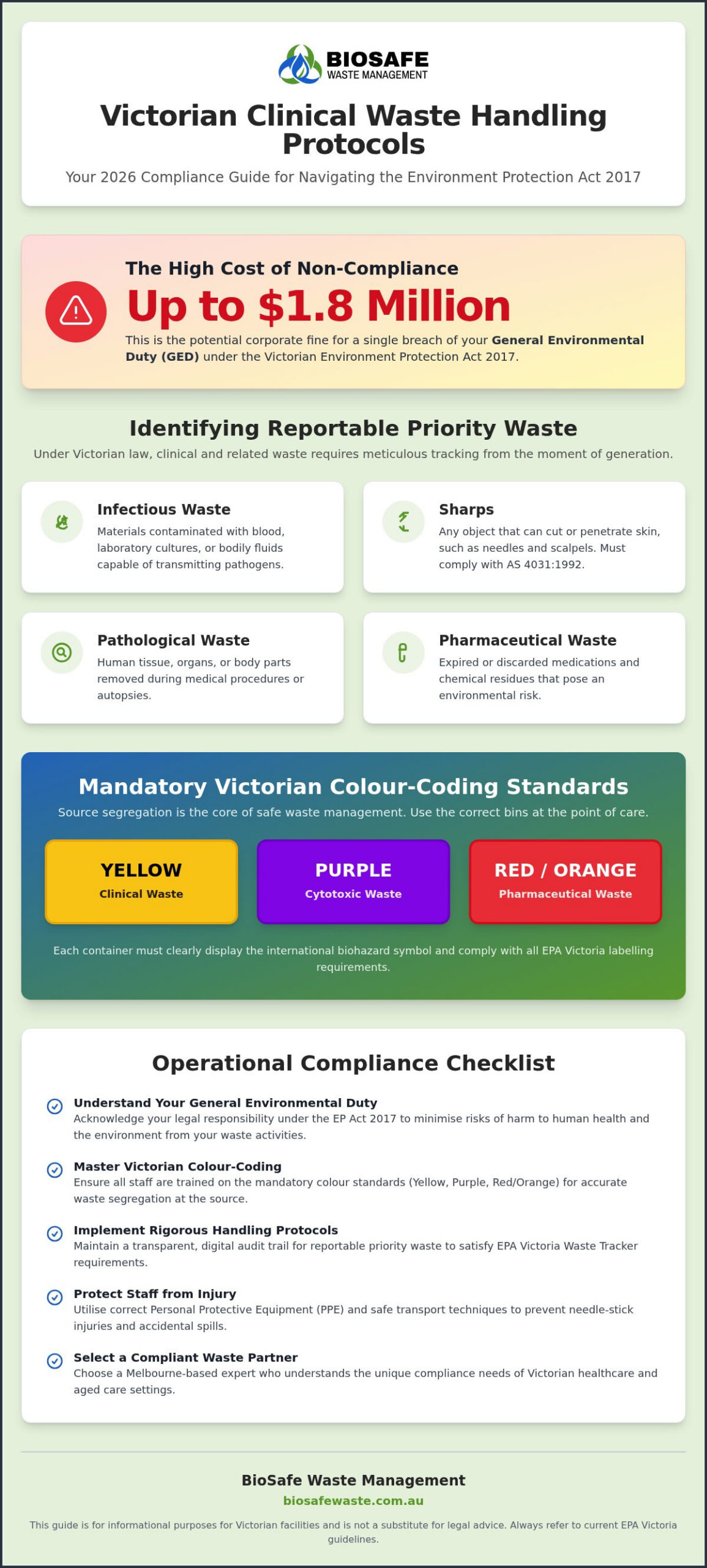
Victorian law classifies clinical and related waste under Schedule 5 as reportable priority waste. This classification requires meticulous tracking from the moment of generation. In a 2026 healthcare setting, this includes:
- Infectious Waste: Materials contaminated with blood, laboratory cultures, or bodily fluids capable of transmitting pathogens.
- Sharps: Any object capable of cutting or penetrating the skin, such as needles, scalpels, and lancets. These must comply with Australian Standards AS 4031:1992.
- Pathological Waste: Human tissue, organs, or body parts removed during medical procedures or autopsies.
- Pharmaceutical Waste: Expired or discarded medications and chemical residues that pose a risk if released into the environment.
The Risk of Improper Handling
Treating clinical waste as general refuse leads to severe consequences. Occupational health is the most immediate concern. Staff face the constant threat of needle-stick injuries, which can lead to the transmission of blood-borne viruses like Hepatitis B, Hepatitis C, or HIV. These accidents are often preventable through strict adherence to containment protocols.
Legally, the stakes are exceptionally high. Under the Environment Protection Act 2017, every business has a General Environmental Duty (GED) to minimise risks. A breach of this duty can result in corporate fines of up to $1,814,400 for a single offence. Beyond financial penalties, improper disposal allows hazardous medical plastics and chemicals to enter the general waste stream, potentially contaminating Victorian soil and waterways. A disciplined approach to waste is the only way to mitigate these professional and environmental risks.
Classification and Segregation: The Core of Waste Management
Effective clinical waste handling protocols rely entirely on the principle of source segregation. This process requires staff to separate waste at the exact moment and location it is generated. When general waste, such as paper towels or packaging, is incorrectly placed into clinical streams, it leads to “waste creep”. This unnecessary inflation of clinical waste volumes significantly increases operational costs and complicates the audit trail required by EPA Victoria. Bins should be positioned at the point of care, ensuring that compliance is the path of least resistance for busy medical professionals. Strategic placement reduces the likelihood of errors during high-pressure clinical procedures.
Victorian Colour-Coding and Labelling Standards
Victoria adheres to a strict colour-coded system to ensure different waste streams are treated and disposed of appropriately. Yellow bins and liners are the universal standard for infectious clinical waste. Under EPA Victoria guidelines, purple containers are specifically reserved for cytotoxic waste, which requires specialised high-temperature incineration. Red or orange containers are frequently utilised for pharmaceutical or specific laboratory waste streams depending on the facility’s risk profile. Every container must clearly display the international biohazard symbol and comply with Victorian EPA labelling requirements. Establishing a consistent clinical waste collection schedule ensures these bins are managed efficiently and never remain on-site longer than regulations permit.
Sharps Management Protocols
Sharps management is perhaps the most critical component of workplace safety due to the immediate risk of needle-stick injuries. The “point of use” rule is the gold standard. Needles, scalpels, and lancets must be discarded into a compliant container immediately after a procedure is completed. Carrying used sharps across a treatment room or corridor is a high-risk activity that should be strictly prohibited.
Containers must never be filled beyond the 75% capacity mark. Overfilling is a primary cause of accidental injury during the final sealing process. All sharps bins used in Victorian facilities must meet the Australian and New Zealand Standards AS 4031:1992 or AS/NZS 4261:1994. These standards ensure the containers are puncture-resistant and feature secure, tamper-proof locking mechanisms. Once the 75% limit is reached, the container should be locked and moved to a secure storage area to await professional collection.
Victorian EPA Compliance and Legal Duties
The Environment Protection Act 2017 serves as the primary legislative pillar for waste management in Victoria. Central to this framework is the General Environmental Duty (GED), which requires every clinic to take reasonable and practicable steps to eliminate or reduce risks to human health and the environment. Unlike previous reactive models, the GED is a proactive obligation. It means you must identify potential hazards before they cause harm. Implementing comprehensive clinical waste handling protocols isn’t just a best practice; it’s your primary evidence of meeting this legal duty.
Failing to uphold the GED carries severe penalties. As of July 2026, a company breaching this duty can face fines reaching $1,814,400. For smaller facilities, even minor administrative errors in waste classification can result in significant financial strain. The 2021 Regulations classify clinical waste as “reportable priority waste”, the highest tier of waste oversight in Victoria. This status triggers mandatory digital tracking and strict storage requirements that every facility manager must understand. Your role as the waste producer means you remain responsible for the waste until it’s appropriately treated, even after it leaves your premises.
The General Environmental Duty (GED) for Clinics
The GED shifts the burden of proof onto the waste producer. If an incident occurs, EPA Victoria will examine whether your facility had robust systems in place to prevent it. Your protocols should detail every step of the waste lifecycle, from the moment a sharp is used to the final collection. These documents prove you’ve exercised due diligence. Recent 2026 updates to Victorian waste codes have further refined how pathological and pharmaceutical residues are categorised. It’s essential to review your internal classifications annually to ensure they align with these specific technical standards.
Waste Tracking and Documentation
Digital accountability is now the standard for Victorian healthcare. All movements of clinical waste must be recorded through the EPA Victoria Waste Tracker portal. This system creates a transparent, real-time “chain of responsibility” that links the producer, the transporter, and the disposal facility. As the waste producer, you’re responsible for ensuring the data entered into the portal is accurate. Errors in these digital records can lead to fines, such as the $1,976 penalty issued to a Hoppers Crossing site in early 2025 for failing to record transactions correctly.
You must maintain copies of all waste manifests and transport certificates. While many clinics digitise these records, ensure they’re easily accessible for an EPA audit. Choosing an EPA-licensed contractor is a critical part of this process. Your contractor must hold a valid “Transport reportable priority waste registration”, which currently incurs a fee of $248.34 for the 2026-27 financial year. Verifying your partner’s licence status protects your facility from being held liable for illegal disposal activities further down the supply chain. Understanding the full breakdown of these costs is equally important; facilities seeking transparency on invoicing and levies can benefit from reviewing a detailed guide to medical waste disposal cost in Melbourne to avoid hidden charges and ensure budget certainty. Facilities should also familiarise themselves with the regulatory requirements governing clinical waste transport in Melbourne, including the 2026 EPA Waste Tracker updates and mandatory 72-hour storage limits that apply once waste leaves your premises.
Operational Checklist: Safe Handling and Storage Procedures
Translating legal obligations into daily clinical practice requires a disciplined operational framework. Effective clinical waste handling protocols are only as strong as the physical procedures your staff follow during every shift. A single lapse in handling technique can lead to a workplace accident that compromises staff safety and triggers an EPA investigation. This section outlines the essential physical safeguards every Victorian facility must maintain to bridge the gap between compliance and practical safety.
Staff PPE and Handling Protocols
Personal Protective Equipment is the final line of defence against blood-borne pathogens. Mandatory gear for anyone handling waste bags or sharps containers includes:
- Puncture-resistant gloves: Specifically designed to withstand accidental nicks from hidden objects.
- Protective eyewear: Essential for preventing mucosal exposure during bag sealing or bin transport.
- Fluid-resistant aprons: To be utilised whenever there is a high risk of liquid breach or splashing.
Staff must strictly adhere to the “no-hand-compression” rule. You should never push down on clinical waste bags to create more space; this action is a leading cause of needle-stick injuries when sharps have been incorrectly disposed of in soft waste streams. When transporting waste within the facility, staff should use dedicated trolleys rather than carrying multiple bags by hand. This reduces the risk of bag rupture and physical strain. Rigorous hand hygiene protocols must be followed immediately after waste handling or bin exchange, regardless of whether gloves were worn.
Internal Storage and Security
Your on-site storage area must be a secure, dedicated zone that is inaccessible to the public, patients, and animals. Victorian regulations require these areas to be lockable and clearly marked with biohazard signage that reads “Clinical Waste Storage – Authorised Personnel Only”. For facilities generating pathological waste, storage conditions must include adequate ventilation and temperature control to prevent decomposition and odour issues. The storage area should feature a hard, impervious floor that is easy to clean and disinfect in the event of a leak. Maintaining a clean, organised storage point is a visible indicator of your facility’s commitment to professional integrity.
Every Victorian clinic must maintain a dedicated spill kit near waste storage and generation points. These kits should contain high-absorbency granules, hospital-grade disinfectant, and additional PPE to manage liquid breaches. Rapid response prevents hazardous fluids from entering the drainage system, which is a core requirement of your General Environmental Duty. For facilities seeking to bolster their safety standards, professional sharps disposal and collection services provide the necessary infrastructure to manage these risks effectively.
Selecting a Compliant Waste Partner in Melbourne
Choosing a waste management provider is a decision that impacts your facility’s legal standing and staff safety. In Victoria, local expertise is non-negotiable. Many providers offer general services, but few possess the technical depth required to manage “reportable priority waste” according to current 2026 standards. A partner who understands the specific nuances of the Victorian EPA framework acts as a vital safeguard for your practice. They ensure your clinical waste handling protocols aren’t just documents on a shelf but active, compliant processes that protect your staff and the public.
A reliable partnership is built on the steady cadence of professional briefings and consistent service delivery. You need a provider that doesn’t just collect bins but understands the gravity of the healthcare industry. When assessing a partner, evaluate their knowledge of the Environment Protection Act 2017 and their ability to provide a transparent audit trail. This level of meticulousness is what separates a generic contractor from a specialist who serves as the backbone of your facility’s sanitation strategy. Before committing to any provider, it is also prudent to compare 2026 medical waste disposal pricing in Melbourne to ensure you receive compliant service at a fair and transparent cost.
BioSafe Waste Management: Your Victorian Specialists
BioSafe Waste Management operates as a disciplined and authoritative expert in the Victorian sector. We provide specialised collection services tailored to the high-stakes environments of dental clinics, medical centres, and aged care facilities. Our team manages the entire lifecycle of clinical waste, from providing Australian-standard sharps containers to ensuring regular, reliable collection schedules. We also support NDIS providers and tattoo studios, recognising that these facilities have unique waste profiles that require meticulous attention. By focusing exclusively on Victorian operations, we maintain a deep, unwavering commitment to local regulatory integrity and professional standards.
Next Steps for Facility Managers
Transitioning to a professional waste service should be a methodical and reassuring process. During the first 30 days, we focus on auditing your current waste streams to identify any compliance gaps. This audit helps establish a collection frequency that balances your clinic’s volume with safety requirements, preventing the hazardous accumulation of waste. We assist with the integration of your facility into the EPA Victoria Waste Tracker portal, ensuring every manifest is accurate and audit-ready. This transition period is designed to provide you with absolute certainty that your clinical waste handling protocols meet every 2026 Victorian standard.
Establishing a reliable collection frequency is the most effective way to maintain order and hygiene. It removes the anxiety of overfilled bins and ensures you’re always prepared for an unannounced inspection. Our goal is to be the “safe pair of hands” that allows you to focus on patient care while we manage the complexities of compliance.
Ensure your facility is 100% compliant with BioSafe Waste Management
Securing Your Facility’s Compliance for 2026 and Beyond
Adopting disciplined clinical waste handling protocols is the most effective way to fulfil your General Environmental Duty while safeguarding your staff from avoidable injury. By mastering Victorian colour-coding standards and maintaining rigorous digital manifests, you move from reactive compliance to proactive risk management. This commitment to order ensures that your facility remains a safe, hygienic environment for both patients and practitioners. Meticulous waste management is a core component of professional integrity in the healthcare sector.
As a Melbourne-owned and operated specialist, BioSafe Waste Management understands the unique pressures facing Victorian medical and care facilities. We are an EPA Victoria Licensed Transporter with specific expertise in dental and aged care waste streams. We provide the stability and precision required to manage your waste lifecycle without ambiguity. Protecting your practice starts with a clear, authoritative understanding of your current operational gaps.
Request a Victorian Clinical Waste Compliance Audit to ensure your practice meets every regulatory standard with total confidence. We look forward to being the reliable partner that supports your facility’s safety and legal adherence.
Frequently Asked Questions
What are the specific colour-coding requirements for clinical waste in Victoria?
Victoria follows strict colour-coding standards to ensure safe segregation and appropriate treatment. Yellow bins and liners are mandatory for infectious clinical waste and sharps. Cytotoxic waste must be placed in purple containers, while pharmaceutical waste requires separate white or red containers depending on the specific chemicals involved. Using these colours correctly is a fundamental part of your clinical waste handling protocols to prevent cross-contamination and ensure each waste stream is processed at a licensed facility.
How should our clinic handle a clinical waste spill?
Clinical waste spills must be managed immediately using a dedicated on-site spill kit. Staff should don full PPE, including puncture-resistant gloves and eye protection, before containing the liquid with absorbent granules. Once the material is safely recovered into a yellow clinical waste bag, the area must be treated with a hospital-grade disinfectant. This proactive response is a core requirement of your General Environmental Duty to prevent pathogens from entering the environment or posing a risk to public health.
Does our small dental practice need to use the EPA Waste Tracker?
Yes, every Victorian dental practice must utilise the EPA Waste Tracker portal for all clinical waste movements. Under the 2021 Regulations, clinical waste is classified as reportable priority waste, which triggers mandatory digital tracking from the point of generation to final disposal. This requirement applies to all facilities regardless of their size or waste volume. Maintaining these digital records is essential for proving compliance during an EPA audit and avoiding significant administrative fines.
How often should clinical waste bins be collected from a Melbourne clinic?
Collection frequency is determined by your waste volume and the specific types of materials generated within your facility. High-volume Melbourne clinics often require weekly or fortnightly collections to prevent waste accumulation and odour issues. Pathological waste may require more frequent removal due to its biological nature. A professional waste partner can help you establish a schedule that ensures your storage areas never exceed capacity, keeping your facility compliant with Victorian health and safety standards.
What is the maximum weight for a clinical waste bag before it is unsafe?
Clinical waste bags should generally not exceed 5kg to 10kg to ensure safe manual handling and prevent bag rupture. While specific limits depend on the micron thickness of the liners used, the primary goal is to maintain bag integrity during transport. Overloading bags increases the risk of spills and physical strain for staff. It is safer to use multiple smaller bags that can be easily sealed and moved without compromising the puncture-resistant material.
Can we put pharmaceutical waste in our standard clinical waste bins?
No, pharmaceutical waste must be managed in a separate waste stream from standard clinical waste. Placing medications or chemical residues into yellow clinical bins can lead to environmental contamination, as these streams are often treated through different processes. Pharmaceutical waste requires specialised disposal to ensure hazardous chemicals don’t enter the water system. Correct segregation at the source is a critical step in your clinical waste handling protocols to maintain legal and environmental integrity.
What training are we legally required to provide to staff regarding waste?
Victorian law requires you to provide comprehensive training to all staff members who handle or generate waste. This includes an initial induction and periodic refreshers on waste segregation, the correct use of PPE, and emergency spill response procedures. You must document this training as evidence that your facility is meeting its General Environmental Duty. Providing clear, practical instructions ensures that every team member understands their role in maintaining a safe and compliant clinical environment.
How do we dispose of cytotoxic waste differently from standard clinical waste?
Cytotoxic waste requires distinct handling and disposal protocols because it is toxic to cells. It must be segregated into purple-coloured bins and liners marked with the cytotoxic symbol. These materials require high-temperature incineration at a specialised facility to be fully neutralised. Standard clinical waste is often treated via autoclaving, which is insufficient for cytotoxic materials. Ensuring this distinction is clear in your facility protects both your staff and the Victorian environment from hazardous exposure.