
In 2026, a “low-cost” quote for clinical waste collection often becomes the most expensive mistake a Melbourne healthcare facility can make. You likely feel the frustration of opaque invoices and hidden levies that seem to fluctuate without warning. It’s a significant burden to manage a busy dental, medical, or tattoo practice while worrying if your current provider is actually meeting EPA Victoria’s strict 72-hour storage limits or if a surprise audit could result in a heavy fine. We understand that you need more than just a bin collection; you require a silent, dependable partner that ensures your facility remains safe, hygienic, and lawful.
This guide helps you master the nuances of medical waste disposal cost melbourne, ensuring you secure a service that is as transparent as it is compliant. We’ll provide clarity on the current regulatory landscape, including the impact of the A$169.79 per tonne metropolitan landfill levy, and explain how to avoid the 30% overpayment common in unmonitored contracts. We’ll also outline how to establish a predictable, reliable waste management schedule that protects your staff, your patients, and your professional reputation through unwavering adherence to Victorian health standards.
Key Takeaways
- Learn how to accurately evaluate a medical waste disposal cost melbourne quote by identifying the specific variables that drive pricing, including waste stream types and the Victorian landfill levy.
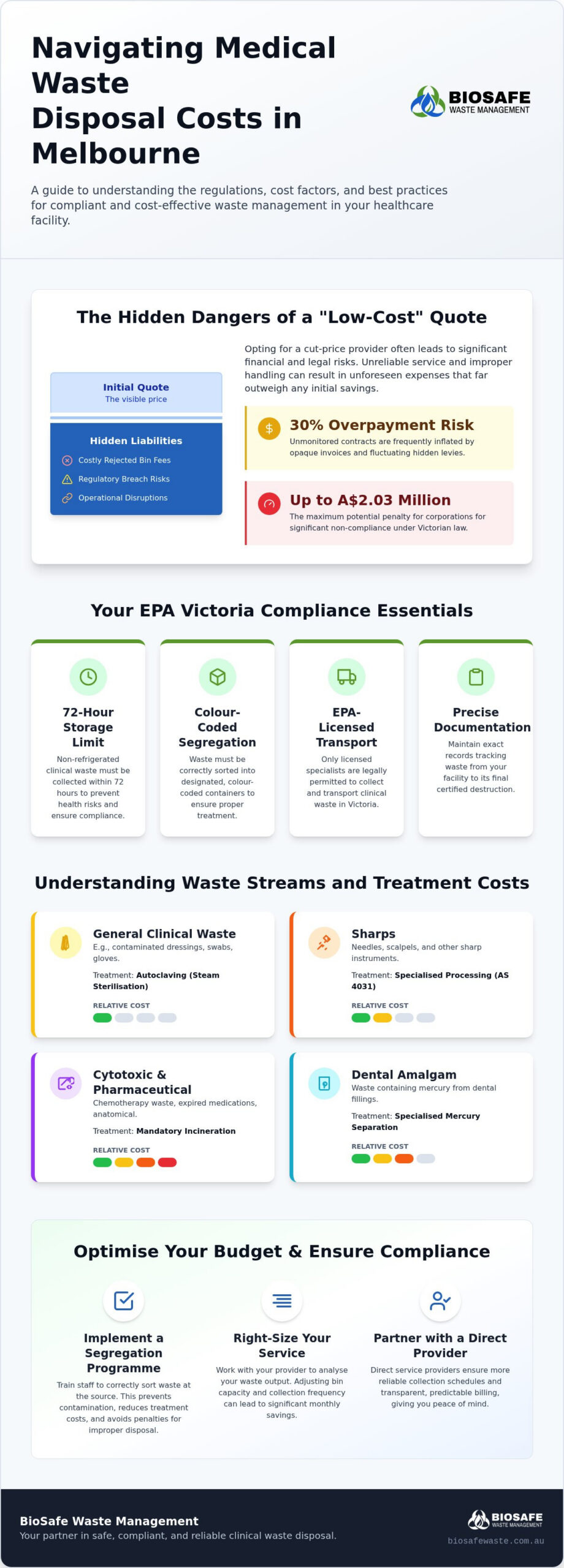
- Understand the essential EPA Victoria compliance requirements, such as mandatory colour-coded segregation and the strict 72-hour storage limit for non-refrigerated clinical materials.
- Discover how implementing a rigorous waste segregation programme and right-sizing your bin capacity can reduce monthly expenses without compromising facility hygiene.
- Compare the benefits of partnering with a direct service provider versus a waste broker to ensure more reliable collection schedules and transparent, predictable billing.
- Gain insights into the specialised disposal protocols required for high-stakes environments like dental surgeries, veterinary clinics, and tattoo studios to ensure total regulatory adherence.
Understanding Medical Waste Disposal Costs in Melbourne
Determining a fair medical waste disposal cost melbourne requires an understanding of the specialised logistics involved in handling biohazardous materials. Unlike general municipal waste, clinical waste demands meticulous containment, secure transport, and high-temperature treatment. This necessity for safety, combined with the state’s A$169.79 per tonne metropolitan landfill levy for 2025-2026, drives the premium pricing observed across Victoria. Facilities must account for the “Total Cost of Compliance,” which includes the physical collection and the legal assurance that every gram of waste is tracked from the point of generation to final destruction. For a broader understanding of how these materials are categorised globally, this Biomedical Waste Overview details the management practices that inform local regulations.
The Regulatory Framework in Victoria
The Environment Protection Act 2017 mandates that all Victorian businesses exercise a General Environmental Duty (GED). This legal obligation requires you to proactively minimise risks to human health and the environment from your waste. Clinical waste in Victoria consists of waste that has the potential to cause disease, injury, or public offence, including sharps, human tissue, and items contaminated with blood or body fluids. Maintaining precise documentation and using EPA-licensed transporters isn’t optional; it’s a core requirement for any Melbourne practice. This regulatory oversight ensures that hazardous materials don’t enter the general waste stream, protecting both the public and the environment.
Why “Cheap” Can Become Expensive
Opting for a cut-price provider often results in hidden liabilities that far outweigh any initial savings. Improper waste segregation can lead to bins being rejected at treatment facilities or, in severe cases, result in massive EPA fines. Under current Victorian law, corporations can face penalties of up to A$2.03 million for significant non-compliance. Unreliable collection schedules also create operational bottlenecks. If a provider misses a pickup, your facility may exceed the 72-hour storage limit for non-refrigerated clinical waste, creating both a health risk and a regulatory breach. Understanding the full chain of custody is essential; a comprehensive guide to clinical waste transport in Melbourne can help you identify what a compliant, professional service should look like. A professional partnership offers the reliability and professional indemnity needed to keep your clinic running without interruption.
Primary Factors Influencing Your Service Quote
A precise medical waste disposal cost melbourne quote is built upon the specific operational needs of your facility. Volume remains the most significant driver; a clinic generating 240 litres of waste weekly requires a different logistical approach than a boutique tattoo studio with monthly pickups. Frequency also plays a vital role. Because Victorian regulations restrict the storage of clinical waste to 72 hours without refrigeration, high-volume practices often necessitate multiple weekly collections to remain compliant. Geographic location within Greater Melbourne also impacts transport logistics. Providers must account for transit times and fuel surcharges between metropolitan centres and outlying suburbs. Access issues, such as restricted loading zones or basement-only collections, can also influence the final service fee.
Waste Streams and Treatment Methods
Costs vary significantly between different waste streams due to the treatment required. General clinical waste in yellow bags is often processed via autoclaving, while more hazardous materials require intensive handling. Treatment costs are generally influenced by the required disposal method:
- Autoclaving: A cost-effective steam sterilisation process for general clinical waste.
- Incineration: Mandatory high-temperature destruction for cytotoxic, pharmaceutical, and anatomical waste per the Environmental Protection Regulation 2019.
- Sharps Management: specialised processing for rigid containers that meet Australian Standard AS 4031 safety standards.
Dental practices must also manage amalgam waste, requiring specialised separators and collection protocols to prevent mercury from entering the water system. Choosing a provider that understands these specialised sharps and clinical waste streams ensures you don’t pay for treatment levels your waste doesn’t actually require.
Facility-Specific Requirements
Each healthcare sector in Melbourne faces unique cost pressures. Aged care and NDIS providers often manage high volumes of incontinence aids and sanitary waste, requiring frequent, reliable collections to maintain facility hygiene and meet strict NDIS reporting standards. These facilities need a partner who understands the dignity and safety of residents while managing the logistical burden of large-scale waste. In contrast, tattoo studios and cosmetic clinics handle smaller volumes but face high-stakes biohazard risks, necessitating meticulous sharps management. Veterinary clinics often deal with larger anatomical waste that requires specific incineration protocols, distinguishing their pricing model from a standard GP clinic. Aligning your service with a provider that understands these sector-specific nuances is the most effective way to manage your medical waste disposal cost melbourne while ensuring total safety.
Comparing Waste Management Service Models
Selecting a service model is a critical decision that impacts both your operational budget and your facility’s long term compliance. In Melbourne, businesses generally choose between direct service providers and waste brokers. Brokers act as intermediaries, negotiating rates with various subcontractors to find the lowest price. While this might appear to lower your initial medical waste disposal cost melbourne, it often results in a fragmented service where the person collecting your waste has no direct accountability to your clinic. Direct providers own their specialised fleet and employ their own staff, offering a “safe pair of hands” that ensures consistency and a deep understanding of your specific site requirements.
Invoicing structures also vary significantly across the industry. Some providers offer all-inclusive pricing, which covers the bin, collection, transport, and treatment in one predictable monthly fee. Others utilise a “pay-per-collection” model that may seem cheaper for low-volume users but often includes hidden “environmental levies” or “admin fees” that inflate the final cost. Transparent invoicing is essential for dental and medical practices that require predictable overheads. You should prioritise a partner that provides clear, itemised billing without the fluctuating surcharges that often plague broker-led agreements.
The Direct Provider Advantage
Partnering with a direct provider ensures that you have a single point of contact for all your waste management needs. This direct line of communication is invaluable when you require an urgent collection or have questions regarding Victorian regulatory changes. Because direct providers operate their own local routes, they can offer faster response times and more reliable schedules. You’ll often see the same driver at every pickup, which builds a level of trust and security that is essential in high-stakes healthcare environments. This local expertise allows providers to offer practical advice on bin placement and segregation that external brokers simply cannot provide. When evaluating providers, it is also worth reviewing the safety standards governing clinical waste transport in Melbourne to ensure your chosen partner meets all 2026 EPA Waste Tracker and chain-of-custody requirements.
Contractual Transparency and Flexibility
It’s vital to examine the “fine print” of any waste service agreement to avoid restrictive lock-in traps. Many large-scale providers require multi-year contracts that don’t allow for adjustments as your clinic grows or changes. Flexible 30-day arrangements are often superior for modern practices, as they provide the freedom to scale services up or down based on actual waste generation. When you evaluate the true value of a medical waste collection Victoria service, look for a partner that prioritises your facility’s needs over rigid contractual obligations. A transparent agreement should clearly outline the collection frequency, bin sizes, and the exact waste streams covered, ensuring there are no surprises when the invoice arrives.
How to Optimise Your Waste Management Budget
Optimising your medical waste disposal cost melbourne requires a proactive approach to internal logistics. Many facilities overpay by as much as 30% because they fail to monitor what actually enters their specialised waste streams. By implementing a rigorous segregation programme, you ensure that only truly hazardous materials are processed at the higher clinical rate. This begins with conducting regular internal waste audits to identify where general office waste or recyclables are being incorrectly discarded into yellow bins. Training your staff to recognise these distinctions protects your budget and reinforces the safety protocols of your practice. When every team member understands the financial and environmental impact of waste sorting, the facility operates with much greater efficiency.
Effective Waste Segregation Strategies
Clear colour-coding is the foundation of a cost-effective clinic. Victorian standards require yellow for clinical waste and purple for cytotoxic materials. When staff are properly trained to distinguish between these categories, you avoid the unnecessary expense of treating general waste as biohazardous. One common inefficiency is the disposal of non-clinical items, such as paper towels or packaging, into sharps containers. Because these rigid containers are more expensive to procure and process, using them for anything other than needles and blades significantly inflates your overheads. Organising waste stations with clear signage reduces these errors and streamlines the disposal process for busy clinicians, ensuring that your medical waste disposal cost melbourne remains as low as possible without compromising safety.
Leveraging Technology for Cost Control
Modern practices use digital tracking to monitor waste generation patterns over time. This data allows you to move away from estimated pickups and transition to a schedule based on actual usage. Right-sizing your bin capacity ensures you aren’t paying for the transport of half-empty containers, which is a common source of wasted expenditure. Integrating professional sharps container collection Melbourne services into your digital reporting provides a comprehensive view of your compliance and spending. This level of oversight turns waste management from an unpredictable expense into a controlled, manageable utility. It’s a strategic way to ensure that your facility remains fully compliant with EPA Victoria mandates while maintaining a lean operational budget. To start refining your facility’s efficiency, you can request a tailored waste audit to identify potential savings and improve your current disposal protocols.
Choosing BioSafe: Professional Waste Management in Melbourne
BioSafe Waste Management operates as a dedicated specialist for the Victorian healthcare and sanitation sectors. We understand that managing your medical waste disposal cost melbourne is a balance between fiscal responsibility and the unwavering requirement for safety. Our service is built on a “safe pair of hands” philosophy; we provide the steady, disciplined expertise required to handle high-stakes biohazardous materials. By maintaining a direct service model rather than using third-party brokers, we ensure total accountability for every collection. This approach provides Melbourne facility managers with the peace of mind that their waste is handled by a local partner who understands the gravity of EPA Victoria compliance and the specific needs of the local medical community.
A Tailored Approach for Every Practice
Every professional environment has unique requirements that a generic waste service cannot meet. Tattoo studios and cosmetic clinics, for instance, deal with smaller volumes but require meticulous sharps disposal and clinical waste collection due to high biohazard risks. Our specialised dental waste solutions focus on total regulatory adherence, including the secure management of amalgam waste and contaminated instruments. For NDIS and aged care facilities, we provide discreet, reliable services that prioritise the dignity of residents while maintaining a sterile environment. We don’t believe in one-size-fits-all pricing; instead, we provide transparent, tailored quotes based on your specific waste streams and collection frequencies, ensuring you only pay for the exact level of service your practice requires.
Your Next Steps for a Compliant Facility
Establishing a reliable waste management programme with BioSafe is a methodical and straightforward process. We begin with a professional audit of your current waste generation to identify inefficiencies and ensure your bin sizes are correctly matched to your output. This initial assessment helps stabilise your medical waste disposal cost melbourne by eliminating unnecessary pickups and improving segregation at the source. Transitioning from an existing provider is managed with precision to ensure zero service disruption. We coordinate the delivery of new, compliant containers and the removal of old bins according to your clinic’s schedule. This seamless handover allows your staff to focus on patient care while we maintain the essential backbone of your facility’s hygiene. We invite you to request a professional consultation to review your current disposal protocols and secure a compliant, cost-effective waste management partner for the long term.
Securing Your Facility’s Long-Term Compliance
Managing your clinical waste requires a balance of regulatory precision and operational efficiency. By implementing rigorous segregation and selecting a direct service model, you protect your staff and ensure your practice remains fully compliant with EPA Victoria mandates. A transparent approach to your medical waste disposal cost melbourne allows you to maintain predictable overheads while avoiding the hidden fees often associated with broker-led arrangements. You’ve learned how right-sizing your bin capacity and utilising local expertise can transform waste management from a complex burden into a reliable, background utility.
BioSafe provides the “safe pair of hands” your facility needs to handle high-stakes biohazardous materials. Our local Melbourne-based team offers reliable scheduling and specialist support for dental surgeries, aged care centres, and tattoo studios. We ensure every collection is handled with meticulous care and transported via EPA-compliant vehicles. To stabilise your budget and reinforce your facility’s hygiene standards, you can Request a Professional Waste Audit and Quote from BioSafe today. We look forward to establishing a supportive partnership that keeps your professional environment secure and compliant for the long term.
Frequently Asked Questions
Is medical waste disposal more expensive than general waste in Melbourne?
Yes, clinical waste attracts a higher fee than municipal waste because of the specialised handling and treatment required by Victorian law. Every tonne sent to a metropolitan Melbourne landfill incurs a state government levy of A$169.79 for the 2025-2026 period. Additionally, providers must use EPA-licensed vehicles and high-temperature destruction methods, such as incineration, to ensure public safety. These regulatory factors contribute to the overall medical waste disposal cost melbourne.
What are the EPA Victoria requirements for medical waste bins?
EPA Victoria mandates strict colour-coding for all clinical waste containers to ensure safe segregation. General clinical waste must be placed in yellow bins, while cytotoxic materials require purple containers. Sharps must be stored in rigid containers that comply with Australian Standard AS 4031. Regulations also stipulate that medical waste shouldn’t be stored for more than 72 hours unless it’s kept in a refrigerated environment to prevent bacterial growth and odours.
How often should a dental practice in Melbourne have clinical waste collected?
Collection frequency for dental practices is primarily dictated by the 72-hour storage limit for non-refrigerated waste. Most busy metropolitan clinics schedule weekly or bi-weekly pickups to maintain compliance and facility hygiene. Factors such as the volume of sharps and the presence of dental amalgam also influence the schedule. BioSafe provides tailored collection plans that ensure your practice never exceeds regulatory storage limits while maintaining a predictable, steady service rhythm.
Can I reduce my medical waste costs by changing bin sizes?
Right-sizing your bin capacity is an effective way to control your medical waste disposal cost melbourne. If your facility consistently presents half-empty 240L bins for collection, switching to 120L units or adjusting the frequency can reduce transport overheads. It’s essential to ensure that smaller bins don’t lead to overfilling or improper storage. A professional waste audit can identify the optimal bin size for your actual output, preventing you from paying for unused space.
Are there hidden fees in medical waste disposal contracts?
Many industry contracts include fluctuating environmental levies, administration fees, or fuel surcharges that aren’t clearly stated in the initial quote. These hidden costs are particularly common in agreements managed by waste brokers who outsource the physical collection. To avoid these surprises, look for direct service providers that offer all-inclusive, transparent invoicing. Clear documentation should detail the exact cost per bin or collection without additional, unitemised charges appearing on your monthly statement.
What happens if my medical waste is not properly segregated?
Improper segregation poses significant safety risks and financial liabilities for your facility. If general waste is mixed with clinical materials, the entire bin must be treated at the higher clinical rate, inflating your costs. Seriously, Victorian corporations can face fines of up to A$2.03 million for significant breaches of the Environment Protection Act. Treatment facilities may also reject contaminated bins, leading to collection delays and the need for costly emergency remediation services.
Does BioSafe provide waste management for small NDIS home care providers?
BioSafe offers specialised waste management solutions tailored for NDIS and aged care providers, including small home care settings. We understand that these environments require discreet, reliable service to manage sanitary waste and clinical materials safely. Our team ensures that all collections meet NDIS reporting requirements and maintain the high hygiene standards necessary for vulnerable residents. We provide a safe pair of hands for providers who need consistent, compliant disposal without operational disruptions.
How do I switch to a more reliable medical waste service in Victoria?
Switching to a reliable provider like BioSafe begins with a professional audit of your current waste streams and collection schedules. We coordinate the seamless transition of your equipment, ensuring new, compliant bins are delivered before your old service ends to prevent any gaps in your clinic’s operations. Our team handles the documentation and ensures your new schedule aligns perfectly with Victorian EPA requirements, providing a steady and disciplined transition to a more accountable service.