
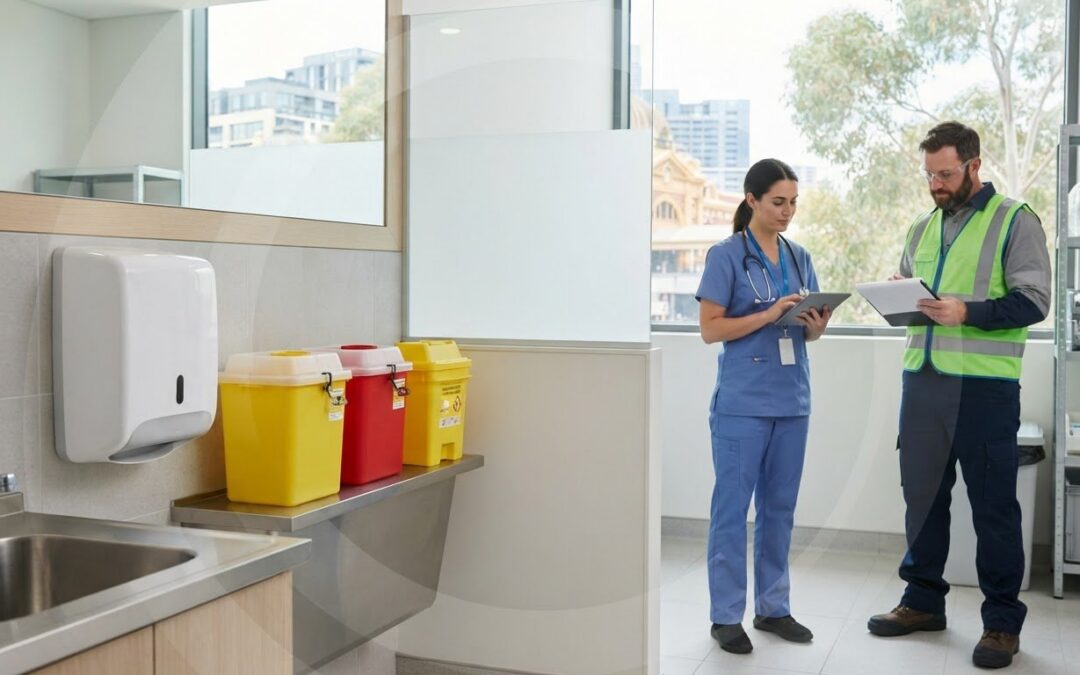
In a healthcare setting, sanitary disposal is an essential line of infection control, not a routine washroom chore. For practice managers and clinical directors across Victoria, managing compliant sanitary disposal for medical clinics means balancing patient dignity with stringent workplace safety and environmental standards. An overflowing unit or improper segregation doesn’t just trigger disruptive plumbing blockages; it compromises clinical hygiene and invites regulatory scrutiny under Victoria’s General Environmental Duty.
You already know that your washrooms reflect the high standards of care delivered in your consulting rooms, and keeping them pristine while avoiding EPA non-compliance is an ongoing responsibility. Master the complexities of clinical hygiene and Victorian EPA regulations with this definitive guide to professional sanitary waste management for healthcare facilities. Below, we examine the legal boundary between washroom sanitary items and reportable clinical waste, outline current WorkSafe accessibility mandates, and show you how to establish a seamless, discreet service that protects your patients and staff.
Key Takeaways
- Understand why ordinary commercial washroom services fail clinical infection control standards, and how specialised containment prevents cross-contamination.
- Clarify your Victorian EPA compliance obligations under the Environment Protection Act 2017, establishing a clear boundary between washroom hygiene items and reportable clinical waste.
- Evaluate the clinical infection control advantages of touch-free sensor technology when choosing sanitary disposal for medical clinics to eliminate manual contact points.
- Review practical audit steps to align your washrooms with WorkSafe Victoria accessibility mandates and RACGP infection control criteria.
- Establish a reliable, discreet collection protocol with an accredited Victorian waste specialist to protect your clinic from regulatory non-compliance liabilities.
The Critical Role of Sanitary Disposal in Clinical Infection Control
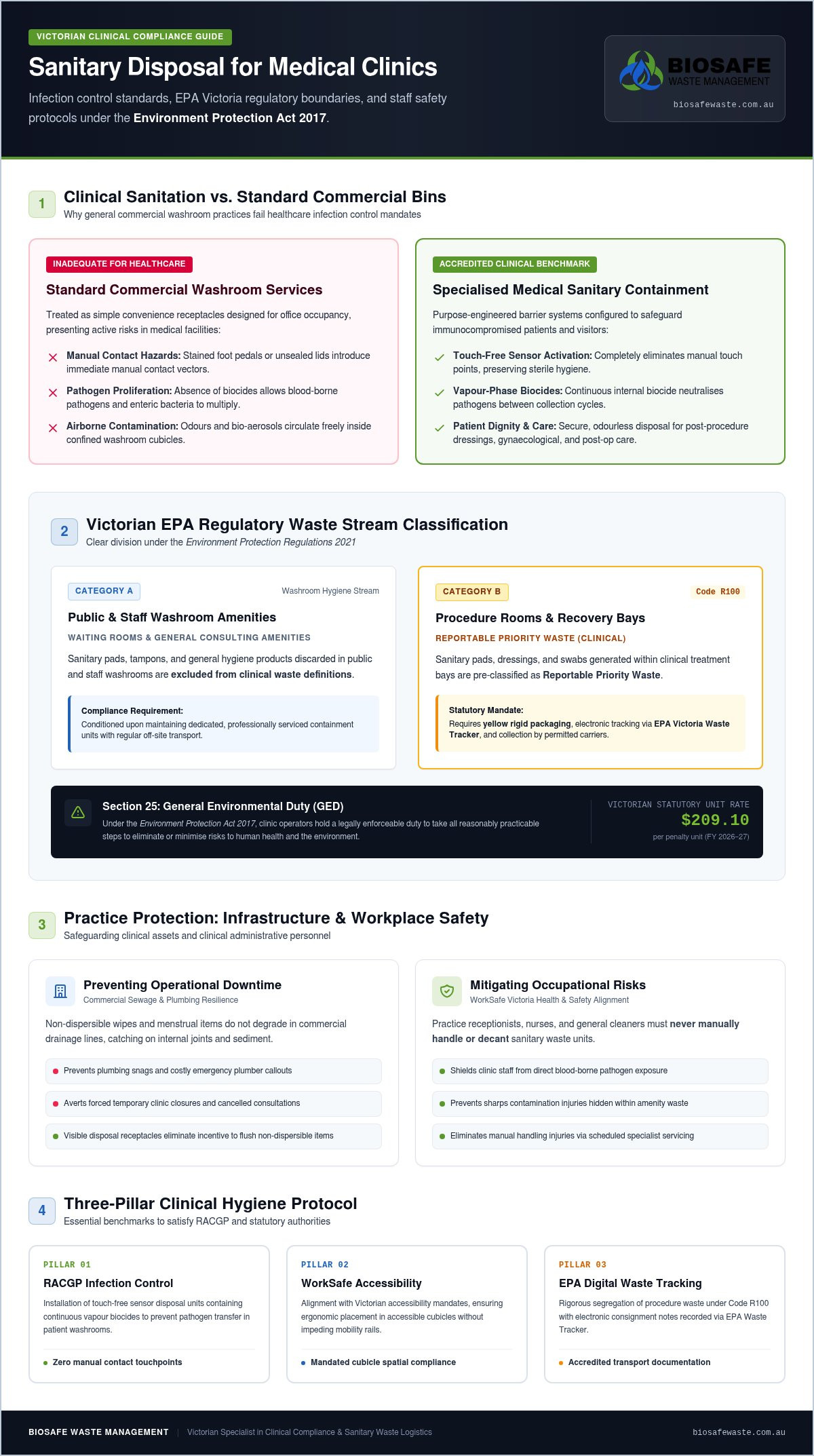
Standard commercial washroom contractors typically treat sanitary units as simple convenience receptacles designed for standard office use. In general practice clinics, specialist consulting rooms, and allied health centres, however, waste generated in patient amenities carries elevated microbiological risks. Patients who enter a medical facility often have compromised immune systems or communicable conditions. When healthcare washroom amenities fall below clinical standards, patient confidence erodes immediately. A stained pedal, unsealed lid, or noticeable odour sends an immediate negative signal regarding the clinic’s overall sterilisation standards and professional competence. Purpose-engineered sanitary disposal for medical clinics acts as a primary infection control barrier, isolating organic matter safely away from public contact.
Beyond Aesthetics: The Clinical Necessity
Menstrual products, post-procedure dressings, and incontinence aids can harbour blood-borne pathogens, enteric bacteria, and other microorganisms. Standard bins without antimicrobial vapour controls allow bacteria to proliferate rapidly, enabling odours and airborne contaminants to circulate within confined washroom cubicles. Specialised clinical sanitary units neutralise these risks by incorporating continuous vapour-phase biocides that sterilise pathogens inside the unit between services. Discreet, hands-free containment also preserves patient dignity and comfort, offering total reassurance to individuals managing post-operative recovery, gynaecological appointments, or chronic health conditions.
Protecting Practice Infrastructure
In high-traffic medical practices, the absence of accessible disposal bins leads directly to drainage failures and costly emergency callouts. Despite marketing claims, so-called “flushable” wipes and sanitary products do not degrade in commercial sewage pipes. Instead, they snag on internal fittings and bind with sediment, creating stubborn blockages that can force temporary clinic closures and disrupt scheduled patient appointments.
- Preventing operational downtime: Providing visible, touch-free sanitary units removes any incentive for patients or visitors to flush non-dispersible items.
- Mitigating staff occupational risks: Internal practice staff or routine cleaners should never manually handle or decant sanitary waste. Utilising scheduled sanitary bin services ensures that medical receptionists and practice nurses are completely shielded from blood-borne pathogen exposure, sharp contamination, and manual handling injuries.
Investing in reliable sanitary disposal for medical clinics protects practice infrastructure while maintaining the rigorous safety standards expected of a modern healthcare facility.
Victorian Regulatory Standards for Medical Sanitary Waste
Victorian healthcare facilities operate under stringent environmental legislation. Under Section 25 of the Environment Protection Act 2017, clinic operators hold a legally enforceable General Environmental Duty (GED). This duty requires practice managers to take all reasonably practicable steps to eliminate or minimise risks to human health and the environment from their waste streams. Compliant sanitary disposal for medical clinics demands a precise understanding of where general washroom hygiene ends and regulated biohazardous waste begins.
EPA Victoria Compliance for Small-to-Medium Clinics
The Environment Protection Regulations 2021 establish a clear division between waste categories based on risk and facility location. Sanitary items discarded in public waiting rooms and staff washrooms are excluded from clinical waste definitions, provided the practice maintains a dedicated, professionally serviced containment system. Conversely, sanitary pads, dressings, and swabs generated within patient procedure rooms or recovery bays are pre-classified as Reportable Priority Waste under Clinical Waste Code R100.
These clinical materials mandate yellow rigid packaging, tracking through EPA Victoria’s digital Waste Tracker, and transport by permitted carriers. Misclassifying waste streams creates significant legal exposure. In Victoria for FY 2026–27, statutory penalties are indexed at $209.10 per penalty unit, with severe corporate breaches carrying fines reaching thousands of units. Selecting an accredited local provider like BioSafe Waste Management guarantees that all consignment documentation and off-site disposal pathways withstand strict RACGP and EPA audits.
Health and Safety (OHS) Obligations
Under Victoria’s Occupational Health and Safety Act 2004 and WorkSafe compliance codes, healthcare employers must provide a working environment that eliminates exposure to biological hazards. Clinical nurses and reception staff should never decant or transport unsealed hygiene waste. Dedicated disposal units charged with vapour-phase biocides actively sterilise pathogens inside the liner between services. Maintaining documented, contracted collection intervals ensures staff safety, preserves your practice indemnity, and satisfies the legal duty of care owed to everyone inside your facility.
Comparing Sanitary Disposal Systems for Modern Practices
Selecting the right hardware and servicing model directly influences your clinic’s infection control efficacy and physical presentation. While commercial washrooms often rely on basic manual pedal bins, healthcare amenities require hardware that prevents cross-contamination and fits tight floor plans. Specifying purpose-built sanitary disposal for medical clinics means evaluating user mechanics, unit capacity, and collection protocols to ensure uncompromised hygiene.
Hardware Selection: Sensor-Operated Units
Touch-free infrared sensor units represent the clinical benchmark for healthcare amenities. Manual pedals can malfunction under heavy foot traffic, and patients occasionally use their hands to lift stubborn lids, instantly transferring bacteria. Sensor-activated flaps eliminate physical contact entirely. High-capacity commercial battery packs provide uninterrupted operation for months, while slimline profiles preserve clear transfer space beside toilets, ensuring alignment with Australian accessibility standards. Combined with vapour-sealed lids and antimicrobial liners, these modern units effectively neutralise odours and isolate biological materials within compact consulting suites.
Service Models: Exchange vs. On-site Servicing
Healthcare facilities generally choose between on-site liner replacement and full-unit exchange services. While on-site relining is common in general retail spaces, medical facilities benefit significantly from disciplined servicing protocols that minimise contamination risks inside the cubicle:
- Full-unit exchange: The technician removes the entire sealed unit from the clinic and replaces it with an off-site sanitised, freshly pre-dosed replacement. This eliminates any aerosolisation of bacteria or open handling of waste within the washroom.
- On-site relining: The technician replaces the internal liner, cleans contact surfaces with hospital-grade disinfectant wipes, and recharges the vapour biocide on site. This approach requires minimal equipment transport through patient waiting areas.
- Calibrated collection frequencies: Service intervals should match patient throughput. High-volume general practices, imaging centres, and day surgeries typically require fortnightly or weekly collections, whereas boutique specialist rooms may operate smoothly on a four-weekly rotation.
Regardless of the chosen service model, experienced technicians execute collections discreetly during scheduled windows, avoiding consultation hours and maintaining continuous sanitary disposal for medical clinics without disrupting clinical workflows.
Implementing Best-Practice Hygiene Protocols
Establishing dependable hygiene across medical amenities requires a structured, auditable routine. Implementing compliant sanitary disposal for medical clinics involves four progressive stages: auditing existing washrooms, positioning hardware correctly, implementing clear signage, and uniting all waste workflows under a single compliance policy. When practices execute these steps systematically, they protect clinic infrastructure and provide a reassuring washroom environment for patients.
Washroom Design and Unit Placement
Washroom design directly affects accessibility, infection control, and ease of maintenance. In accessible and all-gender cubicles, units must be positioned to comply with AS 1428.1 access standards. Units should sit within easy reach of the pan without impeding wheelchair circulation space or grab rail clearances. Wall-mounted slimline units keep floors clear for commercial cleaning crews, while compact floor-standing models suit standard cubicles with restricted wall anchoring.
In facilities where patients self-administer medications, co-locating hygiene bins alongside certified sharps disposal services melbourne clinics trust creates an orderly, centralised disposal station. Clear, dignified braille and tactile signage prevents inappropriate flushing while directing patients toward the correct bins.
Staff Training and Safety Protocols
Under RACGP Criterion GP4.1, every medical facility must appoint a dedicated waste management lead to oversee infection control procedures. Practice staff must be trained to recognise early warnings, such as unit malfunctions or unexpected fill rates, without attempting internal servicing. Medical receptionists and administrative staff should never open, compress, or decant sanitary units under any circumstances.
Modern clinics rely on closed-loop servicing where external specialists handle replacement and decontamination. This workflow integrates directly with standard clinical waste handling protocols, creating an auditable chain of custody that simplifies annual accreditation reviews. If you need to evaluate your clinic’s current washroom setup against state benchmarks, you can book a compliant facility waste audit with BioSafe to ensure your operations meet every environmental duty.
By enforcing clear standard operating procedures, medical practices maintain seamless sanitary disposal for medical clinics while eliminating occupational risks for their administrative team.
BioSafe: Your Victorian Partner in Clinical Compliance
Healthcare facilities require a waste management partner that operates with the same disciplined standards applied in consulting and treatment rooms. BioSafe Waste Management serves exclusively as a dedicated specialist for Victorian healthcare facilities, rejecting the generalised, one-size-fits-all approach of municipal contractors. By focusing specifically on medical, dental, and clinical environments, BioSafe delivers compliant sanitary disposal for medical clinics alongside specialised streams such as dental waste management Victoria practices depend upon for total EPA adherence.
The BioSafe Service Guarantee
BioSafe acts as a dependable, safe pair of hands for Victorian practice managers. Our certified service technicians are trained specifically in healthcare protocols, understanding the necessity of privacy, patient confidentiality, and infection control. Servicing is conducted discreetly, following scheduled timetables designed to prevent any disruption to your waiting areas or consultation suites.
Every collection is fully documented. BioSafe provides comprehensive electronic records that demonstrate transparent regulatory compliance under Victorian environmental laws. This meticulous record-keeping shields your practice during RACGP accreditation cycles and WorkSafe inspections, ensuring every waste consignment follows verified, lawful treatment pathways.
Getting Started with a Compliance Audit
Transitioning from an ordinary commercial hygiene contractor to a dedicated clinical provider is straightforward and structured. BioSafe begins by reviewing your facility’s layout, cubicle ratios, and patient foot traffic to determine optimal hardware placements and collection frequencies:
- Facility waste assessment: We evaluate your existing washroom infrastructure against WorkSafe compliance codes and infection control standards.
- Customised scheduling: We align exchange or servicing cycles to your clinic’s patient volumes, ensuring units never exceed safe capacity.
- Consolidated waste streams: We integrate washroom hygiene units with your sharps, clinical, and dental disposal schedules under a single, accountable provider.
Protecting your practice requires reliable systems and experienced support. Contact the Victorian team at BioSafe to schedule a facility assessment and establish professional, medical-grade sanitary disposal for medical clinics that safeguards your patients, staff, and clinical reputation.
Elevating Clinical Standards and Regulatory Peace of Mind
Washroom hygiene in healthcare is never an afterthought; it’s an active extension of your infection control strategy. Maintaining touch-free, antimicrobial hardware and strictly segregating general hygiene items from regulated biohazard streams protects your facility from severe EPA penalties and plumbing disruptions. Prioritising compliant sanitary disposal for medical clinics ensures patient comfort, safeguards staff from occupational hazards, and reinforces your clinical reputation from the waiting room to the consulting suite.
With specialised medical-grade hardware, verified EPA Victoria-compliant disposal pathways, and discreet, reliable service schedules across Victoria, BioSafe provides the steady support your practice needs. Secure your clinic’s compliance with BioSafe’s professional sanitary services today. Partner with an expert team that understands healthcare standards, and ensure your facility remains an impeccably safe, welcoming environment for staff and patients alike.
Frequently Asked Questions
Is it a legal requirement for medical clinics in Victoria to have sanitary bins?
Yes. Under WorkSafe Victoria compliance codes and the Occupational Health and Safety Act 2004, Victorian employers must provide clean, hygienic toilet facilities that include suitable means for disposing of sanitary items. These units must be installed across all female, accessible, and all-gender washrooms. Medical clinics also hold a General Environmental Duty under the Environment Protection Act 2017 to manage offensive hygiene waste safely and prevent environmental contamination.
How often should sanitary bins be collected in a high-traffic GP clinic?
High-traffic GP clinics typically require fortnightly or weekly collection schedules to prevent overflow and control bacterial odours. While smaller, low-volume specialist practices can often manage on a four-weekly rotation, facilities accommodating high daily patient numbers benefit from shorter service intervals. Frequent servicing guarantees that vapour-phase biocides remain fully active, maintaining continuous odour suppression and supporting an impeccably hygienic environment for patients and clinical staff.
Can we dispose of sanitary waste in our general clinical waste bins?
Routine washroom sanitary items should not be placed into clinical waste bins. While sanitary items from procedure rooms or communicable disease bays are classified as Reportable Priority Waste requiring clinical yellow bins, standard restroom pads and tampons are classified as offensive hygiene waste. Placing washroom items in clinical bins needlessly escalates high-temperature treatment processing requirements, while putting procedure dressings into washroom units violates strict Victorian EPA disposal mandates.
What is the difference between a standard sanitary bin and a clinical-grade unit?
Clinical-grade units are built to withstand stringent medical hygiene standards rather than basic commercial washroom conditions. Standard commercial bins often lack robust seals and rely on simple fragranced granules that merely mask odours. In contrast, compliant sanitary disposal for medical clinics uses units dosed with active vapour-phase biocides that sterilise airborne bacteria inside the liner, paired with hands-free infrared sensors to prevent touch-based pathogen transfer.
Does BioSafe provide waste tracking documentation for EPA audits?
Yes. BioSafe supplies detailed consignment records and electronic compliance documentation for all scheduled collections. Under the Environment Protection Act 2017, Victorian healthcare practices must prove that waste is handled by certified transporters and directed to licensed disposal facilities. BioSafe maintains a transparent, traceable chain of custody for every service, giving practice managers complete regulatory peace of mind during RACGP accreditation assessments and state environmental inspections.
Are touch-free sensor bins more hygienic than traditional pedal bins?
Touch-free sensor units are significantly more hygienic than manual or foot-pedal alternatives in healthcare environments. Foot pedals can stiffen or jam over time, prompting patients or staff to lift the lid manually with bare hands and creating a direct cross-contamination risk. Infrared sensors open and close smoothly without physical contact, keeping hands clean and ensuring a sterile, comfortable experience for every patient entering your practice washrooms.
How do you ensure the service is discreet for our patients?
BioSafe coordinates collection schedules specifically to avoid peak consultation hours, ensuring minimal foot traffic in clinic corridors. Our trained service technicians arrive in neat professional attire, transport sealed containment units discreetly, and complete full replacements or relining swiftly without lingering in public amenities. This quiet, unobtrusive workflow protects patient privacy and ensures your practice day proceeds without noisy interruptions or visible waste handling.
Can BioSafe manage both sharps and sanitary disposal for our clinic?
Yes. BioSafe provides a fully integrated solution encompassing sharps disposal, clinical waste collection, dental waste disposal, and dedicated sanitary bin services across Victoria. Consolidating your sanitary disposal for medical clinics alongside specialised biohazard streams streamlines administration, simplifies audit tracking, and guarantees uniform compliance across all patient amenities and clinical suites. Practice managers deal with one reliable partner who understands every facet of Victorian healthcare compliance.