
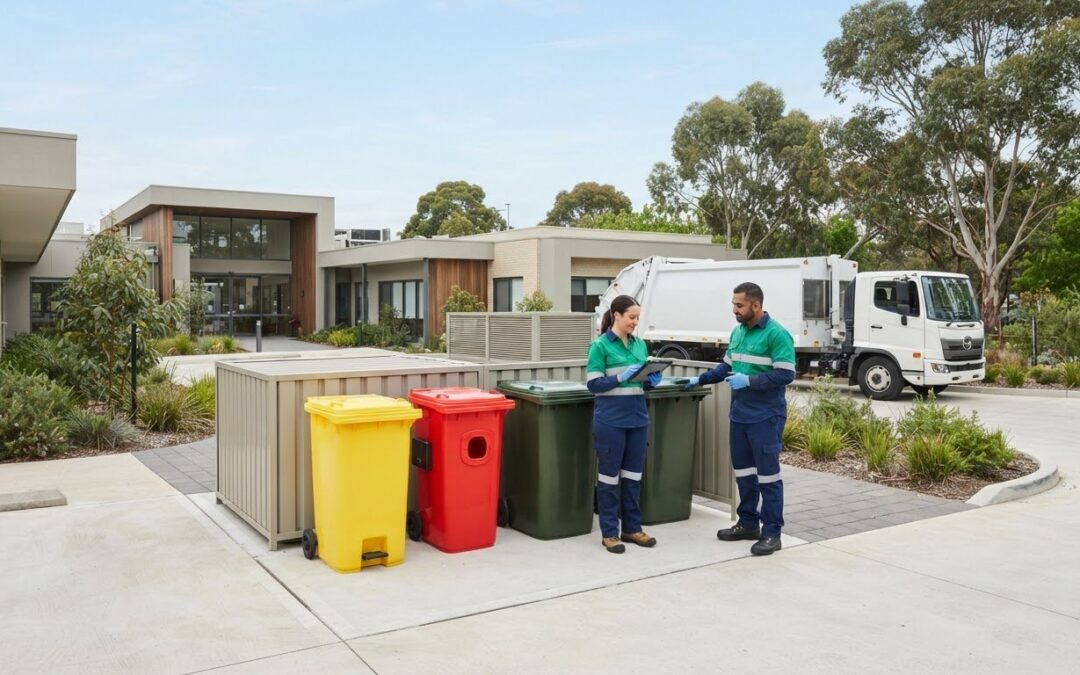
Managing clinical waste in a residential facility isn’t simply a back-of-house logistical task; it’s an active infection control safeguard that directly protects residents and staff. For care providers across Melbourne and regional communities, establishing dependable aged care waste management victoria requires balancing rigorous Environment Protection Authority (EPA) tracking duties against the strengthened Aged Care Quality Standards. When collection schedules slip or busy care teams confuse bin segregation streams, internal storage areas rapidly turn into severe biohazard risks and audit liabilities.
You already know the administrative strain of coordinating overlapping regulatory bodies while ensuring clinical staff remain focused on resident dignity. This operational guide delivers the clear protocols your facility needs to eliminate cross-contamination, streamline consignment traceability under EPA rules, and achieve complete audit readiness across every care wing. Below, we break down practical waste segregation categories, mandatory reporting thresholds, and reliable collection workflows built to protect your home.
Key Takeaways
- Mastering the intersection between the Environment Protection Act 2017 and the strengthened Aged Care Quality Standards ensures full audit readiness and resident safety.
- Accurate point-of-care segregation forms the foundation of reliable aged care waste management victoria, preventing non-hazardous items from entering high-cost clinical disposal streams.
- External holding facilities require secure containment, adequate ventilation, and bunding to prevent pest intrusion and environmental hazards.
- Selecting an EPA-licensed collection partner provides end-to-end electronic waste tracking and discrete collection schedules tailored to clinical routines.
Regulatory Framework: Victorian EPA and Aged Care Quality Standards
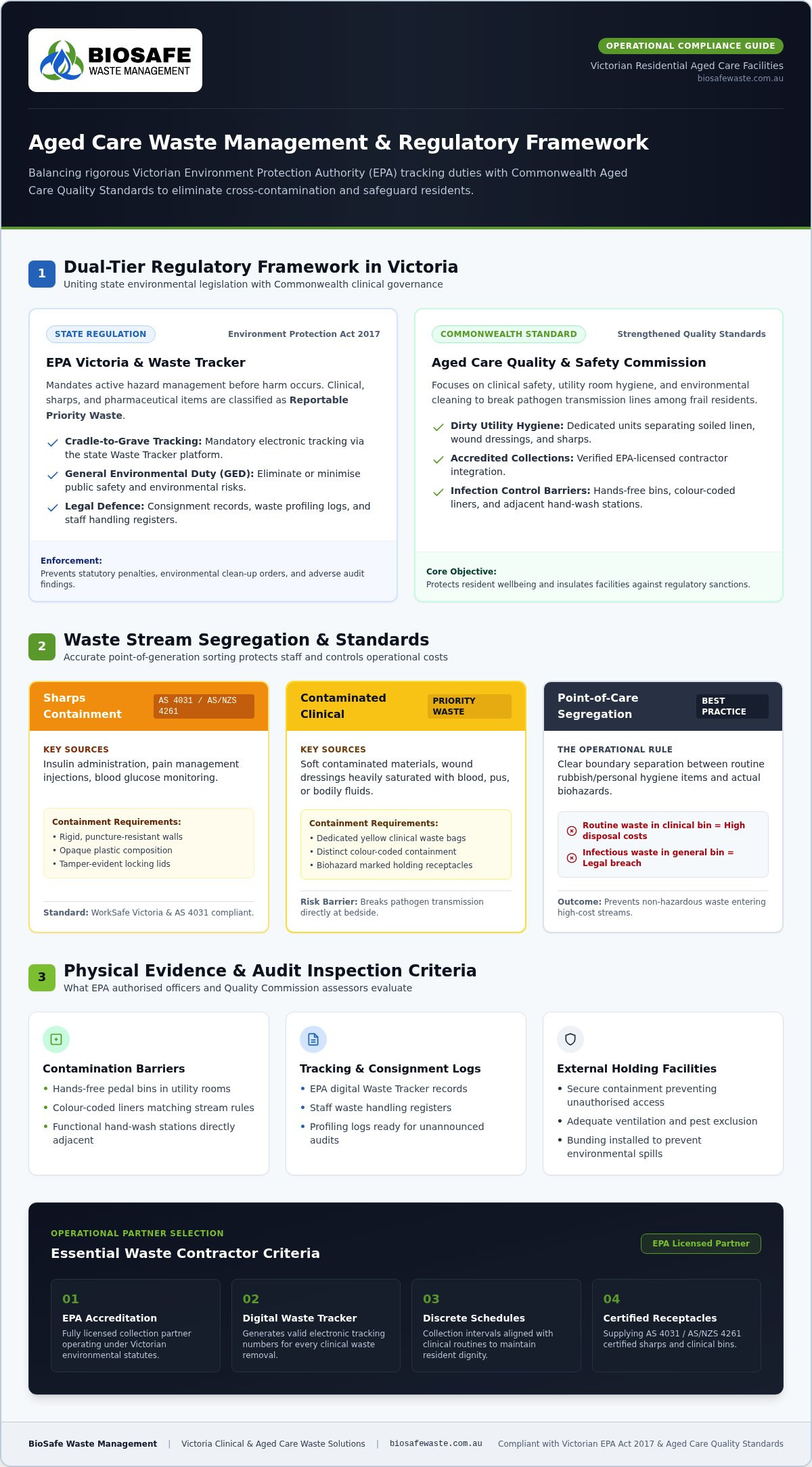
Victorian residential facilities operate under a dual-tier regulatory framework that unites state environmental legislation with Commonwealth clinical standards. Under the Environment Protection Act 2017, operators must actively manage waste hazards before harm occurs. This statutory mandate makes compliant aged care waste management victoria an operational necessity rather than an administrative afterthought.
The Environment Protection Authority (EPA) Victoria classifies clinical, sharps, and pharmaceutical items as reportable priority waste. This classification triggers strict “cradle-to-grave” digital tracking requirements through the state Waste Tracker platform. Meeting these duties ensures facilities avoid substantial statutory penalties, environmental clean-up orders, and adverse audit findings.
The General Environmental Duty and Clinical Governance
The General Environmental Duty (GED) requires facility managers to understand the risks their activities pose to public safety and eliminate or minimise them so far as reasonably practicable. Within aged care, this duty extends directly to internal waste rooms and dirty utility areas. Operational leaders must maintain comprehensive documentation, including consignment records, waste profiling logs, and staff handling registers. Public health compliance inspectors and EPA authorised officers can request these tracking certificates at any time during unannounced visits, making accurate records your primary legal defence.
Aged Care Quality and Safety Commission Expectations
Cross-contamination risks in residential care can quickly lead to severe healthcare-associated infections among frail residents. The Aged Care Quality and Safety Commission evaluates utility room hygiene and waste containment strictly against the quality standards, focusing on environmental cleaning and clinical safety. Reviewing a detailed Biomedical Waste Overview reinforces how proper categorisation breaks lines of pathogen transmission between resident bedrooms and disposal bays.
Commission assessors look for clear physical evidence of operational hygiene:
- Dirty Utility Segregation: Dedicated disposal units that separate soiled linen, wound dressings, and sharps directly at the bedside or utility room.
- Contractor Accreditation: Engagement with EPA-licensed contractors capable of generating valid electronic tracking numbers for every clinical waste removal.
- Contamination Barriers: Hands-free bins, color-coded liners, and functional hand-wash stations positioned adjacent to waste storage enclosures.
When aged care waste management victoria aligns with these overlapping state and federal benchmarks, care homes protect resident wellbeing while insulating themselves against regulatory sanctions.
Classifying Waste Streams in Victorian Residential Aged Care
Precise waste stream segregation forms the operational core of compliant aged care waste management victoria. In a busy care wing, misclassifying routine rubbish as clinical waste drives up operational costs unnecessarily, while placing infectious materials into municipal bins breaches Victorian environmental law. Staff need crystal-clear boundaries between general personal hygiene items and actual biohazards.
Every clinical stream requires specific, certified containment that aligns with Australian Standards and occupational guidelines like the WorkSafe Victoria Safety Basics framework. Protecting personal carers from physical puncture injuries and pathogen exposure demands rigorous point-of-generation sorting across all shifts.
Sharps and Contaminated Clinical Waste Streams
Sharps generated during routine insulin administration, pain management injections, or blood glucose monitoring pose immediate bloodborne pathogen risks. Rigid sharps containers must comply strictly with AS 4031 (for single-use containers) or AS/NZS 4261 (for reusable units). These receptacles feature puncture-resistant walls, opaque plastic, and tamper-evident locking lids that prevent accidental spills. Facility managers seeking certified receptacles and scheduled collection intervals should review professional sharps disposal services in Melbourne to equip dirty utility rooms appropriately.
Yellow clinical waste bags handle soft contaminated materials, including dressings saturated with blood, purulent discharge, or bodily fluids from known infectious wounds. These heavy-duty bags must feature the universal black biohazard symbol and maintain a minimum film thickness of 50 microns to prevent tearing during manual handling.
Sanitary, Incontinence, and Pharmaceutical Management
Incontinence aids generate substantial volume across residential care, but not all used pads represent clinical waste. Facilities must classify these streams accurately using practical clinical criteria:
- Routine Incontinence Aids: Daily pads and nappies without visible blood or identified enteric pathogens belong in general waste streams, provided they are securely bagged to maintain dignity and odour control.
- Gastroenteritis and Outbreak Waste: During confirmed infectious outbreaks (such as norovirus or rotavirus), soiled pads, wipes, and disposable bed protection transition immediately into clinical biohazard streams.
- Pharmaceutical and Cytotoxic Lines: Expired prescription tablets, partially used ampoules, and schedule medications require dedicated pharmaceutical destruction bins. Cytotoxic waste from specialised palliative treatments must enter purple, heavy-gauge containers rated for high-temperature incineration.
- Washroom Sanitary Units: Dedicated, hands-free sanitary disposal units protect resident and visitor restrooms from cross-contamination and drain blockages.
For facilities coordinating care across both residential and community settings, understanding how medical waste disposal for home care differs from institutional streams helps staff apply the correct classification rules when supporting residents who transition between care environments. Facilities looking to reinforce their clinical sorting protocols can partner with BioSafe Waste Management for compliant receptacles and dependable clinical collections.
Evaluating Waste Contractors: Key Criteria for Facility Managers
Selecting an external service provider is a pivotal governance decision for any residential facility. A general transport business without clinical expertise can easily expose a provider to licensing violations, cross-infection risks, and tracking failures. High-standard aged care waste management victoria requires an accredited partner capable of maintaining strict regulatory continuity while respecting the day-to-day realities of a residential healthcare setting.
A dependable contractor acts as a quiet compliance shield. Facility leaders must evaluate prospective collection partners across several core operational capabilities to ensure their service integrates cleanly with internal infection control routines.
Licensing, EPA Permissions, and Tracking Portals
Never assume a standard waste carrier possesses the legal permissions required for biohazardous transport. Contractors must hold valid EPA Victoria permissions specifically authorising the transport of reportable priority clinical and pharmaceutical categories. These operators should provide seamless electronic integration with EPA Waste Tracker, automatically logging waste movements and generating verifiable consignment records.
Every collection event must yield transparent documentation, confirming lawful receipt and certified final treatment. Reviewing the core operational benchmarks for medical waste collection in Victoria helps facility directors confirm whether a contractor’s chain-of-custody protocols satisfy both health department auditors and governing boards.
Service Reliability and Sensitive Facility Demeanour
Residential aged care facilities aren’t standard industrial estates; they’re homes to vulnerable people. Collection teams must display empathy, quiet professionalism, and strict security discipline whenever they enter care zones. Evaluating contractor suitability involves checking three critical factors:
- Outbreak Scalability: The provider must absorb sudden volume surges when viral respiratory or gastro outbreaks strike, adding rapid collections without administrative delays.
- Discreet Handling: Technicians should transfer bins quietly during low-activity windows, avoiding resident rest periods, family visiting hours, and meal services.
- Safeguarding Protocols: Drivers must be fully vetted, trained in facility access security, and disciplined around restricted doorways, keypad codes, and resident privacy.
- Sanitised Bin Exchanges: Every removed unit must be replaced with a decontaminated, mechanically sound bin to stop residual pathogens from entering clean storage zones.
When external contractors work with this level of precision, facility managers gain total peace of mind, knowing collection schedules support resident dignity while satisfying every statutory mandate.
Internal Facility Protocols: Segregation, Storage, and Staff Training
Flawless execution of aged care waste management victoria relies on establishing practical routines inside the home. High staff turnover and heavy shift rosters often test compliance standards. When procedures are overly complicated, mistakes multiply rapidly. Clear visual cues, logical room layouts, and structured induction programs keep care staff confident and protect resident safety across all wings.
Every facility needs defined movement pathways to eliminate cross-contamination during waste transfers. Sealed transport carts must move along dedicated service routes, avoiding meal distribution corridors and visitor entries during peak morning hours.
Setting Up Compliant Dirty Utility and Holding Rooms
Dirty utility rooms require methodical physical organisation. Pedal-operated, color-coded bins should sit directly adjacent to dirty benches and sluice sinks, preventing carers from handling bin lids with contaminated gloves. Distinct labels must clarify general waste, infectious linen, clinical waste, and sharps containment. Central external waste compounds must feature non-porous washable floors, dedicated ventilation, secondary bunding to capture washdown liquids, and functional vermin exclusion barriers. Reliable keypad access is mandatory to stop wandering residents from entering hazardous holding areas.
Staff Induction, PPE, and Biohazard Spill Procedures
Worker protection underpins every handling protocol. Personal care workers and nursing personnel must wear appropriate PPE, including single-use nitrile gloves, fluid-resistant aprons, and eye protection, whenever transferring clinical bags into central bins. Regular refresher sessions must cover rapid biohazard containment using dedicated spill kits:
- Isolate and Protect: Restrict immediate corridor access and don heavy-duty PPE before approaching contaminated fluids.
- Neutralise and Absorb: Apply clinical absorbent granules across the liquid, allowing sufficient contact time before scooping matter into yellow biohazard bags.
- Disinfect and Document: Clean non-porous flooring with hospital-grade disinfectant and file a mandatory internal incident log.
Reviewing Allied Health and Dental Waste Streams
Residential homes routinely host visiting podiatrists, wound specialists, and mobile oral health professionals. These external practitioners introduce complex items, including amalgam capsules, heavy bone cutters, and specialised debridement scalpels. Rather than leaving visiting clinicians to manage their own disposals offsite, facilities should maintain unified central waste tracking. Aligning your internal protocols with established dental waste management in Victoria standards guarantees full consignment compliance for all subcontractor activities. Facilities that also host visiting physiotherapists providing dry-needling or wound care services can benefit from reviewing the clinical waste disposal for physiotherapists guide to ensure these allied health streams are correctly segregated and tracked alongside other clinical waste.
To upgrade your facility’s utility setups or audit your holding areas, contact BioSafe Waste Management for tailored support across Victoria.
Implementing a Resilient Waste Management Partnership with BioSafe
Maintaining regulatory compliance across multiple care wings requires more than generic collection schedules. Facilities need a dedicated service partner that understands clinical workflows, residential privacy, and the detailed compliance tracking demanded by Victorian authorities. BioSafe Waste Management provides specialized aged care waste management victoria, delivering structured clinical, sharps, and washroom sanitary collections designed around the operational demands of residential aged care and NDIS providers.
Every collection tier integrates full EPA Victoria transport and tracking procedures. This approach eliminates administrative burdens for your clinical leadership team, guaranteeing full chain-of-custody transparency from the moment waste leaves your utility bays to certified offsite treatment.
Comprehensive Audit and Facility Transition Process
Transitioning between waste service contractors shouldn’t create logistical friction or disrupt daily care routines. BioSafe manages facility changeovers through a structured onboarding procedure designed to preserve continuous infection control:
- On-Site Capacity Review: Specialists evaluate current waste volumes, dirty utility layouts, and wing-by-wing holding bins to establish tailored pickup intervals that eliminate bin overflows.
- Direct Container Swap-Out: Clean, mechanically sound clinical consoles, rigid sharps units, and pedal-operated sanitary receptacles are positioned before removing outgoing units, ensuring zero operational downtime.
- Surge Response Protocols: Clear communication pathways provide immediate bin capacity increases and priority call-outs when sudden gastroenteritis or respiratory outbreaks strike your home.
Ongoing Governance and Environmental Compliance Support
Audit readiness demands continuous record keeping. Rather than chasing disparate paperwork during an accreditation assessment, facility directors receive consolidated monthly documentation showing electronic waste consignment details, transport manifests, and certified certificates of destruction. These transparent files integrate directly with Victorian EPA Waste Tracker requirements and quality standard compliance folders.
BioSafe operates as an essential operational backbone across metropolitan Melbourne and regional Victoria. Replacing soiled receptacles with thoroughly sanitised, hospital-grade containers on every rotation preserves spotless waste holding areas. This steadfast commitment protects care workers, safeguards residents, and ensures your home consistently reflects the highest standards of dignity and clinical safety.
Securing Operational Compliance and Resident Safety Across Victoria
Maintaining high clinical standards requires waste processes that operate quietly and dependably in the background. By establishing clear dirty utility room segregation, aligning procedures with the General Environmental Duty, and selecting a specialist collection provider, facility managers safeguard their vulnerable communities against severe infection risks. Reliable aged care waste management victoria transforms statutory tracking from a recurring administrative burden into an orderly, routine safeguard.
Every facility deserves total confidence during accreditation audits and health inspections. BioSafe provides dedicated clinical, sharps, and sanitary bin collection services across Melbourne and regional Victoria. With certified electronic EPA waste tracking, sanitised container exchanges on every visit, and custom collection schedules designed around residential routines, BioSafe ensures continuous audit protection for your care wings.
Equip your team with the specialised support they need to maintain immaculate hygiene standards every single day. Partner with BioSafe for Compliant Aged Care Waste Management and secure a dependable, compliant disposal system built for residential care.
Frequently Asked Questions
How often must clinical waste be collected from Victorian aged care facilities?
Collection frequencies depend on bin volumes, refrigeration status, and clinical generation rates, but weekly or fortnightly pickups are standard across the sector. Facilities holding biohazardous waste without on-site cold storage must arrange frequent removals to prevent odour accumulation and microbiological growth. During acute infection outbreaks, pickup schedules should be adjusted immediately to prevent room overflow and maintain compliant aged care waste management victoria standards.
Can disposable incontinence pads be placed in general waste bins in Victoria?
Yes, routine disposable incontinence pads can be safely placed in general municipal waste streams under normal circumstances. They only require clinical disposal if heavily saturated with blood or if the resident has a confirmed enteric pathogen such as norovirus or salmonella. During declared gastroenteritis outbreaks, all contaminated pads from affected wings must be diverted into yellow biohazard bins to prevent secondary cross-contamination.
What regulatory bodies oversee waste disposal compliance in Victorian nursing homes?
Three primary regulatory authorities govern clinical waste practices across Victorian residential care homes. The Environment Protection Authority (EPA) Victoria enforces the Environment Protection Act 2017 and priority waste tracking rules. The Aged Care Quality and Safety Commission evaluates environmental infection controls against national quality standards. Simultaneously, WorkSafe Victoria inspects worker safety, manual handling risks, and puncture hazard controls in utility rooms.
How should an aged care facility handle a biohazardous body fluid spill?
Staff must isolate the affected area immediately and retrieve a dedicated clinical spill kit before commencing clean-up. Personal care workers should don disposable gloves, eye protection, and fluid-repellent aprons. Absorbent granules or paper towels must be applied to solidify free-flowing fluids before scraping the material into a yellow biohazard waste bag. The surface then requires thorough decontamination using hospital-grade disinfectant.
Are residential aged care homes required to use EPA Waste Tracker for clinical waste?
Yes, residential facilities generating reportable priority waste must account for every movement using the EPA Waste Tracker system. While licensed waste transport contractors generally generate and submit digital consignment transactions, the aged care provider remains legally responsible as the waste consignor. Facility directors must verify digital completion certificates to prove compliant aged care waste management victoria during formal audits and departmental checks.
What is the required standard for sharps containers in Victorian aged care rooms?
Sharps containers must comply strictly with Australian Standard AS 4031 for single-use receptacles or AS/NZS 4261 for reusable units. Compliant containers feature rigid, puncture-proof walls, an opaque exterior, and a secure aperture designed to prevent manual retrieval. Containers must be wall-mounted or kept on stable medication trolleys out of reach of wandering residents, and staff must seal them permanently once filled.
How should expired or returned resident pharmaceuticals be stored prior to disposal?
Expired or discontinued prescription medicines must be stored inside a dedicated, locked pharmaceutical disposal container within a secure clinical room. Schedule 4 and Schedule 8 medications require clear tracking logs and supervision by registered nurses before disposal. Facilities must never flush pharmaceuticals down sinks or place them into general clinical bags, as state environmental standards mandate secure transport to thermal destruction facilities.