

Commercial sharps management is clinical risk mitigation, not simple municipal rubbish removal. When establishing compliant sharps disposal Ballarat medical and personal appearance facilities aren’t merely booking a routine collection run; they’re safeguarding their workplace against needlestick injuries and upholding strict statutory obligations.
You likely know the frustration of relying on centralised Melbourne couriers who skip regional collection routes, leaving yellow puncture-resistant containers overflowing in busy treatment rooms. Sorting through complex Victorian EPA waste tracking rules and unexpected administrative surcharges only compounds the pressure on your practice staff. Your waste management should operate seamlessly in the background, reinforcing clinic safety without threatening your audit readiness.
This 2026 buying guide shows you how to select a dependable, scheduled sharps exchange service tailored to your actual clinical volume. We review essential Australian container standards, reportable priority waste duties under Victorian regulations, and the core criteria required to protect your practice before you sign a service agreement.
Key Takeaways
- Commercial facilities cannot lawfully use civic or public disposal points, requiring private clinical operators to establish dedicated, professional collection contracts.
- Victorian environmental protection legislation classifies clinical sharps as reportable priority waste, keeping cradle-to-grave legal liability with the waste producer until certified destruction occurs.
- Deploying Australian Standard AS 4031 certified puncture-resistant containers with secure wall mountings protects clinical staff and patients from preventable needlestick injuries.
- Evaluating professional sharps disposal Ballarat services requires verifying EPA transport permits, routine regional collection reliability, and transparent digital waste manifests.
- Aligning container volume and exchange frequency precisely to your clinical output prevents overfilling risks and maintains seamless statutory audit readiness.
Understanding Sharps Disposal Requirements for Ballarat Businesses
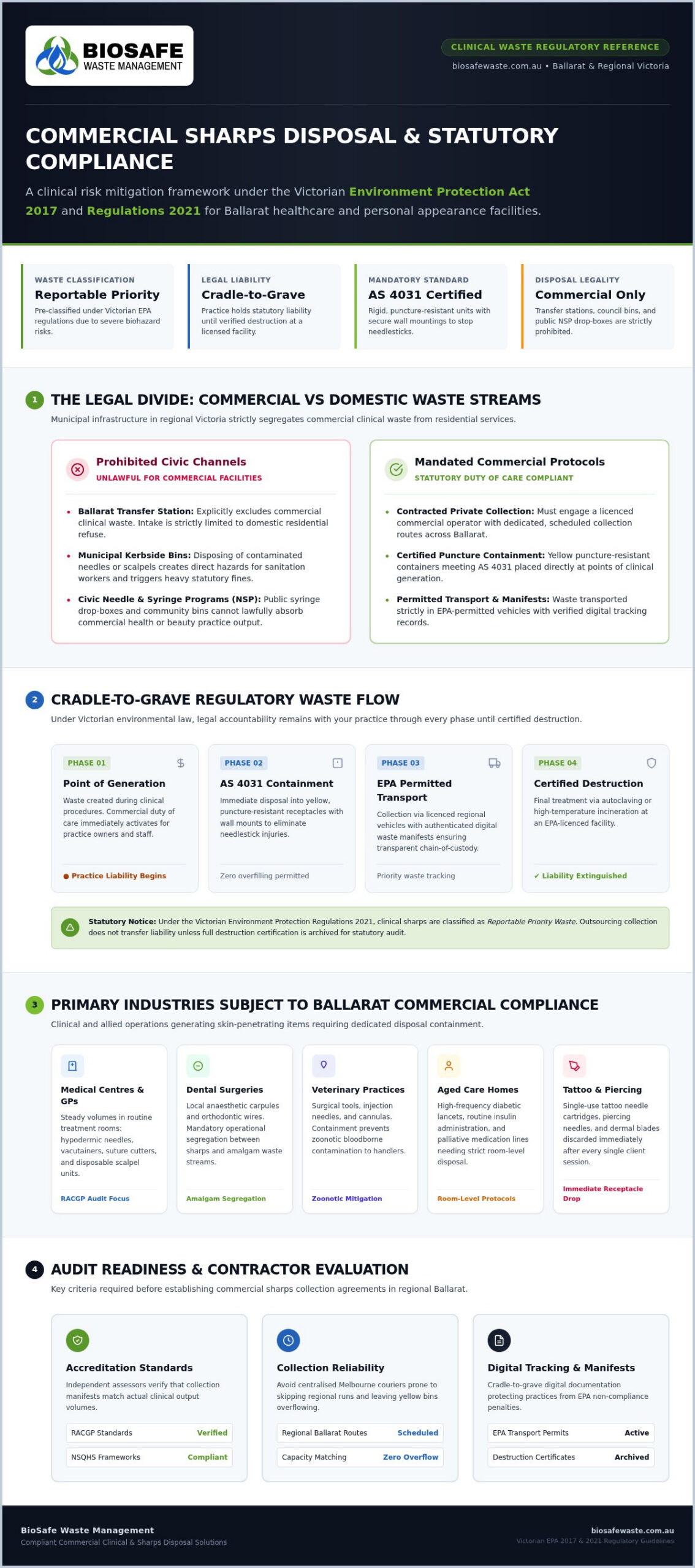
Operating a professional healthcare or personal appearance practice involves strict legal accountability that sets commercial operators apart from the general public. While residential syringe drop-boxes exist throughout the region, commercial facilities cannot lawfully dispose of generated biohazardous items in public community bins, civic needle and syringe programs (NSP), or local council amenities. Clinical enterprises must contract dedicated private collection services to maintain safe operations.
Under Victorian workplace health and safety laws, business owners hold an active duty of care toward staff, patients, and contractors. This statutory obligation covers all discarded clinical items capable of cutting or penetrating the skin. The handling of contaminated sharps waste requires rigid containment in certified, puncture-resistant units, followed by transportation in permitted vehicles and verified treatment through autoclaving or high-temperature incineration.
The Legal Divide: Commercial vs Domestic Waste Streams
Municipal infrastructure across regional Victoria is deliberately segregated by waste classification. The Ballarat Transfer Station explicitly excludes commercial clinical waste, restricting its intake solely to domestic residential rubbish. Disposing of contaminated needles or scalpel blades inside municipal kerbside bins presents serious contamination hazards for council sanitation crews and triggers severe financial penalties under Victorian environmental law.
Healthcare auditing frameworks, including RACGP standards and National Safety and Quality Health Service (NSQHS) accreditations, mandate clear verification of waste handling. Independent assessors regularly review commercial collection manifests to confirm that ongoing collection runs match the clinical volumes produced on site. Without contracted collection logs, practices face formal accreditation failures during regular site audits.
Primary Industries Subject to Commercial Compliance in Ballarat
Sourcing dependable sharps disposal Ballarat services is mandatory across several clinical and allied disciplines:
- General practice and medical centres: Routine treatment rooms generate steady volumes of hypodermic needles, vacutainer needles, suture cutters, and disposable scalpel units requiring routine containment.
- Dental surgeries: Practitioners manage local anaesthetic carpules and orthodontic wires, demanding clear operational segregation between standard clinical sharps and amalgam waste streams.
- Veterinary practices and hospitals: Surgical tools, injection needles, and cannulas must be contained securely to protect clinical handlers from zoonotic bloodborne contamination.
- Aged care and residential homes: Facilities handling diabetic lancets, routine insulin administration, and palliative medication lines require strict room-level disposal protocols.
- Tattoo and skin penetration studios: Single-use tattoo needle cartridges, piercing needles, and dermal blades must be discarded into compliant yellow receptacles immediately following every client session.
Victorian EPA Regulatory Compliance: What Ballarat Facilities Must Know
Managing commercial clinical waste in regional Victoria requires navigating stringent environmental oversight. Under the Victorian Environment Protection Act 2017 and the subordinate Environment Protection Regulations 2021, clinical and related wastes are pre-classified as reportable priority waste. This classification reflects the elevated biological risk these materials pose to public health, sanitation personnel, and ecological systems.
A core tenet of this framework is cradle-to-grave legal liability. As a waste generator, your Ballarat practice maintains statutory responsibility for all discarded needles, scalpels, and contaminated materials from the moment they are generated until an EPA-licensed facility completes certified thermal treatment or autoclaving. Partnering with a fully permitted specialist ensures that routine sharps disposal Ballarat operations satisfy every regional inspection threshold.
Reportable Priority Waste Classification and Tracking
The Environment Protection Authority (EPA) Victoria enforces mandatory digital tracking protocols for priority biohazard streams under publication IWRG612 guidance. Transporting clinical sharps requires specialised vehicles operating under formal EPA transport permits. Handing your containers over to general freight couriers or unpermitted waste carriers constitutes a serious regulatory breach that risks significant institutional fines.
Compliant waste collection demands an unbroken chain of custody through digital consignment records. Whenever containers leave your clinic, your service provider must issue valid electronic waste tracking dockets capturing waste codes, consignor details, transport certificates, and final processing destinations. Maintaining these manifests on file guarantees seamless, audit-ready compliance during healthcare governance checks or impromptu environmental inspections.
Australian Standards for Sharps Containment: AS 4031 and AS/NZS 4261
Regulatory compliance begins directly inside your treatment rooms through rigid containment choices. Clinical sharps receptacles must strictly conform to Australian Standard AS 4031:1992 (for single-use containers) or AS/NZS 4261 (for reusable systems). These engineering benchmarks demand:
- Rigorous puncture resistance: Heavy-gauge polypropylene construction prevents accidental wall penetration by hyper-pointed needles or fine suture blades.
- Drop and tip-leak testing: Certified designs withstand physical impacts and sudden drops without shattering or spilling liquid contents.
- Tamper-resistant closures: Irreversible locking apertures prevent unauthorised access to discarded materials once filled.
- Prominent fill lines: Clear safety markings designate the statutory fill threshold (typically 80% capacity) to halt dangerous overfilling.
Clinical teams should also refer to our comprehensive guide on medical waste collection in Victoria to review complete protocols for handling non-sharps infectious waste and human tissue streams. If your practice requires verified documentation and dedicated regional pickups, you can connect directly with BioSafe Waste Management to inspect your current containment setup.
Evaluating Sharps Disposal Service Features and Container Options
Selecting appropriate clinical containment is not a generic administrative task; it directly affects daily infection control and procedural safety. Improperly sized bins often lead to dangerous overfilling, exposing clinical practitioners to preventable percutaneous injuries. Conversely, installing oversized units results in biohazard waste lingering in clinical rooms for months between scheduled collection intervals. A well-designed sharps disposal Ballarat program balances containment capacity directly with procedural turnover.
Specialised healthcare environments require tailored containment approaches. While standard clinical waste bins handle routine injection equipment, facilities managing chemical contaminants require specific stream segregation. Reviewing dedicated protocols for dental waste management demonstrates how amalgam-tainted sharps and chemical capsules must be isolated from standard biological sharps to comply with Victorian environmental guidelines.
Selecting the Right Container Volume for Your Practice
Containment hardware should match the exact physical profile and generation rate of your procedural spaces:
- 1.4-litre to 3-litre units: Suited for dental operatories, phlebotomy benches, vaccination clinics, and allied consulting suites. These units maintain a small spatial footprint while safely holding fine-gauge needles, suture cutters, and blood lancets.
- 5-litre to 10-litre containers: Engineered for veterinary examination rooms, skin biopsy surgical suites, and busy medical treatment rooms handling larger volumes of disposable syringes, butterfly needles, and cannulas.
- 20-litre floor or bracket units: Built for multi-chair tattoo studios, day surgery recovery bays, and pathology testing laboratories generating substantial volumes of single-use procedural equipment.
- Specialised wide-aperture receptacles: Feature engineered lid openings that allow touch-free scalpel blade ejection directly from reusable handles, eliminating manual disarming risks.
Safety Engineering: Wall Brackets and Final Locking Mechanisms
Receptacle positioning directly influences workplace incident rates. Puncture-resistant sharps containers should never rest loose on treatment trays, low benchtops, or floors where they can be knocked over during emergencies. Heavy-duty lockable wall brackets secure containers between 1.2 and 1.5 metres above floor level, keeping the drop aperture clearly within the operator’s line of sight while preventing unauthorised removal by patients or visitors.
Certified AS 4031 units feature dual-action lid mechanics designed for distinct operational phases. The temporary day closure seals the aperture between patient procedures, containing aerosols and preventing items from falling out if bumped. Once the internal waste reaches the designated fill line, staff engage the irreversible final perimeter lock. This permanently seals the aperture, ensuring the unit is safe for collection, handling, and compliant transport without risk of clinical exposure.
How to Choose the Best Sharps Collection Partner in Ballarat
Regional clinical providers face distinct operational hurdles when selecting a commercial waste partner. National conglomerates often treat regional routes as an afterthought, leading to cancelled services and communication breakdowns. Selecting a partner for sharps disposal Ballarat practices can rely on requires systematic vetting against practical clinical criteria.
Establishing dependable sharps management comes down to five fundamental checkpoints:
- Permit verification: Current Victorian EPA transportation authorisations covering reportable priority biohazardous waste streams.
- Documented chain of custody: Provision of digital tracking dockets confirming pickup, transit, and licensed thermal treatment.
- Local route stability: Established, regular collection runs throughout Ballarat and surrounding regional postcodes.
- Contractual transparency: Clear, itemised invoicing without disguised administrative fees or punitive rollover terms.
- Clinical sector expertise: Trained drivers who understand clinical segregation protocols, spill control, and AS 4031 standards.
Vetting Provider Licensing, Tracking, and Compliance Credentials
Never assume every waste carrier possesses the legal permissions required for clinical materials. Transporting infectious needles requires designated vehicle permits issued by EPA Victoria. Ask prospective providers for proof of carrier permissions, comprehensive public liability insurance, and formal driver handling certifications. Many regional medical practices look at the standards set by proven sharps disposal services in Melbourne to benchmark the level of regulatory rigor their regional contractor should supply.
Collection Frequency and Route Reliability Across Greater Ballarat
A compliant collection schedule should match your practice volume rather than an arbitrary calendar date. Whether your facility produces two litres of lancets a month or twenty litres of procedural needles a week, service intervals must prevent overflowing receptacles. Your haulier must maintain stable service runs servicing Ballarat Central, Lucas, Wendouree, Sebastopol, Delacombe, and Alfredton. Verify their capacity to deliver replacement containers during unexpected procedural surges or flu vaccination clinics.
Contract Terms: Flexibility, Direct Billing, and Zero Hidden Surcharges
Generic waste contracts frequently bundle confusing line items, such as environmental compliance levies, docket fees, and automated multi-year renewals. A trustworthy partner operates on transparent terms with straightforward billing for container supply, collection, and destruction. When you need direct communication with real people rather than an offshore call centre, request a tailored service proposal from BioSafe Waste Management to secure dependable collection for your facility.
Setting Up Your Commercial Sharps Disposal Service with BioSafe
Establishing an efficient collection workflow should eliminate operational stress rather than introduce administrative burdens. BioSafe Waste Management provides structured, compliant sharps disposal Ballarat facilities rely on to keep daily clinical practice safe, orderly, and fully aligned with state mandates. Our regional infrastructure supports medical centres, dental practices, veterinary clinics, aged care homes, NDIS accommodation providers, and professional tattoo studios throughout the Central Highlands.
Every service run operates on a direct replacement framework. When our trained personnel remove sealed containers, they immediately supply fresh, puncture-resistant yellow bins certified to AS 4031 and AS/NZS 4261. This seamless container exchange guarantees your clinical staff never face an interim period without compliant disposal receptacles.
Step-by-Step Onboarding: From Initial Site Audit to First Pickup
Getting your practice fully operational follows a simple three-step setup:
- Clinical volume assessment: Our team reviews your procedure rates, treatment room count, and generation profile to determine optimal container capacities and exchange intervals.
- Containment and hardware delivery: We provide puncture-proof yellow units alongside lockable wall brackets, ensuring receptacles are installed at ergonomic heights away from public touchpoints.
- Roster integration: Your collection schedule is locked into our regular Ballarat transport routes, guaranteeing consistent pickup days that integrate smoothly with your practice rhythm.
Seamless Collection Day Protocols and Waste Documentation
On scheduled collection days, our licensed drivers carry out direct, room-to-vehicle container swaps. This professional approach prevents treatment interruptions, protects patient dignity, and eliminates the risk of contaminated receptacles being transported through public waiting rooms. Our staff follow strict infection control handling guidelines throughout every transfer.
Regulatory compliance completes instantly at the point of exchange. We provide compliant electronic waste tracking manifests directly to your practice administration, detailing container counts, waste classifications, transit confirmation, and approved destruction routing. These digital logs remain readily accessible for healthcare accreditation audits and EPA inspections without cumbersome paper filings. Ready to protect your practice and staff? Partner with BioSafe Waste Management today to schedule dependable clinical collection for your facility.
Securing Compliant Clinical Waste Operations for Your Practice
Safe sharps handling protects your workplace, upholds your professional reputation, and satisfies strict Victorian duty-of-care obligations. Transitioning to a dedicated commercial partner removes the daily hazards of container overfilling and eliminates guesswork surrounding reportable priority waste documentation. With cradle-to-grave tracking manifests generated at every service run, your clinic maintains perpetual audit readiness.
BioSafe Waste Management supports healthcare and personal appearance providers across Central Ballarat, Wendouree, Delacombe, and surrounding districts with punctual, permitted collection services. Every exchange supplies puncture-resistant yellow sharps containers certified to AS 4031 and AS/NZS 4261, keeping your procedure rooms fully equipped without administrative interruption. Choosing a dependable regional partner ensures your sharps management operates smoothly in the background, allowing your clinical team to focus entirely on patient care.
Take the step to simplify your regulatory compliance today. Request a tailored Ballarat sharps collection quote from BioSafe Waste Management to implement a dependable, compliant collection schedule designed around your facility’s exact needs.
Frequently Asked Questions
Can commercial medical practices dispose of sharps at Ballarat transfer stations or pharmacies?
No, commercial enterprises cannot lawfully utilise municipal transfer stations or public pharmacy drop-off boxes. The Ballarat Transfer Station explicitly rejects commercial waste, and civic needle exchange points are reserved strictly for public harm reduction. Healthcare and personal care businesses must engage a licensed private contractor to maintain statutory duty of care and protect council sanitation workers from uncontrolled biohazardous exposure.
What Australian Standards must commercial sharps bins meet in Victorian healthcare facilities?
Receptacles must comply with Australian Standard AS 4031:1992 for single-use containers or AS/NZS 4261 for reusable units. These standards mandate thick-walled, puncture-resistant polypropylene plastic, robust leak-proof construction, and clear drop-test certifications. Units must also feature high-visibility yellow colouring, prominent biological hazard symbols, a legible statutory fill line, and an irreversible final locking lid mechanism to prevent accidental opening.
How frequently should commercial sharps containers be collected from my Ballarat clinic?
Collection schedules depend entirely on your practice volume and clinical risk management profile. High-output facilities like day surgeries, pathology centres, and busy multi-practitioner clinics often need weekly or fortnightly exchanges. Smaller providers, such as consulting suites or dental clinics, typically schedule monthly or bi-monthly services. Reliable providers of sharps disposal Ballarat practices contract will adjust collection schedules to match actual waste output.
What happens if a sharps container exceeds its marked maximum fill line?
Filling containers past the indicated line creates severe percutaneous injury hazards and breaches Victorian workplace safety regulations. Protruding needles prevent the temporary aperture cover and irreversible perimeter lock from latching securely. If a container becomes overfilled, staff must never attempt to push contents downward or transfer items manually. Instead, place the entire container inside a larger, secondary puncture-resistant clinical container and schedule an urgent pickup.
Is digital EPA waste tracking mandatory for small dental or veterinary clinics in Victoria?
Yes, all commercial generators of clinical sharps must comply with Victorian Environment Protection Authority tracking rules. Under the Environment Protection Regulations 2021, clinical and related wastes are pre-classified as reportable priority wastes regardless of practice size. Licensed waste transporters must issue electronic waste tracking dockets capturing precise consignor information, transport permits, and downstream treatment facility details to confirm compliant destruction.
Can tattoo studios and skin clinics establish commercial sharps collection contracts in Ballarat?
Yes, professional tattoo studios, body piercers, and cosmetic skin clinics must establish commercial collection contracts under Victorian public health regulations. Any business performing skin penetration procedures that generates single-use needle cartridges, dermal blades, or piercing tools has a legal duty to isolate biohazardous items. BioSafe Waste Management provides specialised container supply and scheduled exchange routes designed specifically for personal appearance studios across Ballarat.
How does BioSafe Waste Management manage sharps bin replacement during scheduled collections?
BioSafe operates a seamless one-for-one container exchange system directly inside your clinical rooms. When our licensed service personnel remove sealed, full sharps receptacles from their brackets, they instantly supply and mount fresh, AS 4031 compliant yellow containers in their place. This scheduled exchange protocol ensures uninterrupted clinical containment across your practice while our driver immediately generates your digital EPA tracking manifest.