
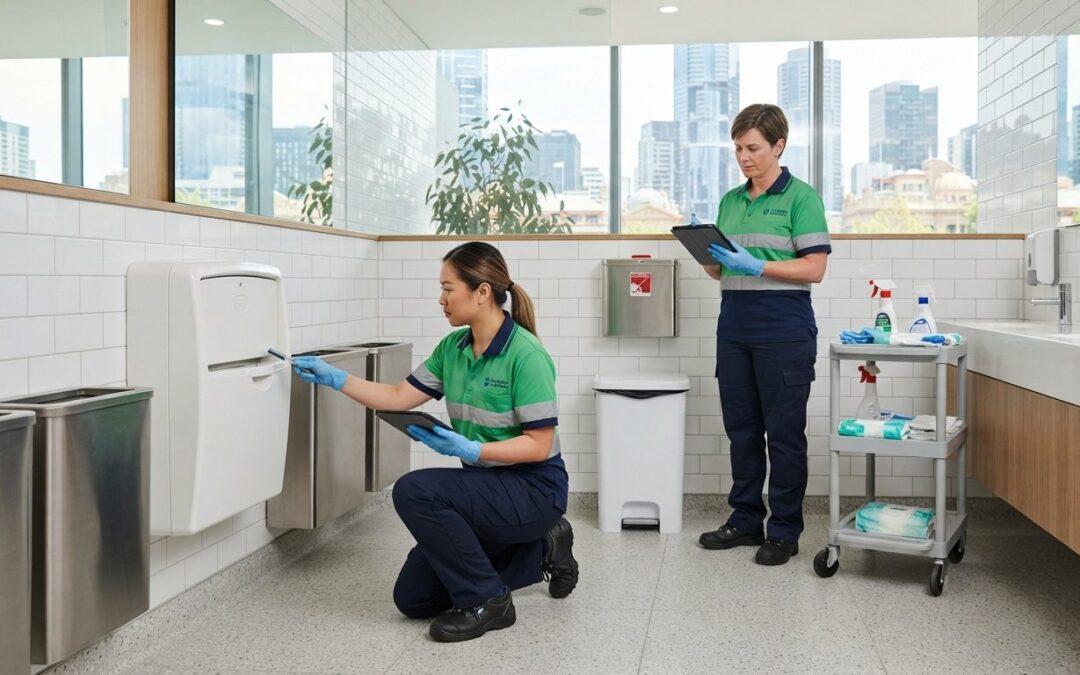
Treating washroom sanitary units as mere janitorial accessories rather than essential infection-control infrastructure creates genuine operational and health risks for your workplace. For facility managers and employers across Victoria, maintaining washrooms often involves frustrating challenges, from persistent odours and plumbing blockages to unreliable contractors who miss scheduled collection rotations. Professional sanitary hygiene services are not simply a standard cleaning expense; they represent a regulated duty of care under Victorian safety standards to protect your staff and visitors from biohazard exposure.
You shouldn’t have to second-guess your legal obligations under WorkSafe Victoria compliance codes or the EPA General Environmental Duty. In this guide, you will discover what compliant sanitary hygiene services involve, why strict servicing cycles safeguard your facility, and how to partner with an accredited waste provider. We examine standard hardware types, practical collection frequencies, and the exact compliance measures needed to keep your commercial facilities dignified, safe, and fully audit-ready.
Key Takeaways
- Understand your exact compliance obligations under Victorian OHS legislation and the EPA General Environmental Duty to protect staff and avoid regulatory exposure.
- Discover why engaging professional sanitary hygiene services mitigates workplace infection risks that general office cleaning arrangements cannot safely manage.
- Learn the necessary equipment benchmarks and cubicle ratios required across clinical environments, corporate settings, and accessible facilities.
- Examine the mechanics of scheduled on-site servicing to ensure zero operational disruption or hygiene compromises for your patrons.
- Identify the core criteria for choosing an accredited, integrated waste contractor capable of managing both sanitary and clinical waste streams reliably.
What Are Sanitary Hygiene Services in Modern Workplaces?
Professional sanitary hygiene services encompass the structured containment, scheduled collection, and licensed disposal of washroom sanitary waste. While often grouped under general building maintenance, managing feminine hygiene units requires specialised clinical handling to isolate biological material effectively. Providing dedicated containment in commercial washrooms supports baseline menstrual hygiene management standards, offering users a private, safe space to dispose of personal items. Without dedicated receptacles, users routinely resort to flushing pads and tampons. This practice causes severe plumbing blockages, costly emergency drainage repairs, and structural overflow issues across commercial sewer infrastructure.
Modern hygiene solutions have evolved significantly beyond static containers. High-traffic environments increasingly utilise automated, sensor-driven systems designed to mitigate contact risk while ensuring complete regulatory adherence.
The Scope of Commercial Sanitary Waste Management
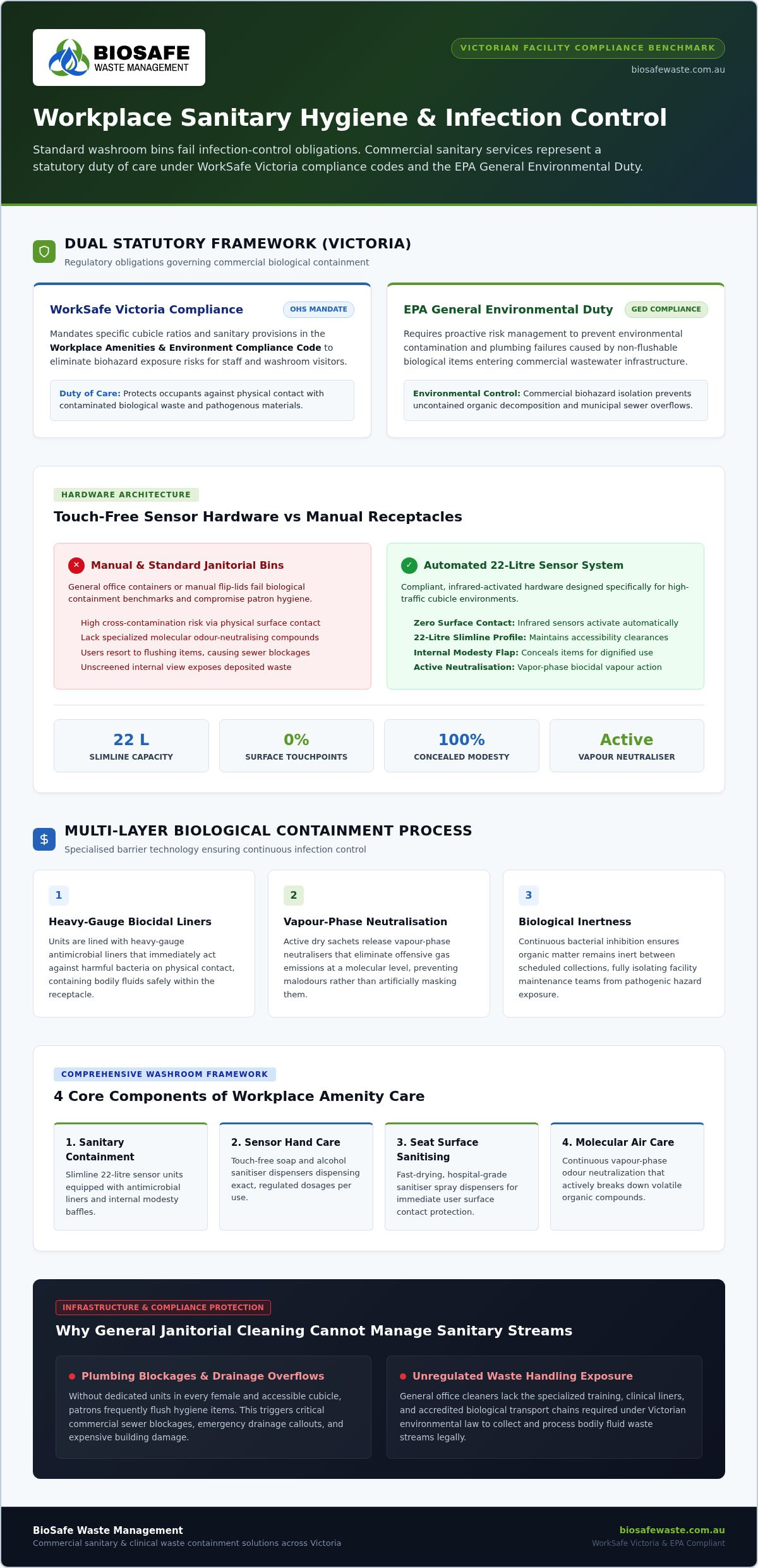
Commercial sanitary waste carries specific compliance duties under Victorian environmental and occupational health frameworks. Unlike standard municipal office refuse, hygiene waste contains biological matter that requires controlled containment to prevent microbial exposure. Professional contractors line dedicated units with heavy-gauge, antimicrobial liners treated with vapour-phase odour neutralisers. These active sachets continuously inhibit bacterial growth, eliminate offensive gas emissions at a molecular level, and ensure the waste remains inert between collection cycles.
Touch-Free Sanitary Units vs Manual Bins
Washroom design continues to shift toward hands-free operation to break chains of surface cross-contamination. Foot-pedal units provide adequate physical isolation, yet infrared sensor-activated bins deliver a superior hygiene baseline:
- Zero Surface Contact: Sensor units open automatically upon hand proximity, completely eliminating physical touchpoints in high-traffic cubicles.
- Minimised Microbial Transfer: Touchless disposal prevents the spread of pathogens between successive washroom patrons.
- Ergonomic, Slimline Profiles: Standard 22-litre slimline enclosures fit neatly beside modern toilet suites without encroaching on required accessibility clearances.
- Discreet Internal Flaps: Built-in modesty flaps obscure previously deposited contents from view, maintaining a clean, dignified presentation.
Deploying dedicated, hands-free hardware ensures commercial washrooms remain clean, functional, and fully protective of employee dignity throughout daily operational cycles.
Essential Components of a Complete Washroom Hygiene Solution
A comprehensive workplace hygiene program extends well beyond standalone sanitary bins. Establishing total cubicle care demands an integrated framework of containment, hand sanitisation, and targeted infection control. Facility managers across Victoria must align these provisions directly with the statutory benchmarks outlined in the WorkSafe Victoria workplace facilities compliance code. Implementing cohesive hardware configurations ensures everyday hygiene, legal compliance, and user confidence across high-traffic environments.
Sanitary Disposal Units and Liners
Effective cubicle sanitation relies on specialised containment hardware designed for compact spaces. Slimline sanitary units fit beside modern plumbing fixtures without obstructing accessible movement. Inside each unit, heavy-duty biocidal liners actively neutralise harmful bacteria on contact. Specialized vapour-phase deodorising granules combat malodour continuously throughout the service cycle, breaking down offensive gases rather than merely masking them with heavy fragrances.
Hand Hygiene, Surface Sanitising, and Air Care
Maintaining high hygiene standards requires consistent touchpoint sanitisation across the entire amenity space:
- Automated Soap and Sanitiser Dispensers: Wall-mounted, sensor-activated units deliver precise measures of antibacterial soap or alcohol sanitiser without requiring manual touch.
- Toilet Seat Sanitiser Sprays: Dedicated cubicle spray dispensers allow users to clean contact surfaces directly with fast-drying, hospital-grade sanitising fluid.
- Continuous Air Freshening Units: Programmable micro-burst dispensers release neutralising formulations that destroy airborne malodour molecules at the source.
Specialised Clinical and Healthcare Washroom Needs
Clinical settings face heightened biohazard risks requiring specific waste segregation strategies. Dental practices, for example, must integrate dual protocols within patient facilities, pairing sanitary hygiene units with compliant sharps containers to address acute clinical risks. General healthcare clinics regularly coordinate certified medical waste collection Victoria to run seamlessly alongside standard washroom rotations, ensuring full tracking documentation across all streams. Aged care facilities and NDIS providers similarly require dedicated, larger-capacity containment solutions tailored specifically for incontinence and personal care items.
Managing multiple specialist waste streams under separate, fragmented suppliers frequently leads to missed service rotations and unnecessary administrative overhead. If your facility oversees complex clinical or personal hygiene waste requirements, partnering with an accredited specialist like BioSafe Waste Management provides fully compliant, scheduled collection cycles that keep your washrooms safe, orderly, and fully audit-ready.
Australian Regulations: Legal Duties for Victorian Employers
Victorian employers carry strict legal responsibilities regarding amenity standards and biological waste handling. Under the Occupational Health and Safety Act 2004 (Vic) (Section 21(2)(d)), duty holders must provide adequate facilities for employee welfare. A persistent misconception in commercial facility management is that internal office cleaners may simply empty sanitary receptacles into general waste bins. This practice exposes janitorial personnel to potential bloodborne pathogens and concealed sharps, generating immediate liability under WorkSafe Victoria enforcement frameworks. Contracting professional sanitary hygiene services safely transfers this risk through accredited, protective containment protocols.
Workplace sanitation duties are framed across state and federal boundaries. Victoria does not operate under harmonised national workplace safety laws, meaning local inspectors enforce state-specific compliance codes directly against your operational setup.
Safe Work Australia Compliance and Amenities Codes
National benchmarks outlined within Safe Work Australia’s Model Code of Practice for managing the work environment and facilities define baseline welfare expectations across Australian commercial operations. Victorian guidelines reflect these core tenets through distinct statutory mandates:
- Universal Cubicle Access: WorkSafe Victoria’s compliance code requires dedicated, hygienic disposal units inside all cubicles designated for female employees.
- All-Gender Provision: Facilities with 10 or fewer regular personnel operating a single unisex cubicle must equip that cubicle with a dedicated sanitary receptacle alongside hand-washing amenities.
- Accessible Toilet Standards: Accessible amenities designed under AS 1428.1 mandate permanent sanitary disposal hardware regardless of assigned user demographics.
- Worker Dignity: Codes emphasise secure, private access to clean disposal mechanisms, mitigating personal distress and public washroom contamination.
Environmental Protection and Chain of Custody
Managing hygiene waste extends past physical collection to strict environmental governance. Under Victoria’s Environment Protection Act 2017, commercial facilities are legally bound by the General Environmental Duty (GED) to minimise risks of harm to human health and the environment. Sanitary items must never enter stormwater drains, municipal sewers, or general recycling streams. Authorised waste service providers maintain licensed, climate-controlled transport vehicles to transfer biological materials safely to certified off-site treatment facilities. Standard industrial autoclaving and high-temperature thermal treatment render pathogens inert before final disposal. Each service cycle generates formal waste transfer documentation, providing facility managers with an indisputable audit trail confirming total statutory compliance.
How Scheduled Sanitary Servicing Works: Step-by-Step Logistics
Implementing a structured service contract removes the operational and hygienic burden of waste containment from internal workplace teams. Rather than requiring staff to handle biological waste, licensed technicians manage all on-site sanitisation during planned visits. Scheduled collection runs occur discreetly during ordinary operating hours, allowing commercial facilities to uphold infection control standards without disrupting tenants, clients, or patients. Technicians operate under clinical hygiene protocols, ensuring every receptacle is disinfected and secured systematically.
Professional sanitation involves methodical on-site servicing that protects the building environment from cross-contamination.
The On-Site Service and Sanitisation Process
Rather than wheeling soiled units through reception areas or shared corridors, technicians complete a precise four-step exchange process inside each cubicle:
- Discreet Arrival: The technician enters the washroom equipped with neutral carry modules, fresh consumable stocks, and hospital-grade cleaning supplies.
- Containment and Sealing: The technician unlocks the unit, removes the used biocidal liner, and hermetically seals the biological material inside puncture-resistant transport bags.
- Antimicrobial Wipe-Down: All external housing, internal chambers, and sensor mechanisms undergo a detailed clean with broad-spectrum disinfectant wipes.
- Recharging the Unit: A fresh biocide-treated liner is inserted, accompanied by a high-potency vapour-phase odour neutralising sachet to inhibit bacteria until the next cycle.
Determining the Right Service Frequency for Your Facility
Collection cycles must reflect actual footfall, facility type, and seasonal shifts. Standard corporate office environments typically maintain a four-weekly (monthly) collection rotation, which keeps waste levels within safe containment parameters. High-traffic settings, such as educational institutions, hospitality venues, and medical clinics, require fortnightly or weekly collections to avoid overfilling and prevent odour accumulation. Warmer summer temperatures also accelerate microbial activity, making higher collection frequencies necessary to maintain clean indoor air quality.
Establishing an appropriate servicing schedule protects your staff, simplifies compliance audits, and prevents washroom failures. To secure a dependable hygiene routine for your workplace, arrange a compliant sanitary hygiene service schedule with BioSafe Waste Management today.
Selecting a Reliable Sanitary Hygiene Partner in Victoria
Selecting an accredited contractor directly safeguards both your staff welfare and commercial reputation. Rather than relying on multi-tiered sub-contractors or generic janitorial firms, Victorian facility managers benefit most from specialised providers who understand local regulatory enforcement. Engaging a provider that manages integrated biological waste streams avoids the administrative fatigue of balancing disparate collection schedules. A dedicated local partner delivers dependable servicing rotations, transparent chain-of-custody documentation, and rapid resolution when unexpected operational demands arise.
Carefully vetting a provider’s operational credentials guarantees long-term compliance and protects your premises from preventable safety incidents.
Key Criteria When Evaluating Washroom Service Providers
When assessing prospective hygiene partners across Victoria, facility operators should focus on core operational capabilities:
- Transparent Digital Tracking: Reliable operators provide electronic service confirmation and waste transfer dockets immediately upon visit completion, establishing an audit-ready chain of custody.
- Hardware Durability: Bins must feature commercial-grade construction, antimicrobial finishes, and reliable hands-free sensor or foot-pedal mechanisms that hold up under heavy use.
- Vetted Field Personnel: Technicians must be thoroughly trained in infection control protocols and undergo formal background checks before servicing private facilities.
- Rapid Operational Support: A quality contractor maintains responsive communication channels to address emergency maintenance, hardware repairs, or out-of-cycle collections without delay.
Consolidating Sanitary and Clinical Waste Collections
Facilities operating in the healthcare and allied health sectors face complex compliance demands that standard washroom suppliers cannot satisfy. Dental surgeries, for example, streamline their vendor management by pairing everyday cubicle care with compliant dental waste management Victoria. Similarly, general medical clinics and pathology centres gain substantial efficiency by scheduling their feminine hygiene rotations alongside dedicated sharps disposal services melbourne.
BioSafe Waste Management serves as a trusted local partner across Victoria, providing certified sanitary hygiene services alongside comprehensive clinical disposal solutions. Consolidating these waste streams under a single accredited provider eliminates duplicate transport fees, simplifies reporting for statutory inspections, and ensures all biological materials are handled strictly within Victorian EPA guidelines.
Securing Long-Term Washroom Compliance for Your Workplace
Maintaining high amenity standards under WorkSafe Victoria and the EPA General Environmental Duty protects staff welfare, prevents plumbing emergencies, and upholds facility dignity. Relying on specialised sanitary hygiene services ensures biological waste is contained, sanitised, and safely transported off-site without burdening internal cleaning staff or exposing your business to regulatory liability.
Partnering with an accredited contractor gives facility managers complete peace of mind through transparent chain-of-custody documentation and dependable on-site care. BioSafe Waste Management provides reliable, discreet collection schedules across Melbourne and regional Victoria. As an integrated provider managing sanitary, clinical, and sharps waste streams under one roof, our team ensures your operations remain fully compliant with EPA Victoria and Safe Work Australia standards. Request a tailored sanitary hygiene quote for your Victorian facility to establish a safer, audit-ready washroom environment today.
Frequently Asked Questions
Is it a legal requirement to have sanitary bins in Australian workplace toilets?
Yes, Australian employers are legally required to provide dedicated sanitary disposal units in workplace toilets. Under WorkSafe Victoria compliance codes and Safe Work Australia model codes, all female and all-gender cubicles must contain an adequate and hygienic means of disposing of sanitary items. Accessible toilets built to Australian Standards also mandate these units. Failing to supply dedicated disposal hardware breaches statutory employer obligations regarding workplace welfare and infection control.
Can regular office cleaners legally empty and dispose of sanitary bin waste?
Standard office cleaners should not empty sanitary bins into general municipal waste. Doing so exposes janitorial staff to potential bloodborne pathogens and concealed sharps, generating clear liability under Victorian occupational health and safety laws. Regulated hygiene waste must be handled by trained technicians using biocidal liners and transported via licensed disposal routes, ensuring biological materials are processed at certified facilities rather than entering municipal landfill streams.
How often should commercial sanitary hygiene bins be serviced?
Standard commercial offices typically require a four-weekly collection schedule to maintain compliant sanitation. High-footfall environments, including healthcare clinics, educational facilities, and hospitality venues, generally require fortnightly or weekly rotations to prevent overflow and malodour. In hotter Victorian summer months, facilities often increase service frequency because warmer ambient temperatures accelerate microbial activity and bacterial gas release inside cubicles.
What is the difference between manual, pedal, and automatic sanitary units?
The primary difference lies in the contact mechanism and infection control standard. Manual units require users to lift the lid by hand, creating significant cross-contamination risks. Foot-pedal units eliminate hand contact through a mechanical base lever. Automatic units utilise infrared proximity sensors to open touch-free as hands approach, offering the highest hygienic barrier against pathogen transfer in modern commercial washrooms.
How do sanitary hygiene services prevent washroom odours and bacterial spread?
Professional sanitary hygiene services prevent odour and microbial proliferation through multi-layered chemical and physical controls. Licensed technicians install heavy-duty antimicrobial liners paired with vapour-phase deodorising sachets inside each unit. These active formulations continually neutralise airborne volatile compounds and suppress bacterial reproduction between service cycles. Regular physical wipe-downs using hospital-grade disinfectants eliminate external surface pathogens that cause persistent washroom malodour.
Can commercial sanitary waste be flushed down the toilet using macerators?
No, sanitary items must never be flushed into commercial plumbing, even if macerators are installed. Modern pads and tampons contain dense synthetic fibres and super-absorbent polymers designed to expand rather than disintegrate in water. Disposing of these items down sewer lines causes catastrophic plumbing blockages, pump station failures, and environmental contamination that violates Victorian EPA discharge regulations and local water authority bylaws.
Can our business combine sanitary hygiene services with clinical and sharps disposal?
Yes, businesses can consolidate washroom hygiene management with clinical and sharps waste under a single service contract. BioSafe Waste Management provides integrated collection routines across Victoria, catering directly to medical practices, dental clinics, veterinary surgeries, and aged care environments. Bundling your sanitary hygiene services with certified sharps and biohazard waste collection streamlines site logistics, reduces administrative overhead, and provides unified compliance documentation for regulatory audits.