
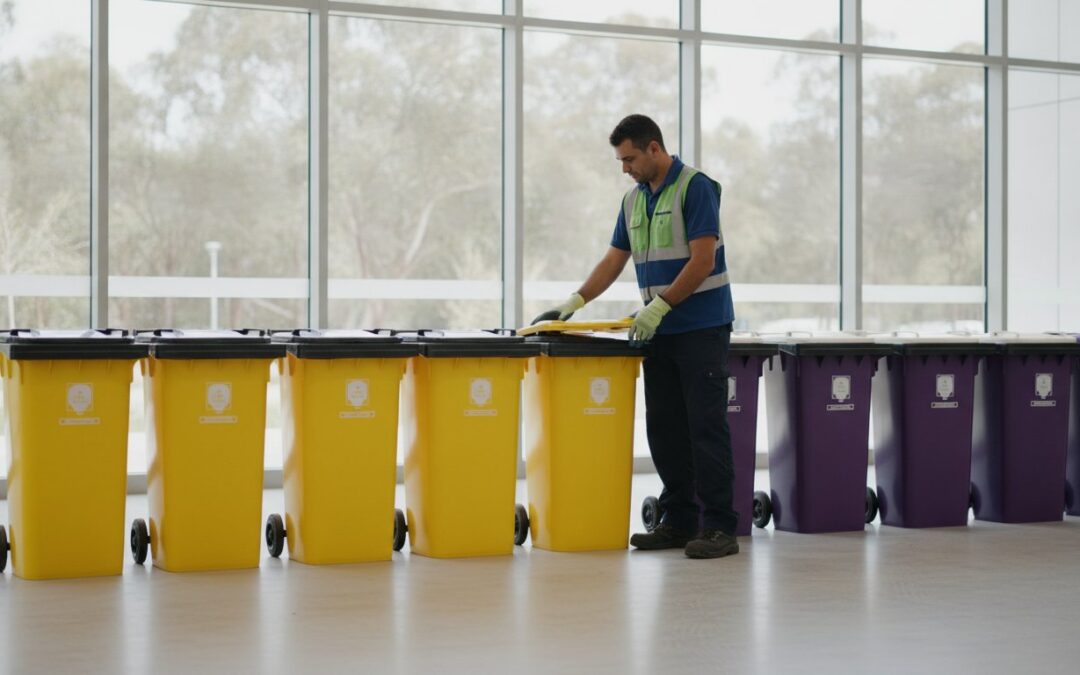
A corporate fine of up to $2.03 million for improper waste disposal isn’t just a theoretical threat; it’s a legal reality under Victoria’s current Environment Protection Act. For healthcare providers and facility managers, the pressure to maintain perfect compliance with clinical waste bin requirements Victoria while ensuring staff safety during sharps handling can be a significant source of professional anxiety. You likely feel the weight of responsibility that comes with managing “Priority Waste” and the constant concern that a single segregation error could lead to a failed EPA audit. It’s understandable to feel overwhelmed by the technicalities of the digital Waste Tracker system or the meticulous standards required for hazardous materials.
This guide provides professional clarity and restores your confidence. We’ll outline the essential differences between yellow colour-coded bins and purple cytotoxic containers, explain the updated AS 23907:2023 standards for sharps injury protection, and provide a clear roadmap for meeting your General Environmental Duty. By following these protocols, you can establish a streamlined process for waste collection that protects your staff, your patients, and your facility’s standing with the regulators. This methodical approach ensures your organisation remains a safe and compliant environment for everyone.
Key Takeaways
- Understand your legal duty under the Environment Protection Act 2017 to manage clinical waste as ‘Priority Waste’ throughout its entire lifecycle.
- Ensure all containers meet the latest Australian Standards, specifically the puncture-resistance and safety requirements of AS 23907:2023 for sharps.
- Identify how to meet the clinical waste bin requirements Victoria enforces for different waste streams, ensuring your facility remains compliant and audit-ready.
- Implement rigorous segregation and labelling protocols within your clinical zones to prevent cross-contamination and protect staff from handling risks.
- Reduce your administrative burden by utilising managed bin exchange services that integrate seamlessly with the Victorian EPA’s digital Waste Tracker.
Understanding Clinical Waste Bin Requirements in Victoria
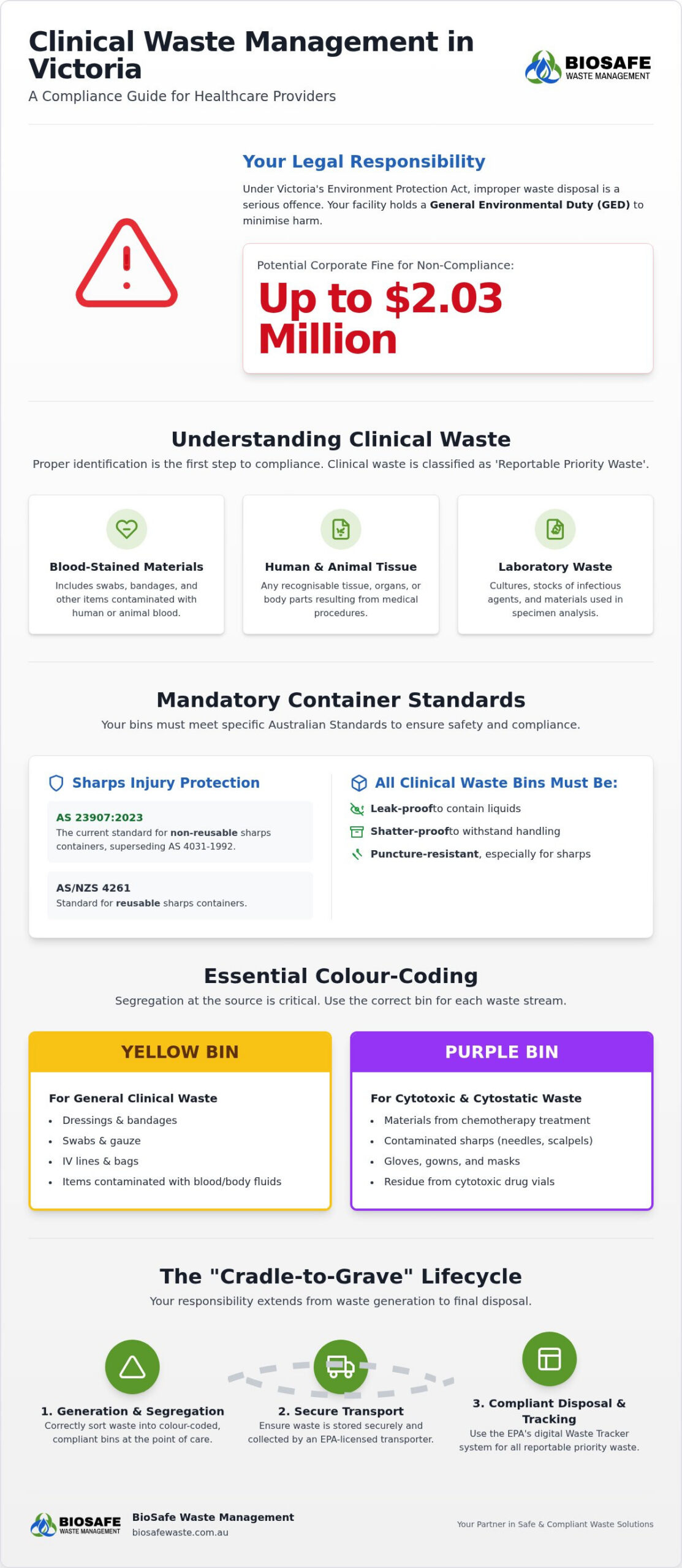
Adherence to clinical waste bin requirements Victoria is a foundational legal obligation for every healthcare provider. Under the Environment Protection Act 2017, practitioners and facility managers carry a General Environmental Duty (GED). This duty requires you to take all reasonably practicable steps to minimise risks of harm to human health and the environment. Because clinical waste is inherently hazardous, your choice of containment is the first line of defence against contamination and injury. Failure to maintain these standards is a serious matter; corporations can face fines of up to $2.03 million for improper disposal or breaching their environmental duties.
What Qualifies as Clinical Waste in 2026?
Victorian regulations distinguish clinical waste from related and general waste streams to ensure specialised handling. Clinical waste includes any waste that has the potential to cause disease, such as blood-stained materials, human tissue, and laboratory waste. In Victoria, clinical waste is formally classified as ‘reportable priority waste’, requiring rigorous tracking and specialised containment. For practitioners seeking a broader context on global management standards, Understanding Clinical Waste provides a baseline for how these materials are categorised internationally. Whether you are managing a veterinary surgery, a tattoo studio, or an aged care facility, you must ensure that only appropriate materials enter the clinical waste stream to avoid unnecessary costs and safety risks.
The Legal Framework: EPA Victoria and the Health Department
The Environment Protection Regulations 2021 serve as the primary legal instrument governing bin management in Victoria. These regulations work in tandem with the Victorian Department of Health’s infection control guidelines. While the Health Department focuses on patient and staff safety within the clinical setting, the EPA focuses on the “cradle-to-grave” responsibility of the waste generator. This means your responsibility doesn’t end when the waste leaves your door. You must ensure that your bins are fit for purpose, correctly labelled, and stored securely until an EPA-licensed transporter collects them.
The GED applies directly to your waste bins and storage areas. In 2026, the EPA continues to utilise the digital Waste Tracker system to monitor the movement of all priority waste. Non-compliance doesn’t just invite financial penalties; it creates physical safety risks, such as needle-stick injuries or environmental leaks, that can damage your facility’s professional standing. Maintaining a compliant bin system is a quiet but essential part of running a responsible medical or care centre. For a comprehensive overview of the 2026 tracking requirements and precise segregation techniques, our guide on infectious waste disposal Victoria healthcare providers rely on offers detailed professional guidance.
Victorian Regulatory Standards for Healthcare Bins
Adhering to clinical waste bin requirements Victoria demands a precise understanding of the physical specifications for waste containers. It’s not enough for a bin to be yellow; it must be engineered to withstand the rigours of the healthcare environment without risk of rupture. Victorian law mandates that all clinical waste containers be leak-proof, shatter-proof, and puncture-resistant. These structural requirements ensure that hazardous materials, including blood-borne pathogens and chemical residues, remain contained during both on-site storage and transit to a disposal facility.
Australian Standards: AS 23907:2023 and AS/NZS 4261
When procuring containers, you must verify they meet specific Australian Standards. For sharps, the industry has transitioned to AS 23907:2023, which focuses on sharps injury protection and supersedes the older AS 4031-1992 standard. This updated standard applies to non-reusable sharps containers, ensuring they can’t be easily punctured by needles or scalpels. If your facility utilises reusable sharps systems, they must comply with AS/NZS 4261. You can identify compliant bins by looking for the standard number clearly embossed or printed on the container’s exterior. Using non-compliant bins, even if they appear sturdy, is a breach of your safety obligations and can lead to significant liability if a staff member is injured.
EPA Victoria’s Priority Waste Duties
Your role as a ‘waste generator’ under the Environment Protection Act 2017 involves more than just filling a bin. You have a legal duty to take reasonable steps to ensure your waste reaches a lawful place. This means you must only engage EPA-licensed transporters to move your clinical waste. The EPA’s digital Waste Tracker system is the primary tool for this oversight. Every movement of reportable priority waste must be recorded in this system, providing a digital paper trail from your clinic to the final treatment centre.
Maintaining meticulous documentation is essential for passing an EPA audit. You should keep records of your waste types, volumes, and collection frequencies, as detailed in the Victorian Regulatory Standards for clinical waste management. A professional waste management partner can help automate this tracking process, ensuring your data is always accurate and available. By standardising your equipment and collection schedule, you reduce the risk of administrative errors that often lead to regulatory scrutiny. This systematic approach ensures your facility operates with the quiet confidence that comes from total compliance.
Choosing the Right Bin: A Healthcare Buyer’s Guide
Selecting the correct hardware is a practical extension of your General Environmental Duty. To meet the clinical waste bin requirements Victoria mandates, you must match the container to the specific waste stream generated in your treatment rooms. This isn’t just about colour-coding; it’s about ensuring the physical capacity and safety features of the bin align with your daily operational risks. Whether you’re managing a high-turnover tattoo studio or a quiet dental clinic, your bin selection dictates how effectively you protect your staff from accidental exposure.
Yellow Bins vs. Sharps Containers vs. Cytotoxic Waste
Yellow clinical waste bins are the standard for infectious materials. For soft waste like dressings or gloves, heavy-duty yellow bags within a foot-operated bin are often sufficient. However, if the waste contains fluids or heavy saturation, a rigid yellow container is necessary to prevent leakage. Sharps disposal requires even greater precision. You must select a container with an aperture that matches your tools. A wide-access lid is essential for scalpels, while a needle-detaching notch is safer for syringe-heavy practices. If your clinic handles oncology drugs or certain hormonal therapies, purple cytotoxic bins are mandatory. These ensure that chemically active wastes are segregated for high-temperature incineration, distinct from standard clinical waste treatment.
Sizing Your Waste Volume for Collection
Bins range from compact 1-litre sharps units for mobile practitioners to 240-litre clinical wheelie bins for high-volume hospitals or aged care centres. To estimate your needs, track your waste output over a typical seven-day period. Most small clinics find that a 120-litre bin collected fortnightly balances cost and hygiene. Larger facilities often require multiple 240-litre bins with weekly collections to prevent overfilling. It’s a risk to choose a bin that is too small. Overfilled bins prevent lids from sealing correctly, which is a direct breach of Victorian safety standards. Conversely, a bin that is too large may sit for too long, leading to odour issues and potential bacterial growth.
Specialised industries have unique needs that go beyond standard sizing. Dental practices require dedicated containers for amalgam waste to prevent mercury from entering the environment. Veterinary clinics often deal with larger volumes of organic tissue, requiring sturdier, leak-proof 60-litre or 120-litre units. Tattoo studios, while smaller in footprint, have a high turnover of needles and contaminated ink caps. In these environments, multiple small, strategically placed sharps units are often more effective than one large central bin. Matching the bin to the specific task ensures a safer, more organised workspace. Securing reliable clinical waste collection with predictable schedules is equally important to ensure correctly sized bins are exchanged before they reach capacity.
Implementation: Handling and Storage Protocols
Establishing robust on-site protocols is the final step in ensuring your facility meets clinical waste bin requirements Victoria. Even with the highest-quality containers, poor handling or incorrect storage can lead to environmental breaches and safety hazards. Success depends on a clear physical separation between your ‘clinical zones’, where waste is generated, and your ‘clean zones’, where sterile supplies are kept. Maintaining this boundary is essential for infection control and regulatory adherence.
Bin Placement and Access Control
Clinical bins must be positioned at the immediate point of waste generation to minimise the distance contaminated materials travel. In a Melbourne dental clinic or tattoo studio, this means a sharps container should be within arm’s reach of the procedure chair. For aged care facilities, managing bin placement is more complex. Bins must be secured from public access, particularly in corridors or common areas where residents or visitors might accidentally interact with them. Utilising foot-pedal operated bins or touch-free sensors is a practical way to maintain hygiene while ensuring staff don’t need to touch potentially contaminated lids.
Once bins are full, they must be moved to a designated, secure storage area awaiting collection. This area should be lockable, well-ventilated, and inaccessible to pests or unauthorised persons. In urban Melbourne environments where space is often limited, this requires careful planning to ensure the storage site doesn’t interfere with pedestrian traffic or emergency exits. A well-organised storage area reflects the professional integrity of your facility and simplifies the collection process for your licensed transporter.
Labelling and Colour-Coding Requirements
Correct labelling is a non-negotiable aspect of Victorian compliance. Every clinical waste bin must clearly display the international biohazard symbol, and the sizing of this symbol must be large enough to be visible from a distance. Following Australian Standard colours—yellow for general clinical waste, purple for cytotoxic, and orange for anatomical—is essential for preventing mis-segregation. These colours are universally recognised across the Victorian healthcare sector, providing a visual shorthand that reduces errors.
Even with perfect signage, the human element remains the greatest risk to your compliance. Regular staff training ensures everyone understands which materials belong in each bin. Providing secondary signage or posters above bin stations can reinforce these habits, reducing the likelihood of general waste entering the clinical stream. If you’re unsure about your current setup, engaging a managed waste service can help you audit your facility’s layout and signage for total peace of mind. This systematic approach ensures your staff remain safe and your facility remains ready for any EPA inspection.
Navigating Compliance with BioSafe Waste Management
BioSafe Waste Management serves as a disciplined partner for Victorian healthcare providers, offering a steady hand in an environment of strict regulatory oversight. Meeting the clinical waste bin requirements Victoria mandates is a continuous task that requires meticulous attention to detail. We understand that your primary focus is patient care, not waste logistics. By integrating our specialised knowledge into your facility’s operations, we ensure that your waste management remains a silent, efficient backbone of your practice rather than a source of administrative stress.
Managed Bin Exchange and Collection Services
Our managed service goes beyond simple pick-ups; it’s a comprehensive exchange system designed to maintain the highest standards of hygiene. Scheduled collections are tailored to your specific volume, ensuring that your bins never reach a point of overflow, which is a common trigger for EPA scrutiny. When we collect your waste, we replace your containers with fresh, sanitised units. This rigorous sanitisation process is essential for preventing cross-contamination within your clinic. For those requiring a broader overview of these services, our guide on Medical waste collection Victoria provides further detail on how we maintain these professional standards.
Documentation and Waste Tracking
The digital ‘Waste Tracker’ system introduced by EPA Victoria represents a significant technical hurdle for many practitioners. BioSafe simplifies this by managing the tracking requirements on your behalf, ensuring every gram of priority waste is correctly recorded from the point of collection to the final treatment facility. This creates a secure, ‘closed loop’ of safety that protects your facility’s reputation. We provide the comprehensive paper trail required for your next accreditation or EPA audit, giving you total transparency over your waste’s journey.
Our expertise extends to specialised environments, including our dedicated approach to Dental waste management Victoria and managed sharps exchange services. We ensure that your facility remains fully compliant with the latest 2026 digital interface updates and Victorian laws. By choosing a partner that values precision and professional integrity, you can operate with the confidence that your environmental duties are being met by a team committed to safety and public health.
Achieving Long-Term Compliance and Safety
Managing medical waste in a high-stakes environment requires a methodical approach that prioritises both legal adherence and staff protection. By understanding the specific clinical waste bin requirements victoria enforces, you ensure your facility meets its General Environmental Duty while avoiding the risk of significant financial penalties. Success lies in the precise selection of Australian Standard containers, correct colour-coding, and the implementation of rigorous on-site storage protocols that prevent contamination.
Maintaining this level of discipline doesn’t have to be an administrative burden for your team. As an EPA-licensed waste transporter and a specialist in Victorian healthcare compliance, BioSafe Waste Management provides the technical expertise and managed sharps exchange services needed to keep your facility audit-ready at all times. We act as a reliable partner, managing the complexities of the digital Waste Tracker system so your staff can remain focused on delivering exceptional care. Request a Compliance Audit and Quote from BioSafe Waste Management to secure your facility’s operations and ensure total peace of mind. Taking these steps today establishes a foundation of security and professional integrity for your practice.
Frequently Asked Questions
What colour bin is used for clinical waste in Victoria?
Yellow is the mandatory colour for general clinical waste containers across Victoria. This colour-coding is required under Australian Standards and Victorian EPA regulations to ensure hazardous materials are easily identifiable. While yellow bins handle general clinical items like blood-stained materials, you must use purple containers for cytotoxic waste and orange for anatomical waste. Consistent use of these colours prevents dangerous mis-segregation and protects both your staff and waste collectors from accidental exposure.
Can I use a regular rubbish bin for clinical waste if I use yellow bags?
No, using a standard municipal rubbish bin for clinical waste is a breach of Victorian safety regulations. Clinical waste must be stored in rigid, leak-proof, and puncture-resistant containers that meet specific Australian Standards. Even if you use yellow biohazard bags, the outer container must be fit for purpose to prevent accidental spills or needle-stick injuries. Proper clinical waste bin requirements Victoria mandates ensure that hazardous materials remain contained throughout the entire storage and transit process.
How often does clinical waste need to be collected from a Victorian clinic?
Collection frequency depends on your facility’s waste volume and the specific risks involved in your practice. Most professional clinics in Melbourne opt for weekly or fortnightly collections to maintain high hygiene standards and prevent odours. However, if your facility generates high volumes of organic tissue or infectious materials, more frequent collections may be necessary. We recommend a schedule that ensures your bins never reach full capacity, as overfilled containers cannot be sealed safely or legally.
What are the specific sharps bin requirements for Melbourne tattoo studios?
Tattoo studios in Melbourne must utilise sharps containers that comply with the latest AS 23907:2023 standards. These containers must be rigid, puncture-resistant, and feature a secure locking mechanism to prevent accidental exposure once they are sealed. Bins should be placed at the immediate point of use, such as the procedure station, to minimise the distance contaminated needles travel. Following these clinical waste bin requirements Victoria helps studios maintain a safe environment for both artists and clients.
Do I need a separate bin for pharmaceutical or cytotoxic waste?
Yes, pharmaceutical and cytotoxic wastes are distinct streams that require dedicated containment to ensure safe disposal. Cytotoxic waste, which includes materials contaminated by chemotherapy or certain hormonal drugs, must be placed in purple bins for high-temperature incineration. Pharmaceutical waste, such as expired medicines or discarded vials, also requires specialised disposal to prevent environmental contamination. Segregating these from standard clinical waste is essential for meeting your General Environmental Duty and ensuring hazardous chemicals are treated according to law.
What happens if the EPA audits my clinical waste bins?
During an EPA audit, officers inspect your facility for correct waste segregation, appropriate labelling, and secure storage conditions. They will verify that all containers meet Australian Standards and that your biohazard signage is clearly visible. Crucially, they will review your digital records in the Waste Tracker system to ensure all priority waste movements are documented. Maintaining a methodical approach to your waste protocols ensures you can confidently demonstrate compliance and avoid significant financial penalties for breaches.
Are there different bin requirements for NDIS home care providers?
NDIS home care providers must still adhere to safe handling and disposal protocols if they generate clinical waste during patient care. While the setting is residential, the waste is still classified as hazardous and must be placed in compliant sharps containers or yellow clinical bags. It is the provider’s responsibility to ensure this waste is collected by a licensed transporter and not disposed of in municipal rubbish bins. This practice ensures the safety of both the NDIS participant and the wider public.
How do I calculate what size clinical waste bin my dental practice needs?
To calculate the required bin size, track your practice’s waste output over a typical seven-day period. Most dental practices find that a combination of 120-litre clinical bins and smaller, dedicated sharps containers balances space and hygiene requirements. You should also account for specialised waste like amalgam, which requires dedicated separators. Selecting a bin size that accommodates your peak periods without overfilling is vital for maintaining a safe, organised clinical zone that meets all Victorian regulatory standards.