
A single administrative oversight in your pharmaceutical waste protocol shouldn’t be the reason your Victorian clinic faces a five-figure EPA fine. It’s understandable that many facility managers feel overwhelmed by the evolving biohazard waste disposal regulations victoria requires, especially with the intricate digital reporting now demanded by the EPA Waste Tracker system. The pressure to protect your staff, the public, and the local environment while maintaining a busy healthcare practice is a significant responsibility that carries high stakes for your professional reputation.
This guide will demystify the 2026 compliance landscape, providing you with a clear, actionable framework to meet your duty of care requirements without the traditional guesswork. We’ll examine the latest segregation standards, simplify the complexities of the Waste Tracker process, and help you establish a reliable system for your team to follow. By the end of this briefing, you’ll have the steady confidence that your facility is meeting every legal obligation while contributing to a cleaner, safer Victoria. You’ll move from a state of regulatory anxiety to one of disciplined, professional control over your facility’s environmental footprint.
Key Takeaways
- Master the 2026 applications of the Environment Protection Act 2017 and the General Environmental Duty (GED) to ensure your facility meets all Victorian legal obligations.
- Stay informed about the latest biohazard waste disposal regulations victoria enforces to avoid significant penalties and maintain accurate records within the EPA Waste Tracker system.
- Implement the “golden rule” of waste segregation at the point of generation to effectively distinguish between cytotoxic and general pharmaceutical waste streams.
- Identify the specific clinical waste bin requirements and security protocols necessary to prevent unauthorised access to discarded medicines in healthcare environments.
- Understand the critical criteria for selecting a local waste partner, focusing on Victorian-specific licensing and a proven history of meticulous service delivery.
What is Pharmaceutical Waste and Why Does it Require Specialised Disposal?
Pharmaceutical waste encompasses any medicinal substance or delivery system that is no longer fit for its intended clinical use. This category includes expired medications, unused vaccines, and items contaminated by pharmaceutical residues, such as partially used vials or pre-filled syringes. In Victoria, these materials are classified as a distinct waste stream because their chemical properties require high-temperature incineration. This process differs significantly from the standard autoclaving used for general clinical waste, which is insufficient for neutralising complex chemical compounds. Strict adherence to the biohazard waste disposal regulations victoria enforces is the only way to ensure these substances don’t pose a risk to the community or the broader environment.
The management of these substances is also a critical public health priority. Correct disposal prevents the diversion of Schedule 8 (S8) poisons and restricted Schedule 4 (S4) medications. If these substances are discarded in general waste or unsecured bins, they remain a target for theft and misuse, potentially leading to severe legal and ethical consequences for your facility. A professional disposal system provides a secure chain of custody, ensuring that restricted substances are tracked and destroyed according to Victorian law.
Common Examples in Victorian Practices
Healthcare facilities across Melbourne and regional Victoria encounter various pharmaceutical waste types daily. Identifying these items at the point of generation is the first step toward compliance. Common examples include:
- Expired S4 and S8 medications: Outdated painkillers, sedatives, or antibiotics held in dental surgeries and GP clinics.
- Discarded anaesthetic vials: Partially used ampoules or vials remaining after local procedures.
- Outdated vaccines: Immunisation stocks that have exceeded their shelf life or suffered a cold chain breach.
- Topical agents: Pharmaceutical-grade creams, ointments, or gels that are no longer required.
The Environmental Impact on Victoria’s Catchments
The environmental stakes for pharmaceutical disposal are exceptionally high. Flushing unused medications into the Melbourne sewerage system is a dangerous practice that bypasses standard filtration. Most treatment plants aren’t equipped to remove microscopic drug residues, allowing active chemical ingredients to flow directly into the Yarra River and Port Phillip Bay. These chemicals can cause bioaccumulation in local aquatic life, disrupting the reproductive cycles of fish and damaging the health of Victoria’s marine ecosystems.
Victorian landfills are also unsuitable for pharmaceutical materials. When these substances are buried, they can leach into the surrounding soil and groundwater, creating long-term contamination issues that are difficult and expensive to remediate. Professional collection and incineration remain the only responsible methods for protecting the natural beauty and safety of Victoria’s waterways and land.
The Victorian Regulatory Landscape: EPA Compliance in 2026
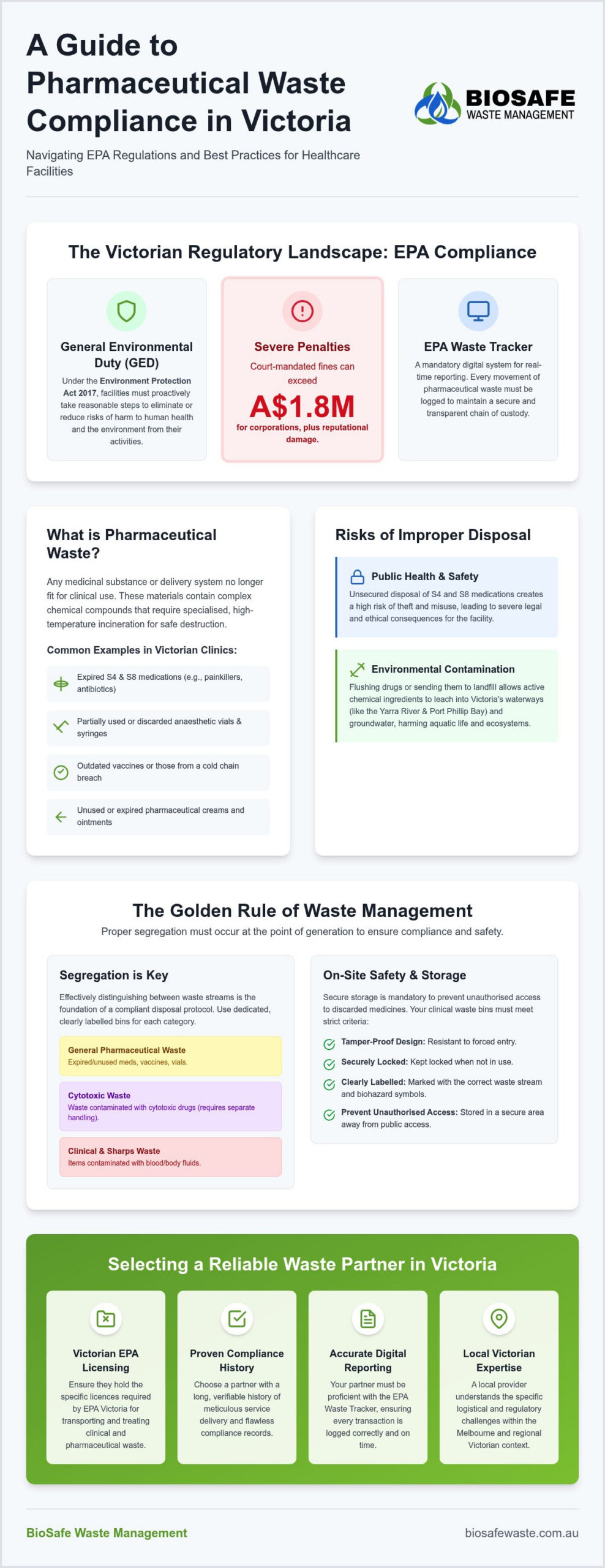
The Environment Protection Act 2017 represents a significant shift in how Victorian healthcare facilities manage their environmental footprint. By 2026, the focus has moved entirely toward the General Environmental Duty (GED). This principle dictates that any person or business conducting an activity that poses risks to human health or the environment must take proactive, reasonable steps to eliminate or reduce those risks. For clinic managers, this means the biohazard waste disposal regulations victoria enforces are a central pillar of daily operations. EPA Victoria maintains a rigorous inspection regime to ensure these standards are met. Non-compliance is a serious matter, and it’s not just about the financial impact. Court-mandated fines can exceed A$1.8 million for corporations, alongside the risk of professional audits and public reputational damage.
Using the EPA Waste Tracker System
Compliance in 2026 is anchored by the digital EPA Waste Tracker system, which replaces traditional paper dockets with a real-time reporting framework. Every movement of pharmaceutical waste must be logged digitally to maintain a clear chain of custody. Accuracy is paramount. It’s essential to use the correct waste code, such as R120 for pharmaceuticals, for every lodgement. This system allows the EPA to monitor waste volumes and ensure that materials reach authorised destruction centres. To simplify this administrative burden, many clinics choose a licenced Victorian waste provider with proven EPA credentials. A qualified partner will manage the digital record-keeping on your behalf, ensuring your facility’s data is always audit-ready and legally sound.
Schedule 8 (S8) Record Keeping Requirements
The destruction of Schedule 8 (S8) medications, known as Drugs of Dependence, is governed by the Drugs, Poisons and Controlled Substances Act 1981. These substances require a higher level of security than standard pharmaceuticals. Victorian practitioners must ensure that the decommissioning of these drugs is witnessed by another registered health professional, with the details meticulously recorded in the facility’s drug register. You must follow these steps for every instance of S8 disposal:
- Record the name, strength, and quantity of the drug being discarded.
- Ensure both the practitioner and the witness sign the register at the time of destruction.
- Place the rendered-unusable medication into a dedicated pharmaceutical waste container immediately.
Utilising a professional disposal service ensures that once these medications leave your site, they’re transported in secure, GPS-tracked vehicles to an EPA-authorised incineration facility. This provides the final layer of security needed to fulfil your duty of care obligations under Victorian law.
Segregation and Categorisation of Pharmaceutical Waste
Effective waste management hinges on a single “golden rule”: segregation at the point of generation. Mixing different waste streams increases disposal costs and creates unnecessary safety risks for staff and contractors. Under the biohazard waste disposal regulations victoria mandates, facilities must ensure that pharmaceutical waste is never co-mingled with general municipal waste or standard clinical streams. This meticulous approach ensures that hazardous chemical compounds are directed toward high-temperature incineration. It prevents these materials from being mistakenly processed through lower-temperature sterilisation methods, which are insufficient for chemical destruction.
Pharmaceutical-contaminated sharps, such as needles containing traces of S4 medications, must be disposed of in yellow sharps containers with white lids. This specific coding identifies the presence of chemical residues, distinguishing them from standard clinical sharps. Using the correct container is essential for the safety of waste handlers throughout the Victorian supply chain. Meticulous segregation ensures your facility remains compliant while protecting the integrity of the waste recovery process.
Cytotoxic vs. Non-Cytotoxic Waste
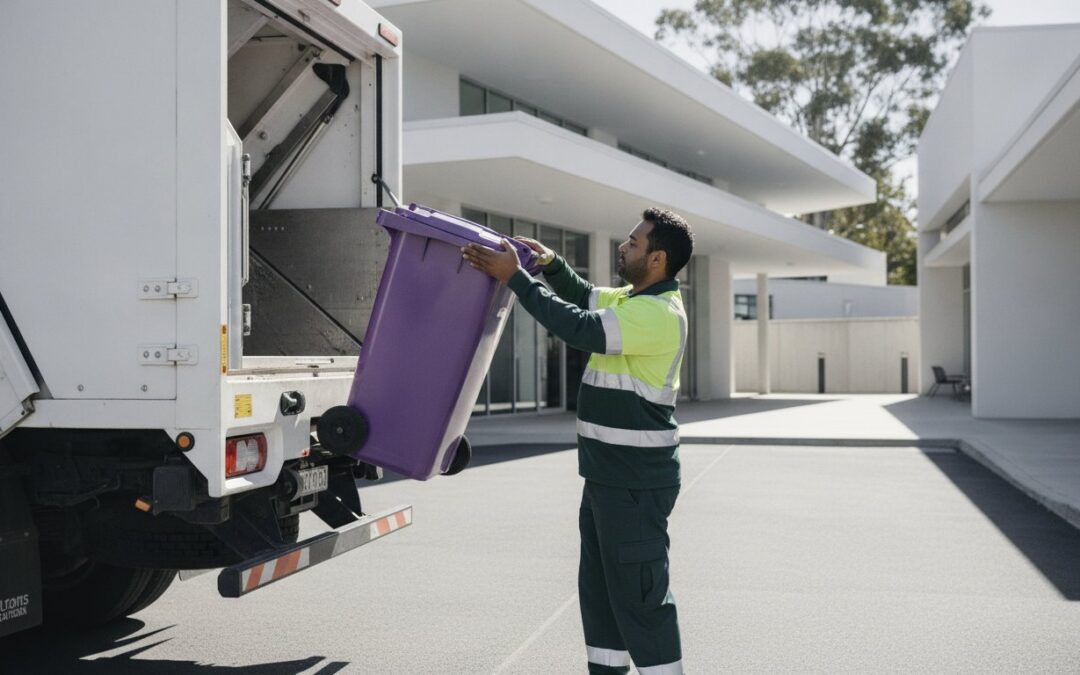
Cytotoxic materials, used primarily in cancer treatments and certain specialised therapies, are highly toxic to cells and require the most stringent disposal protocols in Victoria. These substances must be placed in dedicated purple containers marked with the cytotoxic symbol. In contrast, non-cytotoxic pharmaceutical waste, such as expired antibiotics or vaccines, belongs in yellow bins with a white lid. Mixing these streams is a common compliance error. Staff should always follow a “if in doubt, treat as cytotoxic” approach to prevent environmental contamination. All antineoplastic agents must be destroyed at temperatures exceeding 1,100 degrees Celsius to ensure complete neutralisation.
Sector-Specific Segregation Needs
Different healthcare sectors face unique challenges when categorising their waste. For example, dental waste management Victoria clinics must separate amalgam-contaminated capsules from general pharmaceutical residues. This prevents mercury from entering the high-heat incineration stream incorrectly. Tattoo studios also require specialised care. They must dispose of topical anaesthetics and contaminated ink caps to meet Victorian health standards. In aged care facilities, the sheer volume of resident medications requires a robust system. Handling various S4 and S8 substances daily can be complex. Implementing clear, colour-coded signage at every waste station helps staff maintain these standards without hesitation. This provides a safe pair of hands for both your team and your facility’s reputation.
On-Site Safety and Storage Best Practices for Victorian Facilities
Once you’ve segregated your waste, the next priority is secure containment. Compliance with clinical waste bin requirements Victoria involves more than just selecting a container. It requires a systematic approach to storage that prevents accidental exposure or theft. Under the biohazard waste disposal regulations victoria mandates, waste producers are responsible for the security of their materials until a licenced contractor collects them. This means your storage area must be a “safe pair of hands” within the clinic, ensuring hazardous substances don’t reach public areas or unauthorised personnel.
5 Steps to Secure Pharmaceutical Storage
Creating a compliant storage environment doesn’t have to be complicated. Follow these five steps to maintain order and safety:
- Select appropriate containers: Use lockable, rigid, and puncture-resistant bins specifically designed for pharmaceutical materials.
- Control the environment: Position these bins in a restricted-access, climate-controlled zone to prevent drug degradation or unauthorised tampering.
- Ensure clear identification: Apply Victorian-standard labels and biohazard symbols clearly to every container to avoid handling errors.
- Manage stock rotation: Implement a first-in, first-out (FIFO) system for expired stock to prevent excessive on-site accumulation.
- Utilise secondary containment: Use bunding or spill trays in your storage area to catch any potential leaks from liquid medications.
Staff Training and Occupational Health
Technical controls are only as effective as the team managing them. Regular training ensures that every staff member understands the strict “no-flush” policy for liquid medications. Pouring drugs down the sink is a direct violation of Victorian environmental laws and can lead to severe penalties for the practice owner. Your team should also be proficient in using Personal Protective Equipment (PPE), including gloves and eye protection, whenever they handle or transfer pharmaceutical waste. This meticulous attention to detail is the backbone of a safe clinical environment.
In the event of an accidental spill or exposure, your facility must have a documented procedure ready for immediate use. This includes having a pharmaceutical-specific spill kit accessible in the storage area and a clear reporting line for health and safety officers. Maintaining these standards protects your staff’s health and preserves your facility’s operational integrity. If you need assistance establishing a compliant storage schedule, BioSafe Waste Management provides expert collection services tailored to the specific needs of Victorian clinics.
Selecting a Reliable Pharmaceutical Waste Partner in Victoria
Choosing a waste management partner is one of the most critical decisions for a Victorian healthcare facility. While national providers offer broad coverage, local Victorian expertise is indispensable for navigating the specific nuances of state-based reporting. A partner with a deep understanding of the biohazard waste disposal regulations victoria enforces ensures that your facility doesn’t just meet the minimum requirements but operates at the highest standard of safety. Local specialists are better positioned to manage the real-time demands of the EPA Waste Tracker system, providing the precise data entry required to keep your practice’s compliance record spotless.
When evaluating potential contractors, you must look beyond the service price. Verify that the provider holds all necessary Victorian EPA licences and comprehensive insurance specific to medical waste transport. A contractor’s history with the EPA is a public record that reflects their commitment to professional integrity. Opting for an integrated approach to reliable clinical waste collection allows you to consolidate your pharmaceutical, sharps, and clinical streams under one point of accountability. This reduces administrative friction and ensures that every waste type is handled by a team that understands the gravity of their responsibilities.
The BioSafe Advantage for Victorian Clinics
BioSafe Waste Management operates as a disciplined and dependable specialist for facilities across Melbourne and regional Victoria. We understand that a dental surgery’s needs differ significantly from those of a tattoo studio or a veterinary hospital. Our team provides tailored collection schedules that align with your facility’s specific waste volumes, ensuring you never have excessive hazardous material sitting on-site. We take the burden of digital reporting off your shoulders by providing meticulous documentation for every collection. This professional oversight simplifies your Waste Tracker obligations, allowing you to focus on patient care while we manage the technicalities of your environmental duty.
Next Steps: Booking a Compliance Audit
If you’re uncertain whether your current system meets the 2026 standards, a compliance audit is a prudent first step. This process involves reviewing your waste volumes and segregation efficiency to identify areas where you can improve safety and reduce costs. We can provide a customised quote for your regular clinical and infectious waste disposal Victoria needs, ensuring your facility remains a safe and compliant environment for both staff and the public. Don’t leave your regulatory standing to chance when you can partner with a seasoned consultant who treats your facility’s safety as a matter of professional duty.
Organise your EPA-compliant pharmaceutical waste collection with BioSafe today and secure a safe pair of hands for your Victorian practice.
Securing Your Facility’s Future in Victorian Healthcare
Achieving total compliance with the biohazard waste disposal regulations victoria enforces is a continuous commitment to safety and environmental stewardship. By mastering the 2026 EPA Waste Tracker requirements and implementing disciplined on-site segregation protocols, you protect your practice from heavy fines and preserve your professional reputation. Whether you manage a dental surgery, a tattoo studio, or an aged care facility, your duty of care remains the quiet backbone of your operation.
Partnering with an EPA-licenced Victorian waste transporter provides the security and reliability you need to focus on essential care. BioSafe offers specialised support for dental and aged care compliance, providing local Melbourne-based expertise that understands regional requirements. Secure your facility with EPA-compliant pharmaceutical waste disposal from BioSafe today.
Professional support ensures your facility remains a safe, compliant, and thriving environment for years to come. You don’t have to manage these complex regulatory burdens alone; we are here to provide a steady, reliable service you can trust.
Frequently Asked Questions
What is the correct EPA waste code for pharmaceutical waste in Victoria?
The primary EPA waste code for pharmaceutical waste in Victoria is R120. This specific code identifies medicinal substances that require high-temperature incineration rather than standard clinical treatment or autoclaving. Correctly applying this code within the digital Waste Tracker system is essential for maintaining a transparent chain of custody. It ensures that hazardous chemical compounds are accurately tracked from your facility to an authorised destruction centre, fulfilling your General Environmental Duty under Victorian law.
Can I dispose of expired medications in my regular clinical waste bin?
You cannot dispose of pharmaceutical waste in a standard yellow clinical waste bin. While both streams are biohazardous, general clinical waste is often processed through autoclaving, which doesn’t neutralise chemical medications. Pharmaceutical waste requires dedicated yellow bins with white lids specifically for incineration. Mixing these streams violates the biohazard waste disposal regulations victoria enforces and can lead to significant EPA penalties for your facility due to incorrect waste segregation at the point of generation.
How does the EPA Waste Tracker system work for small dental practices?
Small dental practices must lodge waste records digitally through the EPA Waste Tracker portal for every collection. This system replaces traditional paper dockets and provides real-time oversight of waste movements across the state. As a waste producer, you’re responsible for ensuring the information is accurate before your contractor removes the material. Many practitioners choose a licenced partner like BioSafe to manage this administrative process, ensuring every transaction is recorded correctly without disrupting daily clinic operations.
What are the specific requirements for disposing of Schedule 8 drugs in Victoria?
Schedule 8 (S8) drugs require witnessed destruction by two registered health professionals before being placed in a pharmaceutical waste container. You must record the name, strength, and quantity of the medication in your drug register, with both professionals signing the entry at the time of disposal. Once rendered unusable, the waste is stored in a lockable bin. This process ensures that controlled substances are decommissioned safely and can’t be diverted for illicit use within the Victorian community.
Do I need a special licence to store pharmaceutical waste on-site?
Victorian healthcare facilities generally don’t require a specific licence to store small volumes of pharmaceutical waste generated on-site, provided they meet the General Environmental Duty (GED). You must ensure the waste is stored in a secure, lockable area that prevents unauthorised access and environmental leaks. However, if you store large volumes exceeding specific EPA thresholds, different rules may apply. It’s best to maintain regular collections with a professional provider to keep on-site volumes low and remain compliant.
How often should pharmaceutical waste be collected from a medical facility?
Collection frequency depends on your facility’s waste volume and storage capacity, but most Victorian clinics benefit from regular monthly or quarterly schedules. Storing pharmaceutical waste for extended periods increases the risk of unauthorised access or chemical degradation. A consistent collection cycle ensures you don’t exceed your storage limits and keeps your Waste Tracker records up to date. Professional providers can help you determine an optimal schedule based on your practice’s specific generation rates and space constraints.
What is the difference between purple and yellow waste bins in Victoria?
Purple bins are strictly for cytotoxic waste, such as materials contaminated with antineoplastic agents used in oncology treatments. These require destruction at temperatures exceeding 1,100 degrees Celsius. Yellow bins with white lids are for general pharmaceutical waste, including expired S4 or S8 medications and unused vaccines. Correct identification is vital because mixing these streams can compromise the safety of waste handlers and lead to non-compliance with the biohazard waste disposal regulations victoria mandates for healthcare providers.
Is it legal to return expired medications to a local pharmacy for disposal?
While the Return Unwanted Medicines (RUM) program allows households to return medications to pharmacies, professional medical facilities must use a licenced waste contractor. Victorian clinics have a commercial duty of care that requires a documented chain of custody through the EPA Waste Tracker. Handing professional waste to a retail pharmacy doesn’t provide the necessary legal documentation to prove compliant disposal. You must manage your waste through authorised collection services to ensure full regulatory adherence and professional accountability.