

A single needle-stick injury can compromise a healthcare professional’s health and a facility’s standing in seconds. In the high-stakes environment of Victorian medical centres and care facilities, the margin for error with clinical waste is non-existent. You likely understand the constant pressure of protecting your team from bloodborne pathogens while trying to decipher complex EPA Victoria waste codes before your next inspection. It’s a heavy responsibility that requires more than just a yellow bin; it demands a disciplined, end-to-end strategy for the safe disposal of medical sharps.
This guide provides the essential protocols for handling, storing, and disposing of sharps to ensure absolute staff safety and full regulatory compliance. We’ll outline a clear, compliant workflow that eliminates confusion over waste categorisation and helps you maintain a workplace free from sharps-related accidents. By following these established standards, you can secure the peace of mind that comes from knowing your facility is managed with professional precision, allowing you to focus on delivering exceptional care to your community.
Key Takeaways
- Identify the clinical risks associated with medical sharps and the importance of accurate waste categorisation within Victorian facilities.
- Ensure your facility remains compliant by selecting containers that strictly adhere to Australian Standards AS 4031 or AS 4861.
- Establish rigorous on-site handling protocols, focusing on immediate disposal at the point of use to prevent avoidable workplace accidents.
- Navigate the complexities of EPA Victoria regulations regarding the safe disposal of medical sharps to avoid non-compliance fines and audit failures.
- Streamline your waste management through a professional bin exchange service that provides a reliable, end-to-end collection and destruction lifecycle.
Understanding Medical Sharps and the Risks of Improper Disposal
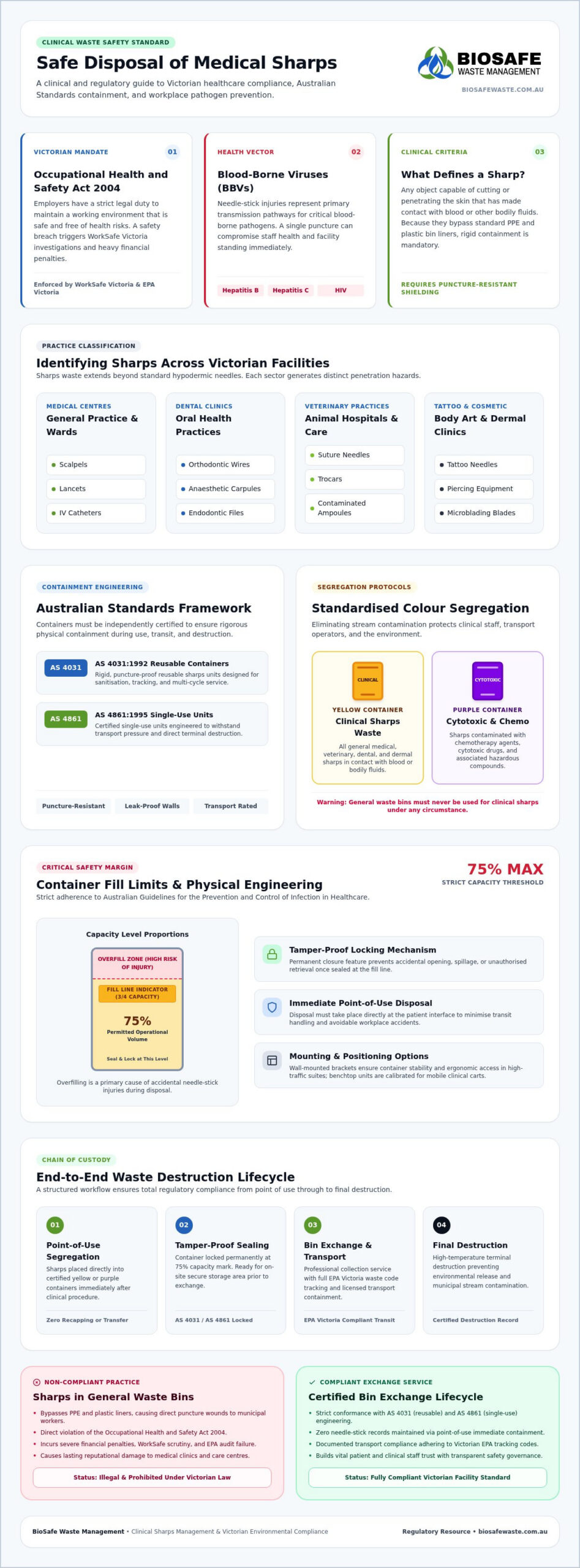
Effective waste management begins with a precise understanding of what constitutes a clinical sharp. In a professional Victorian facility, a sharp is any object capable of cutting or penetrating the skin that has been in contact with blood or other body fluids. Maintaining the safe disposal of medical sharps isn’t merely a site-level preference. It’s a non-negotiable requirement for protecting your clinical staff and the public from serious health risks.
Identifying Sharps in Your Practice
Many facility managers mistakenly believe sharps management only applies to hypodermic needles. However, the definition of medical sharps waste is significantly broader in a clinical context. Depending on your industry, your waste stream may include a variety of hazardous items:
- Tattoo and Cosmetic Studios: Used tattoo needles, piercing equipment, and microblading blades.
- Dental Clinics: Orthodontic wires, anaesthetic carpules, and endodontic files.
- Veterinary Practices: Suture needles, trocars, and contaminated glass slides or ampoules.
- Medical Centres: Scalpels, lancets, and IV catheters.
It’s vital to distinguish these items from general medical waste. While a blood-stained bandage is clinical waste, it doesn’t possess the physical ability to puncture a standard plastic bag. Sharps require specialised containment because their physical properties allow them to bypass traditional PPE and standard waste liners.
The Consequences of Non-Compliance
The risks of improper handling extend far beyond a momentary accident. Needle-stick injuries are primary vectors for blood-borne viruses (BBVs), including Hepatitis B, Hepatitis C, and HIV. For a Victorian business owner, a safety breach can lead to intensive WorkSafe Victoria investigations and substantial financial penalties. Under the Occupational Health and Safety Act 2004, employers have a legal duty to provide a working environment that’s safe and without risks to health.
Placing sharps into general waste bins is never an option. This practice endangers municipal waste workers and can lead to environmental contamination. Beyond the legal and physical threats, a safety breach often results in significant reputational damage. For care facilities and clinics, maintaining a record of zero workplace accidents is essential for building trust with both staff and patients. Implementing a disciplined workflow for the safe disposal of medical sharps ensures your facility operates as a secure, professional environment.
Selecting and Preparing AS 4031 Compliant Sharps Containers
Compliance begins with the physical integrity of the containment system. In Victoria, any facility generating medical waste must utilise containers that strictly adhere to Australian Standards. AS 4031:1992 governs reusable containers, while AS 4861:1995 applies to single-use units. These standards are not mere suggestions. They ensure that every bin is engineered to be puncture-resistant, leak-proof, and capable of withstanding the rigours of transport and final destruction.
Standardisation of colours is a critical component of risk management. Yellow containers are the primary choice for the safe disposal of medical sharps contaminated with clinical waste. If your practice handles chemotherapy or cytotoxic drugs, purple containers are required. Accurate colour-coding prevents the dangerous mixing of waste streams, which could lead to improper treatment and environmental hazards. Selecting a bin size that matches your facility’s weekly waste volume is equally important to avoid the risks associated with long-term on-site storage.
Key Features of a Compliant Sharps Bin
A compliant container must feature a secure, tamper-proof locking mechanism to prevent accidental opening. The most vital safety feature is the “fill line” indicator. You must never fill a container beyond this mark, which is typically set at three-quarters capacity. The Australian Guidelines for the Prevention and Control of Infection in Healthcare emphasise that overfilling is a primary cause of needle-stick injuries during disposal. For high-traffic areas, wall-mounted brackets provide stability and keep the opening at an ergonomic height, while benchtop units are suitable for mobile clinical carts.
Setting Up Your Collection Area
Once a container reaches its fill limit, it must be moved to a designated clinical waste storage zone. This area should be secure, child-proof, and clearly marked with the international biohazard symbol. Victorian regulations require that these zones are easily accessible for professional collection teams but restricted from public access. Maintaining an organised storage area reduces the risk of containers being knocked over or misplaced. Partnering with a specialist for a regular sharps bin exchange service ensures your facility remains uncluttered and compliant with EPA Victoria transport requirements. This systematic approach provides the stability your facility needs to manage hazardous waste without interruption.
On-site Handling Protocols: Minimising Risk in the Workplace
Establishing clear, repeatable protocols for the safe disposal of medical sharps is the most effective way to eliminate workplace accidents. The fundamental rule of sharps management is immediate disposal at the point of use. This practice removes the risk of a used needle or blade being left on a tray, benchtop, or bedside table where it could cause an accidental injury to another staff member or a patient. Every second a sharp remains uncontained is a second of unnecessary risk.
A disciplined workplace culture relies on robust Standard Operating Procedures (SOPs). These procedures should be part of every new staff member’s induction and revisited during regular safety briefings. When your team understands the “why” behind each protocol, compliance becomes a shared responsibility rather than a chore. This collective vigilance creates a stable environment where safety is the default setting for all clinical activities.
Safe Disposal Techniques for Staff
Technical precision during disposal is just as important as the clinical procedure itself. Staff must be trained in specific handling techniques to prevent occupational exposure. Key safety requirements include:
- Never recap, bend, or break needles: These actions are the most common causes of needle-stick injuries. If a needle must be recapped in an exceptional clinical circumstance, use a mechanical device or the ‘one-handed scoop’ technique.
- Use forceps for contaminated items: Avoid direct hand contact with broken glass or used lancets. Use clinical instruments to transfer these items directly into the yellow bin.
- Final Sealing: Once the container reaches the fill line, the lid must be permanently locked. Never attempt to reopen a sealed bin or compress the contents to make more room.
Internal Waste Audits
Maintaining high standards requires regular oversight. Conducting a regular medical waste compliance audit allows you to identify gaps in your current workflow before they lead to an incident. These audits should look for ‘near-miss’ scenarios, such as containers placed too far from the treatment area or staff carrying unsheathed sharps across a room.
Under Victorian health and safety regulations, facilities should also maintain a sharps injury logbook. Recording every incident, no matter how minor, provides the data needed to improve training and equipment selection. This methodical approach to documentation demonstrates to WorkSafe Victoria that your facility takes its duty of care seriously. By treating waste management as a core clinical function, you protect your staff’s wellbeing and your facility’s professional integrity.
The Lifecycle of a Sharp: From Collection to Final Destruction
The responsibility of a healthcare facility doesn’t end when a lid is clicked shut. For professional clinics, community disposal points like local pharmacies are insufficient and inappropriate for the volumes of waste generated. Instead, the safe disposal of medical sharps requires a documented, regulated journey from your facility to a specialised treatment centre. EPA Victoria oversees this lifecycle, ensuring that hazardous materials are tracked via a digital chain of custody to prevent environmental contamination and public health risks.
A professional waste management strategy provides the essential backbone for this process. It ensures that hazardous items don’t linger on-site longer than necessary. This systematic approach to collection removes the burden of logistics from your clinical staff, allowing them to remain focused on patient outcomes while knowing the facility’s compliance is handled by a safe pair of hands.
EPA Compliance and Documentation
As a waste generator in Victoria, you’re legally accountable for your sharps until they’re officially destroyed. Modern compliance relies on the WasteTracker system, which has replaced traditional paper-based methods with real-time digital documentation. Every collection must be accompanied by a Waste Transport Certificate. These records verify that your waste was handled by a licensed professional and reached its intended destination. You must retain these digital or physical records for a mandatory period of five years to remain compliant during regular regulatory audits. Understanding the full container rotation process is essential; a detailed sharps bin exchange service guide for Victorian facilities can help you establish a ‘set and forget’ system that keeps your documentation bulletproof.
Destruction Methods Explained
Once collected through a professional sharps bin exchange service, the waste undergoes a rigorous neutralisation process. Most clinical sharps are treated using industrial autoclaving. This process uses high-pressure steam and heat to eliminate all biological pathogens, rendering the materials sterile. However, if sharps are contaminated with pharmaceutical or pathological waste, high-temperature incineration is required to chemically break down the hazardous components. The final result is a non-hazardous residue that can be safely managed in specialised landfill or, in some instances, processed for material recovery.
To ensure your facility meets every EPA Victoria requirement without the administrative burden, consider a professional clinical waste collection schedule tailored to your specific volume and waste type.
Professional Sharps Disposal Solutions for Victorian Facilities
Managing the safe disposal of medical sharps requires more than just a provider; it requires a partnership based on reliability and technical competence. While ad-hoc disposal might seem convenient for smaller clinics, it often leads to gaps in documentation and inconsistent collection schedules. Transitioning to a managed safety contract ensures that your dental practice, veterinary clinic, or tattoo studio operates with a predictable, compliant waste stream. This shift moves your facility from a reactive safety posture to a proactive, disciplined management model.
Specialised environments like NDIS-funded residences and aged care facilities face additional layers of scrutiny. In these settings, the protection of vulnerable residents and the staff who support them is paramount. Professional waste management ensures that your facility meets the rigorous standards required for NDIS compliance, providing a transparent audit trail that satisfies both health department inspectors and families. By outsourcing this critical function, you eliminate the anxiety of potential regulatory fines and workplace accidents.
Why Local Expertise Matters in Melbourne
BioSafe operates as a specialised backbone for the Victorian healthcare infrastructure. A local specialist understands the specific nuances of Victorian-specific health department guidelines and EPA requirements that national providers might overlook. Whether your facility is located in the heart of the Melbourne CBD or in regional Victoria, having a partner who can provide a consistent, professional sharps container collection Melbourne schedule is essential. This local focus ensures that we remain a “safe pair of hands,” offering the stability and precision your facility depends on to maintain its hygiene standards.
Getting Started with a Managed Service
The first step in modernising your waste strategy is a thorough assessment of your facility’s specific needs. We evaluate your waste volume and the types of sharps generated to determine the most efficient bin sizes and collection frequency. Integrating your sharps management into a broader clinical waste strategy reduces administrative overhead and ensures every waste stream is handled correctly. Setting up your first sharps container collection Melbourne service provides an immediate improvement to your workplace safety profile. This methodical setup process ensures that your team has the tools they need to perform their duties without the constant fear of a needle-stick injury or a compliance failure.
Securing Your Facility’s Safety Standards
Maintaining a secure clinical environment requires a disciplined and consistent approach to hazardous waste. By prioritising immediate point-of-use disposal and utilising AS-compliant containers, you effectively eliminate the primary causes of workplace needle-stick injuries. Integrating a managed collection schedule ensures your facility remains fully aligned with EPA Victoria’s stringent digital tracking requirements without diverting critical resources from patient care. This systematic strategy for the safe disposal of medical sharps provides the long-term stability needed to pass regulatory audits with confidence.
As a Melbourne-owned and operated specialist, BioSafe acts as a dependable backbone for healthcare providers, aged care facilities, and tattoo studios across the state. We provide the technical expertise and regular collection intervals necessary to keep your workspace sterile and compliant. Secure your facility with BioSafe’s professional sharps disposal services today to ensure your operations remain EPA Victoria compliant and your team stays protected. Establishing these professional protocols today creates a safer, more resilient workplace for your staff and the Victorian community you serve.
Frequently Asked Questions
What is the legal definition of medical sharps in Victoria?
In Victoria, medical sharps are defined as any objects capable of cutting or penetrating the skin that have been in contact with human or animal tissue, blood, or body fluids. This includes hypodermic needles, scalpels, lancets, and contaminated glass. These items are classified as clinical waste and require specific containment to prevent occupational exposure. Under Victorian health and safety legislation, facility managers must ensure the safe disposal of medical sharps to protect staff and the public.
Can I use a heavy-duty plastic bottle as a sharps container?
No, you cannot use a heavy-duty plastic bottle or any makeshift container for sharps disposal. Victorian regulations mandate the use of containers that meet Australian Standards AS 4031 (reusable) or AS 4861 (single-use). These approved bins are specifically engineered to be puncture-resistant and feature secure, tamper-proof locking mechanisms. Using unapproved containers increases the risk of needle-stick injuries and can lead to significant penalties during a WorkSafe or EPA Victoria audit.
How often should sharps bins be collected from a dental practice?
Collection frequency for a dental practice depends on your clinical volume, though most busy facilities benefit from a monthly or fortnightly schedule. It’s critical to ensure that bins never exceed the three-quarter fill line before they are exchanged. A regular, managed collection schedule prevents the accumulation of hazardous waste on-site and ensures your facility remains compliant with EPA Victoria’s WasteTracker requirements. This systematic approach provides the reliability needed for a high-traffic clinical environment.
What should I do if a sharps container is accidentally knocked over?
If a sharps container is knocked over, you must treat the area as a biohazard zone immediately. Wear puncture-resistant gloves and use forceps or a scoop to carefully return any spilled items to a compliant container; never pick up sharps by hand. Once the sharps are secured, the area should be disinfected with a hospital-grade solution. You should also document the event in your facility’s incident logbook to identify if the container’s placement needs to be adjusted.
Does the EPA require a permit for small-scale sharps disposal?
While individual practitioners don’t usually need a personal permit, every facility that generates clinical waste is considered a waste generator under EPA Victoria rules. You’re responsible for ensuring that your waste is collected by a licensed professional and tracked through the digital WasteTracker system. This ensures a transparent chain of custody from your clinic to the final destruction site. Maintaining these digital records is a mandatory requirement for all Victorian medical and care facilities.
What are the specific requirements for sharps disposal in NDIS home care?
NDIS and aged care providers must maintain the same clinical standards in a home setting as they would in a hospital. This involves providing residents and support staff with AS-compliant sharps containers and ensuring a professional collection service is in place. Improper disposal in domestic bins is illegal and dangerous for municipal waste workers. Implementing the safe disposal of medical sharps in home care protects the safety of the resident and ensures the provider meets their duty of care.
How do I dispose of needles used for cytotoxic medications?
Needles used for cytotoxic medications, such as chemotherapy drugs, must be disposed of in purple-coded sharps containers. These containers signify that the waste is not only a physical hazard but also a chemical one, requiring high-temperature incineration rather than standard autoclaving. Mixing cytotoxic sharps with general clinical sharps is a serious compliance breach. Using the correct colour-coded system ensures that hazardous materials are treated with the technical precision required for safe destruction.
Are there different disposal rules for tattoo needles versus medical needles?
The disposal rules for tattoo needles and medical needles are identical under Victorian clinical waste regulations. Both items are classified as sharps waste because they are designed to penetrate the skin and are contaminated with blood. Tattoo studios must utilise AS-compliant yellow bins and engage a licensed waste collector for regular disposal. This professional approach ensures that studios maintain the same level of hygiene and regulatory compliance as a medical centre or dental practice.