
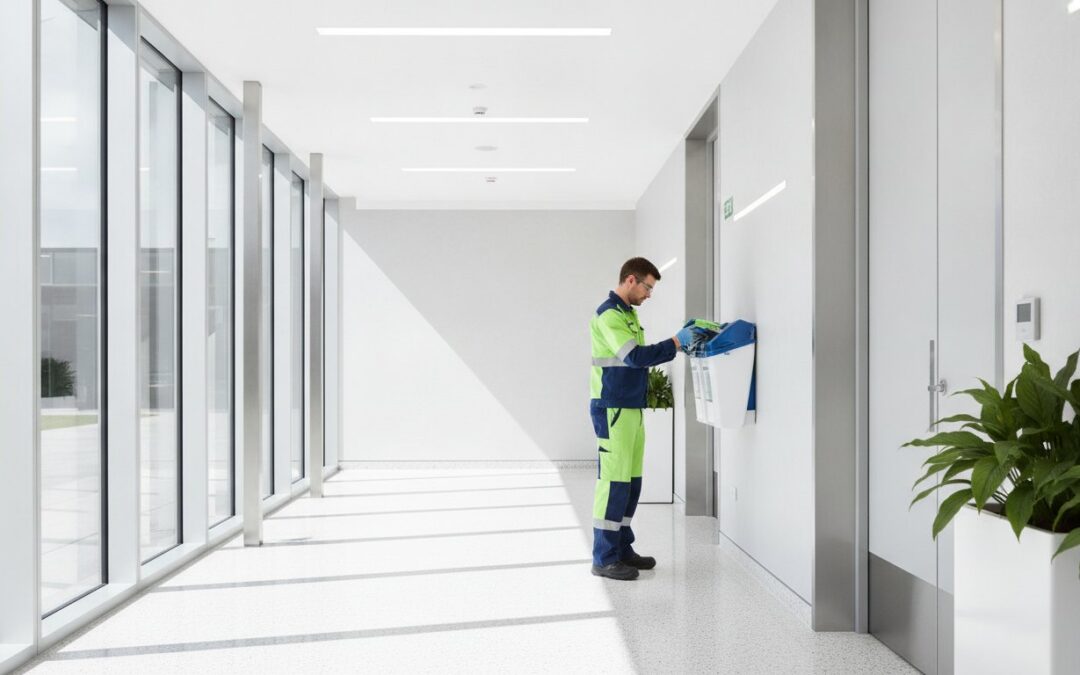
Did you know that an estimated 18,000 needlestick injuries are reported across Australia every year? For healthcare providers in Victoria, these aren’t just statistics; they represent a constant risk to staff safety and a significant administrative burden. You likely understand that managing clinical waste through a professional sharps bin exchange service is a high-stakes responsibility where a single oversight can lead to substantial EPA fines. You want a system that protects your team without adding to your daily workload.
This guide explains how a managed exchange system ensures your practice meets rigorous Australian Standards, simplifies your logistics, and guarantees your compliance documentation is bulletproof. We’ll examine the step-by-step process of container rotation, the mandatory shift to the EPA Waste Tracker digital portal, and how to establish a ‘set and forget’ system that protects both your team and your patients. By the end of this article, you’ll have a clear roadmap for achieving total regulatory peace of mind and maintaining a safer clinical environment.
Key Takeaways
- Learn why a professional sharps bin exchange service is essential for transitioning from manual waste handling to a fully managed, compliant system.
- Discover the logistical advantages of point-of-use bin placement and how scheduled technician visits reduce the risk of on-site accidents.
- Understand your legal obligations under the 2026 EPA Victoria framework, including mandatory digital tracking for all clinical waste movements.
- Compare the total cost of ownership between purchasing bins outright and utilising a professional rotation service to eliminate administrative burdens.
- Identify the specific waste management requirements for diverse Victorian facilities, including dental practices, veterinary clinics, and aged care centres.
What is a Sharps Bin Exchange Service?
A professional sharps bin exchange service is a managed waste solution designed for facilities that generate clinical and related industrial waste. Unlike residential disposal, where individuals take small containers to a local pharmacy or council drop-off point, a commercial exchange service involves an EPA-licensed provider managing the entire lifecycle of the waste. This service ensures that full containers are removed and replaced with clean, compliant units on a predetermined schedule. It’s a proactive partnership that prioritises safety over simple collection.
The distinction between public drop-off points and a managed service is significant. Victorian facilities are legally classified as waste generators. This means you have a General Environmental Duty (GED) to minimise risks to human health and the environment. While a resident might use a council bin, a professional facility must use a licensed contractor for medical waste collection Victoria to remain compliant with R100 waste codes. A managed service provides the infrastructure to meet these legal obligations without distracting from patient care.
The “exchange” model is built on a simple safety principle: facility staff should never handle the waste itself. Once a needle or scalpel blade enters the bin, it stays there. The service technician removes the entire sealed unit from its bracket or console. This means there is no decanting or risk of exposure during the changeover. This process is the most effective way to prevent the thousands of needlestick injuries reported in Australia each year. It shifts the burden of hazardous handling from your staff to trained specialists.
The Core Components of a Managed Service
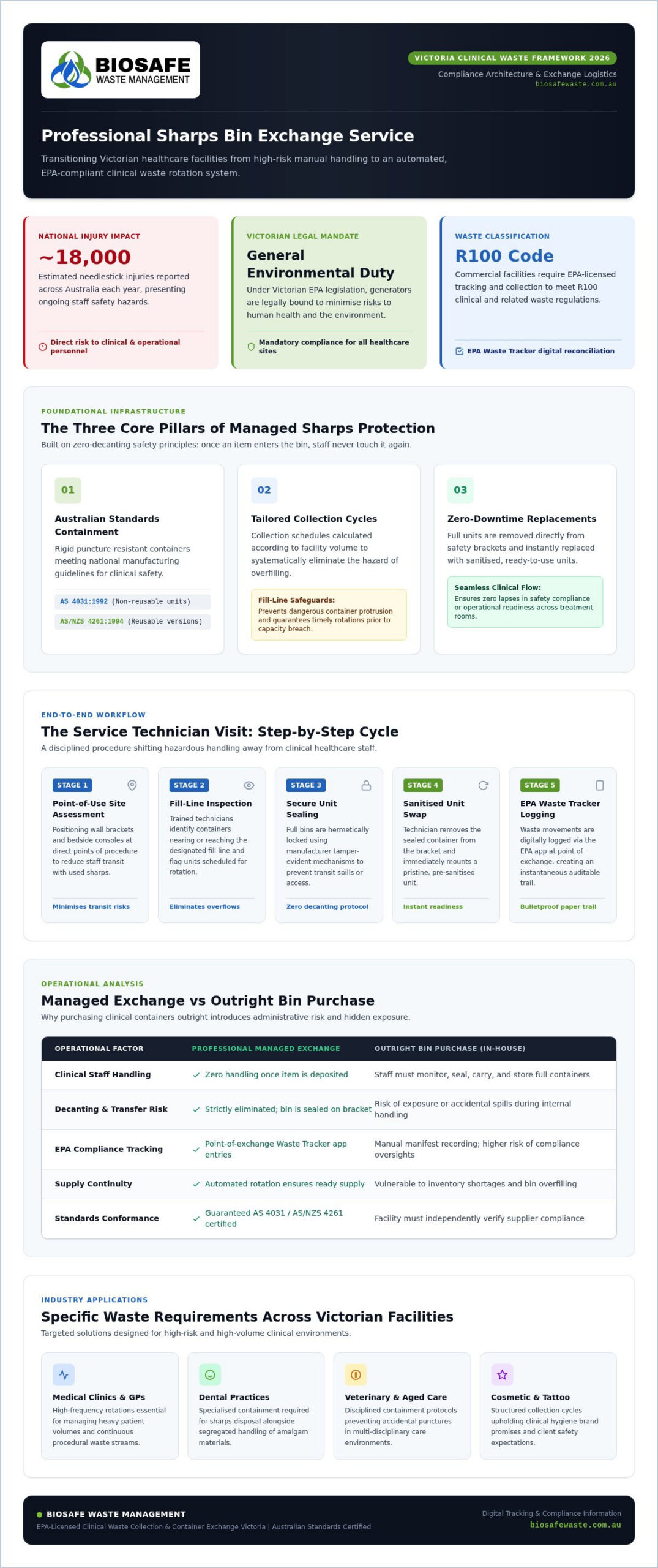
A reliable service consists of three primary pillars. First is the provision of containers that meet Australian Standards, specifically AS 4031:1992 for non-reusable units or AS/NZS 4261:1994 for reusable versions. These bins are puncture-resistant and feature tamper-evident lids with fill-line indicators. Second, collection cycles are tailored to your specific volume. This prevents the dangerous practice of overfilling bins. Finally, every full unit is immediately replaced with a sanitised, ready-to-use container. This ensures your facility never experiences downtime or a lapse in safety protocols.
Who Benefits from a Managed Exchange?
Various sectors rely on this structured approach to maintain a safe workspace. Medical clinics and GP surgeries find high-frequency rotations essential for managing high patient volumes. Dental practices benefit from specialised handling of sharps that may also involve amalgam waste. Additionally, tattoo and cosmetic studios utilise a sharps bin exchange service to uphold their hygiene brand promise. For these businesses, professional waste management is a sign of clinical integrity and a commitment to public safety.
The Logistics of a Professional Exchange: What to Expect
Understanding the operational mechanics of a sharps bin exchange service is vital for any facility manager. This is not a mere pickup; it’s a precise logistical cycle designed to keep hazardous materials moving away from your staff and patients. By implementing ‘point-of-use’ bin placement, we ensure that sharps are disposed of immediately after use. This reduces the distance staff travel with contaminated items, which directly lowers the risk of accidental needle-stick injuries. A managed sharps bin exchange service removes the administrative burden of tracking waste manifest documents manually, allowing your team to focus on clinical delivery.
The logistics begin with a site assessment to determine the most efficient locations for wall brackets and bedside consoles. Our technicians focus on high-risk areas where procedures occur, ensuring a bin is always within reach. This setup creates a disciplined environment where safety is integrated into the workflow rather than treated as an afterthought.
Step-by-Step: The Service Visit
During a scheduled visit, a BioSafe service technician follows a strict protocol to maintain clinical integrity. They first identify containers that have reached their fill line or are due for rotation. Each full unit is securely sealed using the manufacturer’s locking mechanism to prevent spills or unauthorised access during transit. The technician removes the unit from its safety bracket and replaces it with a fresh, sanitised container. Every transaction is logged into the EPA Waste Tracker app at the point of exchange. This digital reconciliation provides an immediate, auditable record of the waste’s journey from your facility to the treatment centre.
Minimising Clinical Disruption
Maintaining a calm environment is essential for patient care. We organise service schedules to align with your facility’s quiet periods, avoiding peak procedure times or busy rounds. Technicians operate as a quiet healthcare partner. They are trained to move through clinical zones discreetly and professionally, ensuring their presence does not disturb patients or interfere with staff duties. Regular rotations prevent the dangerous overfilling of bins, which is a common cause of accidents when staff attempt to force items into a full receptacle. For Victorian providers, partnering with a professional clinical waste specialist ensures these logistics remain invisible yet highly effective.
Comparing Managed Exchange vs. Outright Bin Purchase
Many Victorian facilities initially consider purchasing sharps containers outright from medical suppliers to save on costs. While the upfront price of a plastic bin appears low, this “DIY” approach often ignores the significant logistical and legal requirements that follow. Purchasing a bin doesn’t include the essential disposal component. Under the Environment Protection Act 2017, the facility remains the legal generator of the waste. You’re responsible for its safe storage and eventual transport by a licensed professional. A sharps bin exchange service integrates procurement, transport, and destruction into a single managed workflow, eliminating the need for separate contracts and ad-hoc arrangements.
Storing bulk clinical waste on-site presents a physical safety risk. Without a regular exchange schedule, full containers often accumulate in storage rooms or cupboards. This practice increases the likelihood of accidental exposure and may violate EPA guidelines regarding the duration of hazardous waste storage. A managed service removes the burden of inventory management entirely. You don’t need to track stock levels or find space for bulk empty bins, as clean replacements arrive exactly when needed. For Melbourne-based facilities seeking to understand the full scope of their obligations, our guide to sharps container collection Melbourne provides a comprehensive overview of the 2026 regulatory landscape and technical requirements.
Hidden Costs of the DIY Approach
The true cost of self-managed disposal is often obscured by administrative overhead. Facility managers must spend time sourcing licensed transporters and verifying that they possess the correct EPA permits. Ad-hoc disposal fees for small volumes are typically higher per unit than scheduled services. There’s also the significant cost of staff training. Employees must be educated on how to handle full bins, manage spill kits, and accurately complete waste manifest documents. These hours spent on compliance are hours taken away from clinical operations.
The Advantages of a Service Contract
A service contract provides predictable operational expenses. You avoid large upfront inventory costs and the volatility of one-off collection fees. This model guarantees compliance with the latest EPA Victoria regulations, as the service provider handles all digital lodgements via the Waste Tracker portal. Beyond logistics, a partnership offers access to expert advice for the safe disposal of medical sharps. This ensures your facility uses the most appropriate container sizes and types for your specific waste stream. By choosing a sharps bin exchange service, you transition from managing a hazardous liability to maintaining a streamlined safety system.
Victorian Compliance: EPA Standards for Sharps Waste 2026
The regulatory environment for Victorian healthcare facilities has become increasingly stringent. Under the Environment Protection Act 2017, the General Environmental Duty (GED) requires you to proactively manage risks to human health and the environment. For those generating clinical waste, this means adhering to the 2026 standards for medical waste collection Victoria. A critical component of this framework is the mandatory use of EPA-licensed transporters. You cannot legally transport R100 classified waste in a private vehicle or via a general waste contractor. Engaging a professional sharps bin exchange service ensures that every kilogram of waste is handled by an accredited specialist who understands these legal nuances.
The transition to the digital EPA Waste Tracker system has replaced traditional paper certificates with an end-to-end electronic trail. As the waste generator, you’re responsible for ensuring every transaction is lodged correctly before the waste leaves your premises. This digital manifest provides a transparent record from the moment the waste is collected until its final destruction. Your Duty of Care is an affirmative obligation; it doesn’t end when the technician exits your facility. You remain legally responsible for the waste until you receive a certificate of destruction, making the choice of a reliable partner a vital risk management decision. Facility managers seeking a detailed breakdown of these obligations can refer to our dedicated resource on sharps container collection in Melbourne for guidance specific to the 2026 compliance framework.
Key Victorian Regulatory Requirements
Compliance begins at the point of generation through strict waste segregation. Clinical sharps must be separated from general waste and anatomical streams to avoid cross-contamination and unnecessary disposal costs. Australian Standard AS 3816:2018 mandates that clinical sharps containers are yellow and clearly marked with the biohazard symbol. Storage areas must be secure, bunded, and vermin-proof. If waste is held for more than 72 hours and biological breakdown or odour risks emerge, dedicated temperature control is required to meet EPA operational guidance. Facilities that need to scale their containment capacity should also consider a structured medical waste bin collection Melbourne arrangement to ensure the right bin sizes are always available for your specific clinical volume.
Preparing for a Compliance Audit
Audits by the EPA can occur without notice. To prepare, you must maintain a comprehensive and clean record of all waste destruction certificates. A professional service provider simplifies this process by centralising your records in a digital format, ready for immediate inspection. For specialised fields, such as dental waste management Victoria, maintaining this documentation is essential for ongoing accreditation and professional standing. If you’re concerned about your current compliance status, you can contact BioSafe to discuss a tailored compliance review for your facility.
Why BioSafe is Victoria’s Trusted Sharps Management Partner
BioSafe operates as a disciplined backbone for the Victorian healthcare and sanitation sectors. We understand that clinical waste management is a matter of serious responsibility. Our sharps bin exchange service is built on the principle of providing a “safe pair of hands” for facility managers who cannot afford a lapse in compliance or safety. We move beyond simple collection, offering a partnership grounded in meticulousness and professional duty. Whether you manage a large aged care centre under NDIS protocols or a high-traffic tattoo studio, our approach remains consistent: protection of your staff, your patients, and the public.
Our commitment to reliability is reflected in our Victorian-wide service coverage. We serve a diverse range of sectors including veterinary clinics, dental practices, and cosmetic studios. Each facility has unique waste volumes and spatial constraints. We adapt our service to meet these specific needs while maintaining the sobriety and focus required in high-stakes environments. By choosing a dedicated partner, you ensure that your waste management is handled by experts who value precision over personality.
The BioSafe Difference: Professionalism in Action
Every exchange we perform is executed with meticulous attention to detail. Our technicians are not just drivers; they are specialists trained to operate within sensitive clinical environments. They understand the gravity of handling Reportable Priority Waste and the necessity of maintaining a sterile, organised workspace. We prioritise transparent reporting, ensuring every bin rotation is captured within the digital Waste Tracker system immediately. This provides you with a seamless, audit-ready trail of documentation without requiring your administrative team to intervene. Our reliability is our brand identity. We arrive on schedule, every time, providing the stability your facility needs to function without distraction.
Securing Your Facility Today
Transitioning to a managed waste system is a straightforward process when handled by professionals. We begin with a thorough site assessment to determine the ideal bin volume and placement for your specific workflow. This ensures you have the right capacity for clinical waste without overpaying for unnecessary rotations or suffering from overfilled bins. Our Melbourne-based team handles the transition from your current provider to ensure zero downtime for your practice. We coordinate the removal of old units and the installation of fresh, Australian Standard compliant containers in a single, organised visit. To establish a customised waste management plan that aligns with your facility’s unique requirements, contact our specialists for a professional briefing on our Victorian service options.
Establishing Long-Term Safety and Compliance
Securing your facility against the risks of clinical waste requires a shift from reactive disposal to a proactive, managed system. By implementing a professional sharps bin exchange service, you ensure that your practice remains aligned with the Environment Protection Act 2017 and the latest digital tracking mandates. This partnership eliminates the logistical burden of inventory management while providing your staff with the highest level of protection against injury. It’s a commitment to clinical integrity that benefits both your team and your patients.
BioSafe provides the stability of an EPA Victoria Licensed Transporter, utilising AS 4031:1992 compliant containers to maintain the highest safety standards. Our team offers specialist support for sharps disposal services melbourne, ensuring that your digital manifests are always audit-ready. You can now refocus your energy on clinical delivery, knowing your waste obligations are in a safe pair of hands.
Take the first step toward a simplified, compliant waste management system. Request a Professional Sharps Audit for Your Facility today and experience the peace of mind that comes with expert clinical support.
Frequently Asked Questions
What is included in a professional sharps bin exchange service?
A professional sharps bin exchange service includes the provision of AS-compliant containers, scheduled collection by a licensed technician, and the immediate replacement of full units with clean, sanitised bins. It also encompasses the legal transport of clinical waste and the digital lodgement of waste tracking data. This end-to-end management removes the burden of hazardous handling and ensures your facility remains compliant with Victorian environmental regulations.
How often should a sharps bin be exchanged in a medical clinic?
The frequency of exchange depends on your facility’s waste volume and clinical activity. However, bins must be replaced once they reach the designated fill line to prevent overfilling and needle-stick injuries. Standard Victorian guidelines suggest clinical waste shouldn’t be stored uncooled for more than 72 hours if biological risks emerge. We work with your team to establish a tailored schedule that ensures containers are rotated before they become a safety hazard.
Does my Victorian facility need an EPA permit for sharps disposal?
In Victoria, the responsibility for transport and disposal permits lies with the service provider, but your facility is legally classified as the waste generator. You must ensure that your waste is only collected by an EPA-licensed transporter. While you don’t need a disposal permit for the facility itself, you have a General Environmental Duty to manage waste safely and must use the EPA Waste Tracker system to record all movements of clinical sharps.
Can I dispose of sharps in my general commercial waste bin?
No, you must never dispose of sharps in general commercial or municipal waste bins. Sharps are classified as Reportable Priority Waste (R100) under Victorian law and require specialised handling to prevent injury to waste workers and the public. Placing sharps in general waste is a breach of the Environment Protection Act 2017 and can result in significant corporate fines. Professional collection via a sharps bin exchange service is the only compliant disposal method.
What happens to the sharps waste after it is collected?
Once collected, sharps waste is transported in EPA-licensed vehicles to a specialised treatment facility. The waste typically undergoes high-temperature incineration or autoclaving combined with shredding to neutralise biological hazards. This process ensures the material is rendered non-infectious and unrecognisable before final disposal. For cytotoxic sharps, high-temperature incineration at temperatures exceeding 1,100°C is mandatory to ensure the complete thermal destruction of chemical residues.
Are BioSafe bins compliant with Australian Standards?
Yes, all containers provided by BioSafe Waste Management are fully compliant with Australian Standards, specifically AS 4031:1992 for non-reusable units and AS/NZS 4261:1994 for reusable containers. These units are puncture-resistant, feature tamper-evident lids, and include clear fill-line indicators. Using compliant receptacles is a core requirement for meeting your safety obligations and ensuring that the physical containment of hazardous sharps meets Victorian clinical standards.
How do I track my waste manifests for Victorian compliance?
Victorian facilities must now use the digital EPA Waste Tracker portal or app to lodge and track all movements of clinical waste. Paper waste transport certificates are no longer utilised. When you use a professional sharps bin exchange service, the technician logs the transaction at the point of collection. This creates a digital manifest that allows you to monitor the waste from your premises to the treatment facility, providing an auditable record for compliance purposes.
What should I do if a sharps container is overfilled before a scheduled exchange?
If a container is overfilled, you should immediately seal the unit using the secondary locking mechanism and move it to a secure clinical storage area. You must never attempt to force more items into the bin or decant the contents. Contact your service provider to request an ad-hoc collection. Regular site assessments help us adjust your exchange frequency to ensure your bins are rotated before they reach capacity, maintaining a safe environment for everyone.