
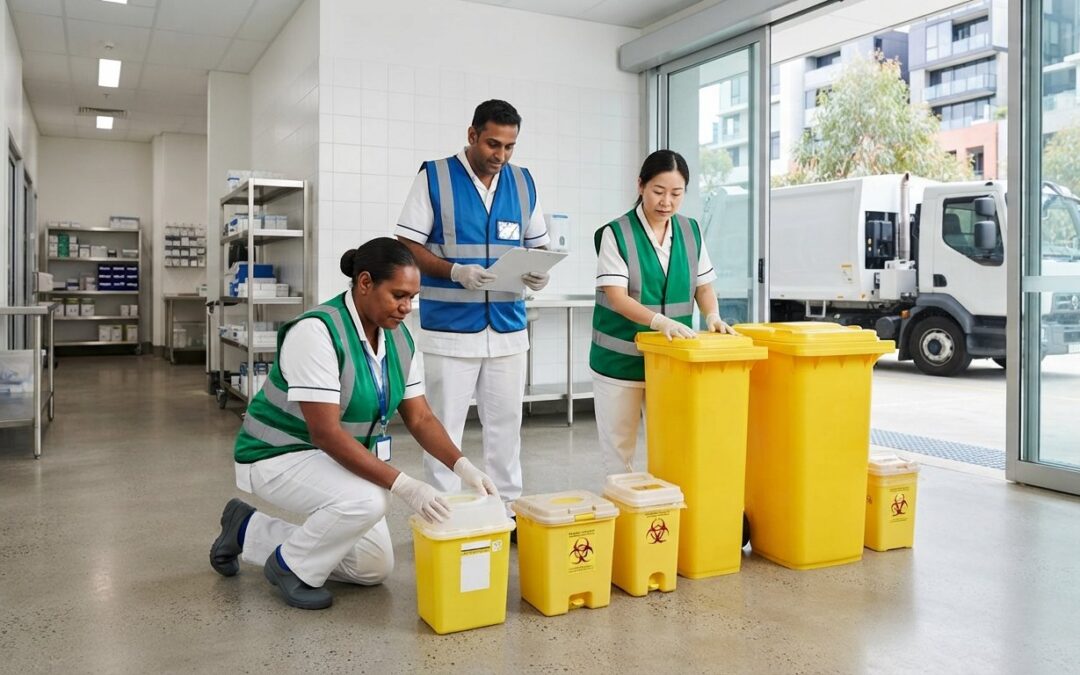
With the Victorian penalty unit rate reaching $209.10 for the 2026 financial year, the cost of a compliance error has never been higher for local healthcare providers. Managing Reportable Priority Waste is no longer just a back-of-house chore; it’s a critical legal duty under the General Environmental Duty framework. You likely feel the pressure of maintaining a sterile clinic while keeping up with the rigorous demands of EPA classifications. Securing a reliable medical waste bin collection melbourne service is about more than just disposal. It’s about building a partnership that offers stability in a strictly regulated environment.
This comprehensive guide helps you navigate the complexities of EPA Victoria standards and the mandatory digital Waste Tracker system. You’ll gain a clear understanding of the bin sizes required for your specific volume, from small sharps units to 240L clinical wheelie bins. We also outline how to structure rental agreements that avoid long-term lock-ins while ensuring your collection schedule remains consistent. By the end of this briefing, you’ll have the knowledge to streamline your waste protocols, avoid heavy fines, and maintain the professional integrity of your clinic.
Key Takeaways
- Learn how to meet the 2026 EPA Victoria regulations, including mandatory digital tracking via the Waste Tracker portal to ensure your facility remains fully compliant.
- Identify the most appropriate bin specifications for your specific clinical needs, ranging from compact 24-litre sharps units to high-capacity 240-litre clinical wheelie bins.
- Discover the operational benefits of a managed medical waste bin collection melbourne service that utilises the ‘exchange’ model to maintain rigorous infection control.
- Understand how to evaluate rental agreements effectively, focusing on service frequency and the requirement for HDPE material standards for biohazard containment.
- Gain insights into why partnering with a local Victorian specialist provides the necessary security for high-stakes environments like dental, tattoo, and aged care facilities.
Understanding Biohazard Bin Rental in Victoria: A 2026 Overview
Professional biohazard bin rental is a comprehensive service agreement rather than a simple equipment lease. It encompasses the supply of compliant containers, scheduled pickups, and the legal documentation required by the Environment Protection Authority (EPA) Victoria. Choosing a local Victorian provider is essential. They possess the specific regional knowledge required to navigate the Environment Protection Act 2017 and the subordinate 2021 regulations. Unlike general municipal waste collection, which handles non-hazardous household items, a professional medical waste bin collection melbourne service manages Reportable Priority Waste (RPW). This involves meticulous handling of materials that pose a direct risk to public health and the environment.
These bins serve as the first line of defence in maintaining clinic hygiene. They ensure that contaminated materials are contained at the source, preventing cross-contamination within your facility. Understanding the nuances of biomedical waste classification and handling is vital for staff safety. By using colour-coded, high-density polyethylene (HDPE) containers, clinics can clearly segregate infectious materials. This practice reduces the risk of needle-stick injuries and accidental exposure to pathogens for both your staff and the public.
Why Professional Rental Beats Purchasing Bins
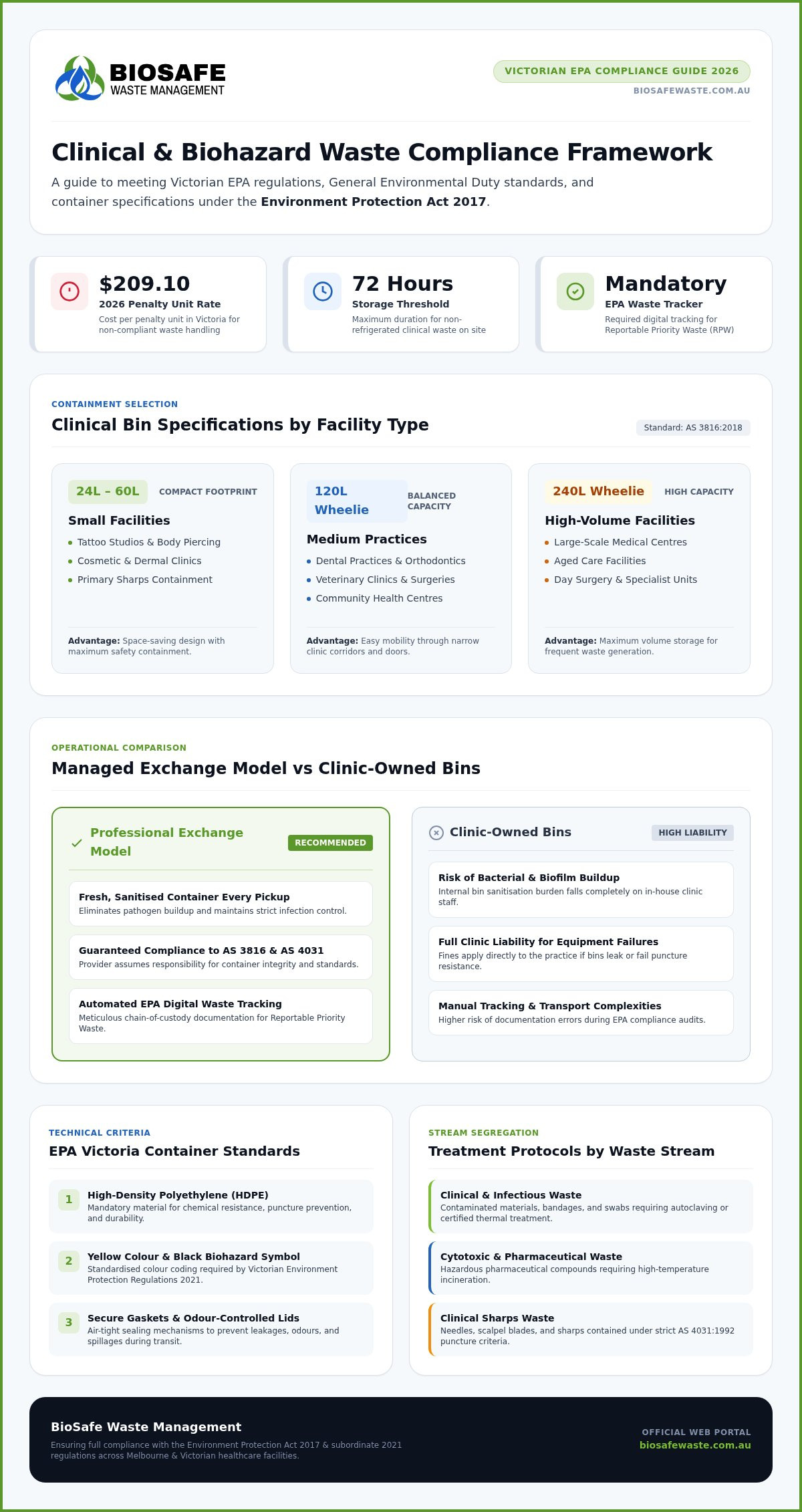
Owning your bins might seem cost-effective initially, but it introduces significant liability and maintenance burdens. Professional rental services operate on an exchange model. This means you receive a fresh, sanitised bin at every collection. This process is critical for infection control. It eliminates the risk of bacterial buildup inside the container that occurs over time. Every rented bin is guaranteed to meet Australian Standards, such as AS 3816:2018 for clinical waste and AS 4031:1992 for sharps. If you own your bins, the responsibility for ensuring they remain leak-proof and puncture-resistant rests solely on your clinic. Any failure in equipment could lead to heavy fines under the current Victorian penalty unit rates.
Identifying Your Waste Stream Requirements
Accurate waste segregation is the foundation of a compliant facility. You must distinguish between clinical waste, cytotoxic waste, and pharmaceutical waste. Each stream requires different treatment methods, such as autoclaving or high-temperature incineration. A reliable medical waste bin collection melbourne partner helps you audit your waste volumes to determine the most efficient bin sizes. Misclassifying waste doesn’t just risk non-compliance; it also inflates costs. For example, placing general waste into clinical bins significantly increases disposal fees due to the energy-intensive treatment required for biohazardous materials. Your rental agreement should reflect your actual volumes to ensure a cost-effective, reliable collection schedule that doesn’t disrupt your daily clinic operations.
Selecting the Right Biohazard Bin: Sizes, Types, and Specifications
Choosing the correct containment system is a technical requirement under the Victorian Environment Protection Regulations 2021. High-density polyethylene (HDPE) is the industry standard for these containers. It’s chosen for its superior chemical resistance and durability. Yellow bins with the black biohazard symbol are mandatory for clinical waste. These units feature secure lid mechanisms and gaskets to control odours and prevent spills during transport. Establishing a reliable medical waste bin collection melbourne schedule ensures your facility remains compliant without operational friction.
Bin Size Guide by Facility Type
Small facilities, such as tattoo studios and cosmetic clinics, often generate lower volumes of infectious waste. For these sites, 24-litre to 60-litre bins provide a compact footprint without sacrificing safety. Dental practices and veterinary clinics typically require 120-litre wheelie bins. These offer a balance between storage capacity and ease of movement through narrow corridors. Large-scale medical centres and aged care facilities rely on 240-litre high-capacity units. Given the 72-hour storage limit for non-refrigerated clinical waste, selecting a size that matches your collection frequency is vital for maintaining a sanitary environment. A professional medical waste bin collection melbourne service can help you audit your output to avoid over-servicing or capacity issues.
Specialised Containers for Sharps and Cytotoxic Waste
Sharps management requires rigid, puncture-resistant containers that comply with AS 4031:1992. These units prevent needle-stick injuries during both use and disposal. Integrating a professional sharps container collection Melbourne plan into your operations ensures these high-risk items are handled with the necessary caution. For facilities handling chemotherapy drugs or specific pharmaceuticals, purple-coded cytotoxic bins are essential. These materials cannot be autoclaved; they require high-temperature incineration at licensed Victorian facilities to neutralise chemical hazards. Selecting the right specialised unit is a fundamental part of your duty of care to staff and the public.
Evaluating Rental Agreements: Service Frequency and Cost Factors
A commercial waste contract in Victoria serves as a formal framework for public safety and regulatory adherence. It dictates the frequency of your medical waste bin collection melbourne and establishes the boundaries of your legal liability. Most Melbourne facilities opt for weekly or fortnightly schedules to ensure they don’t exceed the 72-hour limit for storing clinical waste at ambient temperatures. Adhering to the World Health Organization healthcare waste guidance ensures your facility maintains international standards for infection control while meeting local EPA mandates. Your agreement should clearly define the “duty of care” responsibilities, confirming that the waste producer remains responsible for the material until it reaches a licensed treatment facility.
Rental costs are primarily influenced by three variables: waste classification, collection frequency, and total volume. Cytotoxic waste (R130) and pharmaceutical waste (R140) often incur higher disposal fees than standard clinical waste (R100) due to the necessity of high-temperature incineration. By accurately segregating these streams, you can optimise your service costs and ensure you aren’t paying premium rates for non-hazardous materials. A transparent agreement will itemise these factors, providing a clear overview of your monthly expenditure without unexpected surcharges.
Managed Bin Exchange vs. Simple Collection
Simple collection, where a bin is emptied into a truck on-site, is often unsuitable for medical environments. This method can lead to the aerosolisation of pathogens and lingering odours in your loading bay or clinical area. A professional sharps bin exchange service provides a superior alternative by replacing used containers with industrially sanitised units at every visit. This exchange model is a cornerstone of modern clinical hygiene. It ensures that no residue from previous collections remains on your premises, maintaining a sterile environment for both staff and patients.
Flexibility and Scalability in Waste Contracts
A rigid, multi-year contract can become a liability for growing clinics or those with fluctuating patient numbers. It’s often more effective to seek providers offering flexible 30-day agreements. These allow you to scale your services during peak periods, such as the winter flu season, or reduce frequency if your waste output decreases. Since the full implementation of the EPA Waste Tracker portal, every movement of Reportable Priority Waste must be digitally recorded. Your contract should guarantee that all tracking documentation is integrated into your service, providing a seamless digital audit trail that protects your facility against compliance risks.
EPA Victoria Compliance: Standards for Biohazardous Waste Storage
The Environment Protection Act 2017 establishes the General Environmental Duty (GED), which requires all Victorian businesses to minimise risks to human health and the environment. By 2026, this duty has evolved into a rigorous digital custody chain. Every medical waste bin collection melbourne event must now be recorded in real-time using the EPA Waste Tracker portal. This digital system has entirely replaced legacy paper certificates. If your facility generates Reportable Priority Waste (RPW), you’re legally obligated to ensure that every kilogram is accounted for from the point of origin to the final disposal site. This “cradle-to-grave” responsibility means the waste producer remains liable for any mismanagement that occurs during the transport or disposal process.
Storage areas must meet specific structural standards to remain compliant with Victorian law. These zones require clear biohazard signage and must be fully secured to prevent unauthorised access or tampering. Ventilation is critical for managing odours and maintaining air quality, especially since clinical waste cannot be stored at ambient temperatures for more than 72 hours. Beyond this 72-hour threshold, refrigeration at or below 4°C is mandatory to prevent bacterial degradation. Additionally, your storage site must be easily accessible for heavy collection vehicles. This ensures that the transfer of waste occurs without obstruction, minimising the time that hazardous materials are exposed in common areas.
Waste Segregation and Labelling Protocols
Effective segregation begins with staff education and clear internal protocols. Every bin must be correctly labelled with the appropriate waste code, such as R100 for clinical waste or R130 for cytotoxic substances. Mixing these streams can lead to environmental contamination and significant financial penalties. It’s essential to review our safe disposal of medical sharps guide to ensure your team understands the nuances of puncture-resistant containment. Clear protocols reduce the risk of accidental exposure and streamline the collection process, ensuring that each waste type is routed to the correct treatment facility.
Audit-Ready Documentation
EPA inspections often occur without prior notice, making a current waste manifest indispensable for any medical facility. Your provider should offer integrated reporting that aligns with your Waste Tracker obligations. Since medical waste collection Victoria requires a licensed EPA transporter with an A10a permit, verifying your contractor’s credentials is a vital part of your due diligence. Failure to comply can result in heavy fines calculated by penalty units, which are valued at $209.10 for the 2026-27 financial year. For professional assistance in maintaining your compliance, organise a site audit with BioSafe.
Partnering with BioSafe: Local Melbourne Expertise for Your Facility
BioSafe Waste Management operates as a 100% Victorian-owned specialist. We understand that medical waste bin collection melbourne is a high-stakes service that requires local accountability. Our team doesn’t just provide bins; we act as a silent partner in your facility’s safety protocols. We prioritise reliability and a professional duty of care, ensuring your waste is handled by experts who understand the gravity of EPA adherence. Transitioning to a more efficient system begins with a clear understanding of your specific waste streams and the logistical challenges of your site. Our locally based fleet ensures that we can respond to the specific timing and access requirements of Melbourne clinics with a precision that larger national firms often struggle to match.
A Safe Pair of Hands for Melbourne Healthcare
BioSafe provides tailored support for diverse sectors, including NDIS providers and aged care facilities. These environments often face unique challenges regarding waste volume and staff safety. Our deep knowledge of Melbourne logistics allows us to provide consistent service regardless of your location. For tattoo studios, we offer discreet and fully compliant collection services that meet the specific hygiene standards of the body art industry. We recognise that each niche requires a different approach to containment and frequency. By focusing on these specialised sectors, we’ve developed a reputation as a dependable specialist that values precision over broad marketing claims.
Get Started with a Compliance Audit
The path to total regulatory security starts with a comprehensive assessment of your facility. We evaluate your current bin sizes, placement, and collection intervals to identify areas for improvement. Our onboarding process is straightforward and designed to minimise disruption to your clinical operations. We ensure that your digital Waste Tracker integration is seamless from day one, providing you with a “safe pair of hands” for all your compliance needs. Our medical waste bin collection melbourne service is designed to integrate with your existing workflows to ensure zero downtime. You can explore our sharps disposal services melbourne to see how we provide end-to-end support for your medical waste requirements. A professional audit ensures you aren’t over-serviced or at risk of non-compliance, allowing you to focus on patient care while we manage the complexities of your waste stream. If you’re ready to secure your facility’s compliance, you can reach our Melbourne team directly on 0437 556 299 to discuss your specific requirements.
Securing Your Facility’s Compliance for 2026 and Beyond
Maintaining a sterile and compliant environment in Victoria requires more than just a bin; it demands a disciplined approach to waste segregation and digital tracking. Adhering to the 72-hour storage limit and utilising the EPA Waste Tracker are essential steps to avoid significant penalties. Selecting the correct HDPE containers for your specific volumes ensures you protect both your staff and your bottom line from unnecessary disposal costs. Establishing a reliable medical waste bin collection melbourne schedule is the final piece of the puzzle in your facility’s safety strategy.
BioSafe Waste Management stands as a Victorian owned and operated specialist, acting as an EPA licensed transporter with deep expertise in dental and aged care compliance. We provide the stability you need in an industry defined by strict regulations. To ensure your protocols meet the highest standards, Request a Professional Waste Audit for Your Melbourne Facility today. Our team’s ready to help you streamline your operations, providing the peace of mind that comes with a truly professional partnership.
Frequently Asked Questions
Do I need a separate bin for sharps and clinical waste?
Yes, you must use separate containers for these waste streams. Sharps require rigid, puncture-resistant units that comply with Australian Standards to eliminate the risk of needle-stick injuries. Standard clinical waste is deposited into yellow, high-density polyethylene bins. Proper segregation is a legal requirement under the Victorian Environment Protection Regulations 2021. Mixing these streams increases the risk of staff injury and can lead to significant non-compliance issues during an EPA inspection.
How often should biohazard bins be collected in a dental practice?
Collection frequency depends on your facility’s waste volume and the 72-hour storage threshold. Most dental practices in Victoria schedule weekly or fortnightly pickups to ensure compliance with EPA standards for non-refrigerated clinical waste. If your practice generates significant volumes, a more frequent medical waste bin collection melbourne service may be necessary. Maintaining a consistent schedule prevents odour buildup and ensures your clinical areas remain sterile and safe for both patients and staff.
What happens if our biohazard bin is overfilled?
An overfilled biohazard bin poses a significant safety risk and should be avoided at all costs. Bins must be able to close securely to prevent spills, control odours, and ensure safe transport. If a bin is overfilled, your service provider might be unable to collect it due to transport safety regulations. It’s often necessary to request an additional bin or increase your collection frequency to accommodate higher waste volumes while maintaining a compliant and hygienic environment.
Are there specific storage requirements for biohazard bins on-site?
Biohazard bins must be stored in a dedicated, secure area that is inaccessible to the public. The storage zone should be well-ventilated, clearly marked with biohazard signage, and separated from clean supply areas. It’s also essential that the site remains accessible for collection vehicles to ensure a smooth exchange process. Proper storage is a core component of your General Environmental Duty, protecting your staff and the environment from accidental exposure to pathogens.
Can I rent biohazard bins for a short-term project or event?
Yes, short-term rental options are available for specific projects or temporary medical events. Many Victorian providers offer flexible 30-day service agreements that don’t lock you into long-term contracts. This flexibility is ideal for temporary clinics, research projects, or community health events requiring compliant disposal. You’ll still receive the same level of professional support, including digital tracking and EPA-compliant transport, ensuring your short-term operations remain fully aligned with Victorian waste legislation.
What is the difference between clinical waste and general medical waste?
Clinical waste (code R100) specifically refers to materials that are infectious or potentially contaminated with blood or body fluids. “General medical waste” often refers to non-infectious items like packaging, paper, or uncontaminated PPE. Correctly identifying the difference is vital for cost management. Disposing of general waste in your biohazard bins significantly increases your disposal fees. Professional segregation audits help you distinguish these streams, ensuring you only pay for the specialised treatment required for hazardous materials.
How does the Victorian Waste Tracker system affect my bin rental?
The Victorian Waste Tracker system mandates that every movement of Reportable Priority Waste must be recorded digitally. This affects your rental by requiring a seamless exchange of data between your facility and your waste provider. Your service partner must be registered with EPA Victoria to scan and log each collection in real-time. This digital audit trail replaces legacy paper manifests and ensures your facility remains compliant with the strict end-to-end custody requirements enforced by the EPA.
Is staff training included in a medical waste rental agreement?
While specific training modules vary, professional providers typically offer essential guidance on waste segregation and bin usage as part of the service. This support ensures your staff can confidently identify different waste codes and use the equipment safely. Integrating this knowledge into your facility’s protocols is a proactive way to manage a medical waste bin collection melbourne service. Clear instruction on sharps containment and biohazard protocols reduces the risk of compliance errors and workplace injuries.