

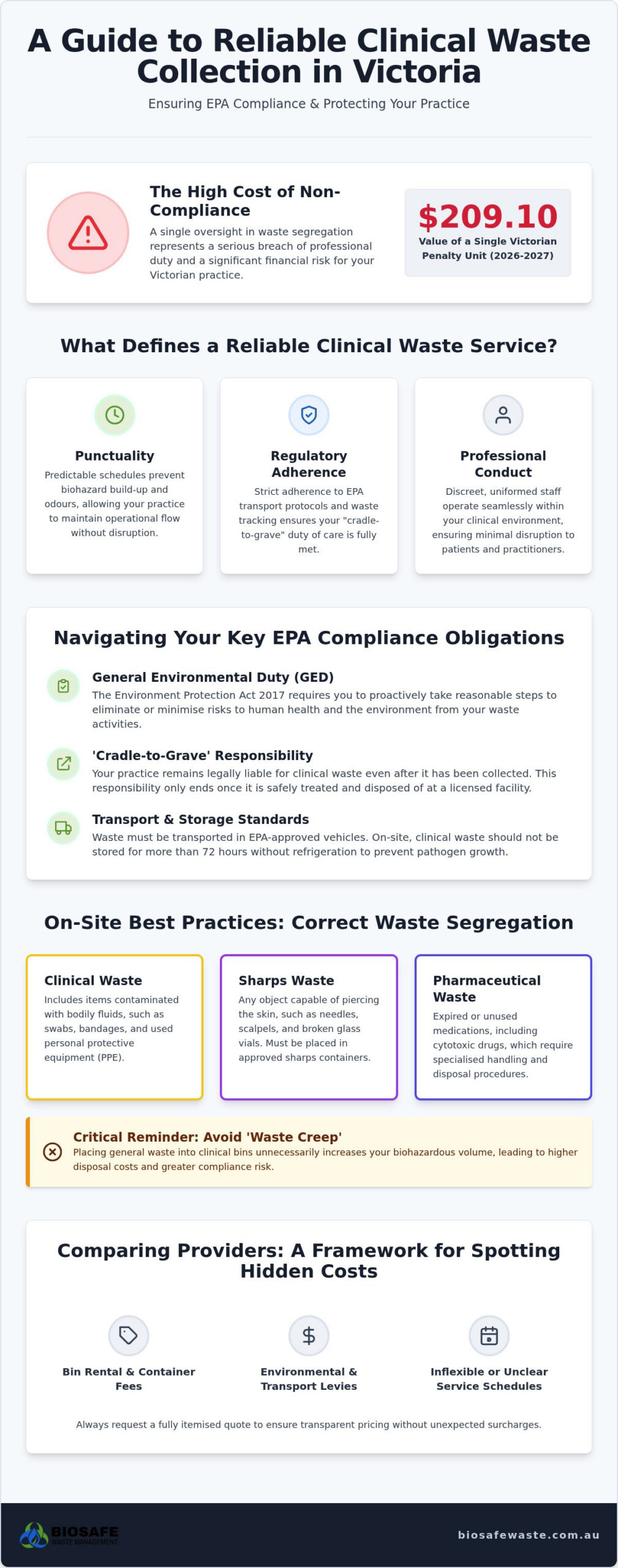
With the Victorian penalty unit now valued at $209.10 for the 2026-2027 financial year, a single oversight in waste segregation represents a serious breach of professional duty and a significant financial risk. You likely find that managing a healthcare facility or dental practice demands absolute precision, yet the shifting landscape of EPA Victoria regulations often makes waste management feel like a source of constant uncertainty. It’s a common frustration when missed pickups lead to biohazard build-up or when hidden contract costs suddenly emerge, disrupting your focus on patient care.
This guide provides the essential criteria for securing reliable clinical waste collection that ensures total EPA compliance and protects your operational continuity. We outline how to navigate your General Environmental Duty (GED) and the technical requirements of the updated AS/NZS 23907:2023 sharps standard. We will detail the specific attributes of a partner that offers predictable schedules and a discreet service, allowing you to maintain a safe environment with total peace of mind regarding your next audit.
Key Takeaways
- Define service reliability as a precise combination of punctuality, professional conduct, and strict adherence to EPA transport protocols.
- Understand the 2026 legal implications of the Victorian Environment Protection Act and how to meet your facility’s ongoing General Environmental Duty.
- Utilise a clear decision framework to identify hidden contract costs, such as environmental levies and bin rentals, when comparing Victorian providers.
- Implement best practices for waste segregation at the source to ensure your reliable clinical waste collection schedule remains efficient and compliant.
- Master the safe handling of sharps and specialised medical waste to protect your team and ensure adherence to the latest Australian Standards.
What Constitutes Reliable Clinical Waste Collection in Victoria?
Reliability in the Victorian healthcare sector is often measured by the absence of crisis. For a busy clinic, it’s the quiet assurance that yellow bins will be emptied and sharps containers replaced before they reach a critical level. True reliability is defined by the intersection of three pillars: absolute punctuality, strict regulatory adherence, and professional conduct. When a provider treats a collection as a mere logistics task rather than a clinical necessity, the safety of the facility is at risk.
In the context of a Biomedical waste overview, the dangers of improper handling are clear; they include the potential for needle-stick injuries and the spread of pathogens. This is why ‘near enough’ is never acceptable in biohazardous waste management. A missed collection isn’t just an administrative error. It leads to biohazard build-up, unpleasant odours, and a tangible decline in staff morale as practitioners are forced to work around overflowing bins. Reliable clinical waste collection serves as a non-negotiable safety barrier for Victorian healthcare facilities, ensuring that hazardous materials are removed before they compromise the clinical environment.
The Clinical Continuity Factor
Maintaining operational flow requires waste storage areas to remain within their designed capacity. Victorian regulations are specific about storage times; for instance, clinical waste shouldn’t be stored for more than 72 hours without refrigeration. Predictable schedules allow dental and medical practices to organise their workflows without the distraction of managing waste logistics. This consistency is a core requirement for meeting the infectious waste disposal Victoria standards, where every step from generation to transport must be documented and executed with precision.
Professionalism and Discretion
The presence of a waste collector in a clinical setting should be seamless and reassuring. Uniformed, trained professionals understand the protocols of a sterile environment and the need for minimal patient disruption. This level of discretion is particularly vital for aged care facilities and NDIS providers, where the comfort of residents is paramount. By managing the unseen side of healthcare with clinical precision, a reliable clinical waste collection partner allows practitioners to focus entirely on their primary duty of care.
Navigating Victorian EPA Compliance and Regulatory Standards
Compliance in 2026 is governed by the General Environmental Duty (GED) under the Environment Protection Act 2017. This framework requires Victorian practitioners to take proactive, reasonable steps to eliminate or minimise risks to human health and the environment. It’s no longer enough to react to incidents; you must demonstrate a system of active risk management. This legal obligation begins at the moment a sharp or contaminated swab is used and continues until the waste is safely destroyed at a licensed facility. In Victoria, clinical waste must be transported exclusively in EPA-approved vehicles that feature specific spill-containment and security measures to prevent environmental contamination.
Your facility’s Duty of Care is a “cradle-to-grave” responsibility. Even after a contractor collects your bins, the legal liability for that waste remains tied to your practice until the final disposal is recorded. This makes reliable clinical waste collection a critical component of your risk mitigation strategy. Selecting a partner who understands these high stakes protects your facility from the financial and reputational damage of non-compliance.
Waste Classification and Segregation
Correctly identifying waste streams is the first step in maintaining a compliant site. You must distinguish between clinical waste, sharps, and pharmaceutical streams to ensure each is handled according to its specific risk profile. A common issue is ‘waste creep’, where general waste is mistakenly placed into clinical bins. This doesn’t just increase your costs; it creates unnecessary biohazardous volume that complicates the disposal process. Ensuring your practice adheres to the clinical waste bin requirements Victoria specifies is essential for passing an EPA audit without incident. Facilities managing multiple waste streams should also review the biohazard waste disposal regulations Victoria requires for pharmaceutical materials, as these carry distinct segregation and documentation obligations under the 2026 framework.
Audit-Ready Documentation
The transition to digital Waste Transport Certificates (WTCs) has made record-keeping more transparent but also more demanding. You’re required to keep accurate logs of every waste movement for at least two years. Common pitfalls include using incorrect waste codes or failing to confirm the waste reached its destination. BioSafe helps practitioners avoid these errors by providing a clear, digital paper trail that simplifies the audit process. By integrating BioSafe’s regulatory support into your operations, you ensure that every collection is backed by the precise documentation Victorian authorities expect from a reliable clinical waste collection service.
Comparing Clinical Waste Collection Providers: A Decision Framework
Selecting a partner for your facility requires looking beyond a generic service list. A local Victorian presence offers a distinct advantage over national generalists who may lack specific knowledge of local EPA nuances. A reliable clinical waste collection service should be transparent about its fee structure from the outset. You must scrutinise contracts for hidden costs such as bin rental fees, environmental levies, and emergency call-out charges that can inflate your operational budget without adding value. Specialist medical waste firms provide superior risk protection compared to general rubbish removers because their entire operational model is built around biohazardous safety.
General waste companies often lack the specific EPA permits required for the transport of prescribed industrial waste. They might not have established the necessary incineration protocols for high-risk materials. Understanding the dental waste management Victoria landscape is essential for practices handling amalgam and specialised sharps. A specialist provider ensures that these materials are handled with the technical precision required to meet Victorian health department standards.
Specialist vs. Generalist Waste Services
Specialist firms focus on the technical requirements of healthcare, such as matching service frequency to your facility’s actual waste generation. This prevents you from paying for unnecessary pickups or dealing with the hygiene risks of overflowing bins. They also ensure that sharps handling follows the latest Australian Standards. This level of detail is often missed by general waste companies that prioritise volume over clinical safety. Choosing a specialist means your waste is managed by a team that understands the high-stakes nature of medical sanitation.
Tailored Solutions for NDIS and Aged Care
In sensitive environments like NDIS and aged care, discretion is a functional requirement. Managing incontinence and sanitary waste requires a high standard of hygiene and a service that doesn’t disrupt the dignity of residents or the focus of staff. Home-based care providers under the NDIS often face unique compliance challenges that require flexible collection volumes. A provider that can adjust to fluctuating patient numbers ensures your facility remains compliant without operational strain. This flexibility is a hallmark of a reliable clinical waste collection partner who views their service as a supportive extension of your care team.
Best Practices for Streamlining Your Facility’s Waste Collection
Operational efficiency in waste management begins with the physical layout of your practice. Designing a waste station that promotes correct segregation at the source is the most effective method for preventing cross-contamination. Bins should be positioned at the point of waste generation to facilitate immediate disposal. This strategic placement reduces the distance contaminated materials travel through your clinical environment. To maintain the highest hygiene standards, practitioners should adopt the ‘no-touch’ principle, which dictates that clinical waste must be disposed of using foot-operated bins or automated lids to eliminate hand contact with potentially infectious surfaces.
Staff Training and Safety Protocols
Training your team on the safe handling and locking of sharps containers is a fundamental safety requirement. Proper bin usage significantly reduces the risk of needle-stick injuries, which remain a primary concern in Victorian clinical settings. Clear signage and consistent colour-coding serve as vital visual cues that reinforce correct habits among staff. Beyond initial training, performing regular internal audits ensures that your facility remains compliant between professional collections. These audits help identify issues like incorrect bin placement or segregation errors before they lead to regulatory complications.
Preparing for Your Collection Day
A reliable clinical waste collection service is most effective when the facility is prepared for the arrival of the transport personnel. Ensuring clear, unobstructed access for collection vehicles prevents unnecessary delays and maintains the security of your building. Before the driver arrives, staff must verify that all bins are correctly sealed and labelled according to EPA transport requirements. Establishing a consistent ‘collection window’ allows your practice to plan staff rotations and patient appointments without the risk of disruption. This predictability is essential for high-volume environments where operational continuity is a priority.
Optimising your internal workflows ensures that your waste partner can perform their duties with maximum precision. By standardising your preparation routines, you reinforce the safety barrier that protects both your employees and the public. To ensure your facility meets these rigorous standards, arrange a professional site assessment with BioSafe to refine your waste management protocols.
BioSafe Waste Management: Reassuringly Reliable Collections Across Victoria
BioSafe Waste Management serves as the quiet, essential backbone for medical and care facilities throughout the state. We approach every pickup with a deep sense of responsibility, positioning ourselves as a “safe pair of hands” for practitioners who cannot afford operational disruptions. Whether you manage a high-volume dental clinic, a specialised tattoo studio, or a local veterinary practice, our service is built on the foundation of professional duty and clinical precision. We understand that reliable clinical waste collection is not just about logistics; it’s about protecting your staff, your patients, and your professional reputation.
Maintaining 100% EPA compliance is a non-negotiable standard for every client we serve. We navigate the complexities of the Victorian Environment Protection Act so you don’t have to, ensuring that every waste stream is tracked and documented with meticulous care. Our local knowledge of Victorian health department standards allows us to provide a level of stability that national generalists often struggle to match. This unwavering reliability ensures that your facility remains audit-ready at all times, regardless of your service volume or location.
Why Victorian Clinics Choose BioSafe
Practitioners across the state trust us because we treat medical waste collection Victoria as a core competency rather than a secondary service. Our reputation is built on punctuality and a discreet, professional conduct that respects the sensitive nature of healthcare environments. We don’t just collect bins; we support the local healthcare community with expert advice on waste segregation and safety protocols. This partnership approach helps facilities reduce their risk profile while maintaining a clean, compliant workspace.
Get Started with a Compliance-First Partner
Transitioning to a more dependable waste partner is a straightforward process designed to eliminate your current pain points. We begin by assessing your facility’s specific needs, including waste volumes and optimal pickup frequencies. This allows us to tailor a collection schedule that integrates seamlessly with your existing workflows. By choosing a partner that prioritises your operational continuity, you gain total peace of mind regarding your regulatory obligations. Contact BioSafe Waste Management today for a reliable clinical waste solution.
Strengthening Your Facility’s Safety Standards for 2026
Maintaining a compliant and hygienic facility in Victoria requires more than just meeting a schedule; it demands a dedicated commitment to the General Environmental Duty. By refining your internal segregation protocols and choosing a partner that prioritises regulatory precision, you eliminate the risks associated with biohazard build-up and non-compliance fines. A reliable clinical waste collection service acts as the silent backbone of your operations, ensuring that your duty of care is met from the point of generation to final disposal.
BioSafe Waste Management provides the stability and local expertise Victorian practitioners require to navigate evolving EPA standards. As NDIS and aged care experts, we offer a discreet and specialised service that maintains the dignity of your environment while ensuring you remain EPA Victoria compliant. Our focus on specialist sharps disposal and technical adherence provides the security your staff and patients deserve. We look forward to supporting your practice with the consistency and professionalism your clinical environment demands.
Secure your facility with reliable clinical waste collection from BioSafe.
Frequently Asked Questions
How often should clinical waste be collected from a Victorian dental practice?
Clinical waste must be collected at a frequency that prevents storage for more than 72 hours unless the waste is refrigerated. For a standard Victorian dental practice, this requirement usually necessitates a weekly or fortnightly schedule to remain compliant. Regular pickups ensure that storage areas never exceed capacity, which is essential for maintaining your General Environmental Duty. BioSafe works with practitioners to establish a reliable clinical waste collection plan that accounts for specific surgery volumes.
What are the specific EPA requirements for clinical waste transport in 2026?
In 2026, all clinical waste movements must be documented with an EPA Waste Transport Certificate, typically managed through a digital tracking system. Transport must be conducted by an EPA-licensed provider using approved vehicles equipped with spill containment and security features. These regulations ensure that biohazardous materials are tracked from the point of generation to a licensed disposal facility, minimising the risk of environmental contamination or public health hazards during transit through Victorian communities.
Can I use my general waste contractor for sharps disposal in Melbourne?
You cannot use a general waste contractor for sharps disposal because they typically lack the required EPA licensing for prescribed industrial waste. Sharps must be placed in containers that meet the AS/NZS 23907:2023 standard and be collected by a specialist provider. Using an unlicensed contractor is a breach of the Environment Protection Act 2017 and can result in significant fines based on the current penalty unit value of $209.10.
What is the difference between clinical waste and infectious waste under Victorian law?
Under Victorian law, clinical waste is a broad category that includes sharps, human tissue, and bulk body fluids. Infectious waste is a subset specifically defined by its potential to transmit disease to humans. The Environment Protection Regulations 2021 treat both as prescribed industrial waste, requiring strict segregation into colour-coded containers. Yellow bins are used for general clinical waste, while purple is reserved for cytotoxic materials to ensure safe handling and incineration.
How does BioSafe ensure discreet collection for NDIS and aged care facilities?
BioSafe maintains discretion by employing uniformed professionals who understand the sensitive nature of aged care and NDIS environments. Our collectors operate with clinical precision to ensure that waste removal is performed quickly and quietly without disrupting patient care or resident privacy. By prioritising professional conduct and utilising subtle transport protocols, we provide a reliable clinical waste collection service that acts as a quiet backbone for sensitive healthcare facilities across Victoria.
What documentation do I need to provide during a Victorian health department audit?
During an audit, you must provide your digital Waste Transport Certificates and a comprehensive waste logbook covering at least the previous two years. Authorities will also look for proof of your contract with an EPA-licensed waste provider and evidence of staff training in waste segregation. Maintaining audit-ready documentation is a core part of your General Environmental Duty; it demonstrates a proactive approach to managing biohazardous risks within your professional facility.
Are there specific waste collection rules for Victorian tattoo studios?
Victorian tattoo studios must adhere to the same stringent EPA regulations as medical clinics regarding the disposal of sharps and contaminated waste. This includes segregating ink-contaminated materials and needles into approved containers and ensuring they are collected by a licensed transporter. Studios have a legal responsibility to prevent environmental harm; failing to use a professional service for biohazardous disposal can lead to heavy penalties under the Environment Protection Act 2017.
What happens if our facility generates more waste than our current schedule allows?
If your facility experiences a surge in waste generation, you should contact your service provider immediately to arrange an additional pickup or increase your collection frequency. Allowing waste to accumulate beyond your storage capacity or the 72-hour limit creates a significant hygiene risk and violates Victorian EPA standards. BioSafe offers flexible scheduling to accommodate fluctuating waste volumes, ensuring your practice remains compliant and safe even during periods of high patient activity.